Full Article
about Gilet
Gateway to the Sierra Calderona, with the Santo Espíritu monastery set in a beautiful valley.
Hide article Read full article
A Monastery Before a Town
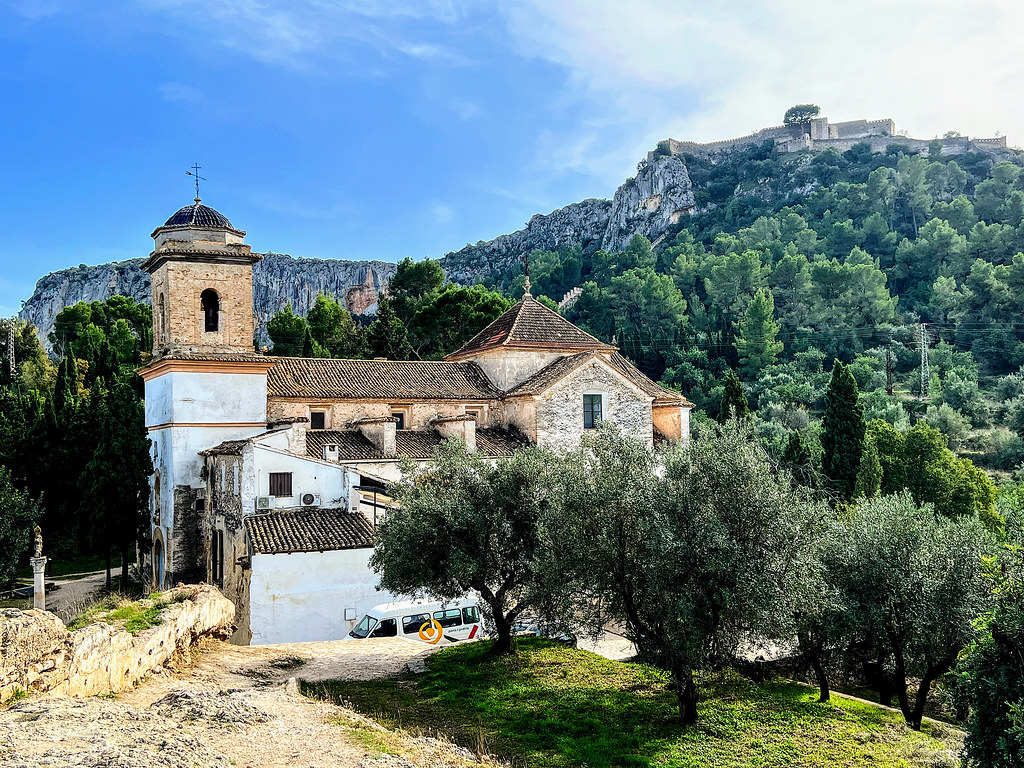
Tourism in Gilet tends to begin in the same place: the monastery of Sancti Spiritu. It appears among orange groves at the foot of the Sierra Calderona, in a setting that feels designed for reflection rather than for a large religious complex. It does not stand in the urban centre, but slightly apart, as was common with many medieval foundations. That detail already hints at how the village developed: first the monastery, then the tracks leading to it, and over time the settlement that became present-day Gilet.
The location explains much about the character of the municipality. Gilet sits at low altitude, yet right where the land begins to rise towards the Calderona range. To the south stretch cultivated fields of oranges. To the north, pine woods and the first mountain paths. The monastery occupies that threshold between cultivated land and hillside, a physical and historical starting point.
The foundation of Sancti Spiritu is linked to María de Luna, queen consort of Aragón and wife of Martín I. In the early 15th century she promoted the creation of this Franciscan convent on the outskirts of what was then a small rural settlement. The complex seen today largely reflects later alterations, particularly from the 17th century, when the present church was built.
Its layout remains clear and ordered: church, cloister and conventual rooms arranged around interior courtyards. Over the centuries the monastery has experienced periods of abandonment and revival. Following the 19th-century confiscation of church property in Spain, it stood empty for a time before returning to religious use. It also served as a hospital during the Peninsular War. Each era has left visible traces, coats of arms on façades, added iron grilles, walls opened or closed to meet changing needs. The monastery continues to have religious activity and forms part of everyday life in Gilet.
A Defensive Tower Turned Library
By the end of the 16th century, the Valencian coast lived under the constant threat of corsair attacks. Nearby Sagunto had a port and enough commercial activity to justify a system of watchtowers on the surrounding hills. It was in this context that the tower of Gilet was built.
Originally conceived as a defensive structure and observation point, the tower has gone through several phases. For centuries it fulfilled its military purpose. Later it was used as an agricultural store and even as a dwelling. Today it houses the municipal library. The contrast is striking: bookshelves and reading tables inside a volume first designed for surveillance and defence.
From the hilltop where the tower stands, there are broad views across the Camp de Morvedre comarca, a local administrative district centred on Sagunto. On clear days the line of the sea can be made out, and inland the first slopes of the Calderona come into focus. The position underlines the strategic logic behind its construction. What was once a lookout over potential danger is now a place for study and quiet.
The Parish That Marked Independence
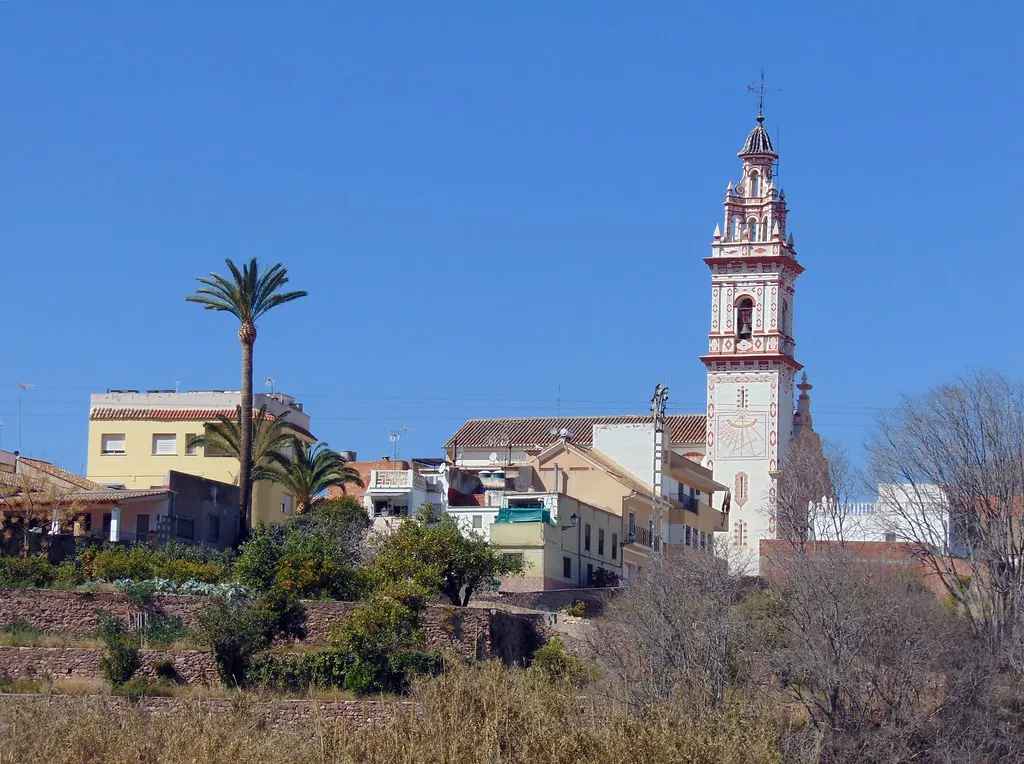
The church of San Antonio Abad began to rise in the 16th century, when Gilet started to function as an independent municipality, separate from Sagunto. At that time, building a parish church of its own was a clear way of asserting autonomy.
The building is sober in style: a single nave, masonry walls and a façade remodelled centuries later. Inside, some artistic elements from before modern refurbishments are still preserved, including altarpieces and devotional objects that connect to the parish’s long tradition.
The church occupies the main square, which remains the centre of the village. Around it stand municipal buildings and the everyday movement of local life. Residents pause to talk, others cross towards the older streets or head out along the roads that lead to the surrounding farmland. The square acts as a hinge between past and present, just as the monastery does between fields and mountains.
Gilet’s urban core is small. It can be walked without hurry in about an hour. Its scale encourages combining a stroll through the streets with time spent in the surrounding landscape, rather than treating the village as a standalone stop.
Between Market Gardens and Mountain Paths
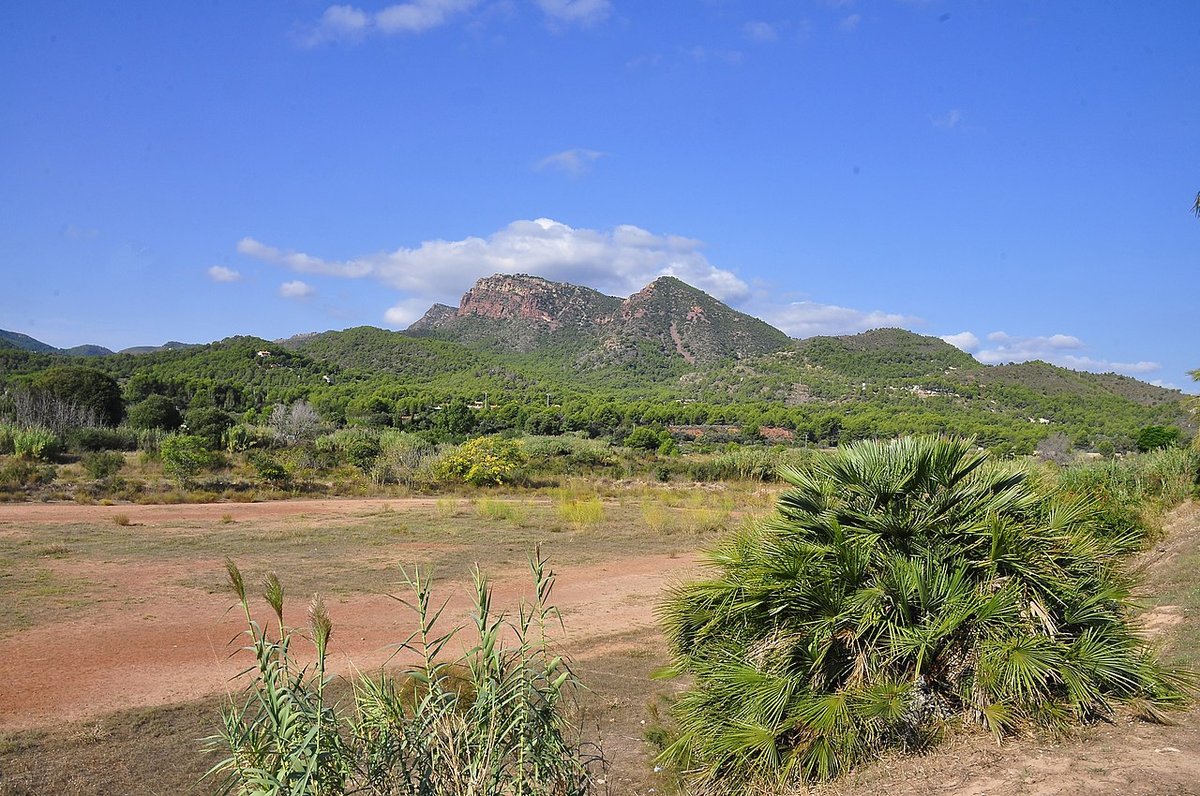
One of Gilet’s defining features is its position between two distinct environments. To the south lie the irrigated orange groves of the huerta. To the north rise the pine-covered slopes of the Sierra Calderona, a natural park that marks the transition from coastal plain to inland hills.
A common walk begins near the monastery and climbs towards the ermita of San Miguel, set on one of the nearby hills. The route follows forest tracks and straightforward paths. From the top, the village’s setting becomes easy to grasp, between the coastal corridor and the sierra.
Other routes link Gilet with Sagunto, crossing ravines and old agricultural tracks. Some sections pass through the dry beds of ramblas, seasonal watercourses that remain empty for much of the year. Carrying water and wearing comfortable footwear is advisable, especially as stretches can be exposed and uneven.
The contrast between cultivated land and mountain terrain is immediate. In a short distance, orange groves give way to scrub and pine. The shift in landscape is part of what defines a visit to Gilet: the sense of standing at a geographical boundary.
Practicalities and Seasons
Gilet lies around thirty minutes by car from Valencia. The usual access is via the A‑7 to Sagunto, and from there along the road that heads inland towards the Calderona. There is also a bus connection with Sagunto and other nearby towns.
Given its size, the historic centre does not require a full day. What makes the visit more complete is pairing time in the village with a walk in the sierra or a gentle circuit through the surrounding huerta.
Spring is generally the most pleasant season, when the orange trees are in blossom and the Calderona still retains some green. In summer the heat intensifies among the hills. In winter the wind can feel sharper than expected for a place so close to the sea.
Gilet does not present itself with grand gestures. Its points of interest are closely tied to the rhythms of its history: a monastery founded by a queen, a watchtower built against corsairs, a parish church marking municipal independence. All are framed by orange groves and rising hills, in a setting that explains why the village grew where it did and why it still looks both towards the coast and towards the mountains.