Full Article
about Petrés
Known for its barons' castle-palace and quiet setting.
Hide article Read full article
A Small Town Between Coast and Countryside
Tourism in Petrés makes most sense when you look at a map first. The village sits just inland in the Camp de Morvedre, a short distance from Sagunto and still within the everyday orbit of Valencia. That position, close to the Mediterranean coast yet firmly rooted in agricultural land, shapes its character. Petrés is a small municipality of just over a thousand inhabitants, surrounded by citrus groves that continue to define the local economy.
Fields occupy much of the municipal area. Orange and mandarin trees spread across the plots that encircle the built-up centre, organised by a network of acequias, traditional irrigation channels that form part of the historic water system of the region. In spring, orange blossom briefly fills the air with its scent. In winter, when the harvest arrives, tractors and work crews are a common sight among the trees.
This is not a place driven by visitor numbers or landmark attractions. Its appeal lies in observing how a working agricultural village functions, and how closely daily life remains tied to the land.
Around the Iglesia de San Pedro Apóstol
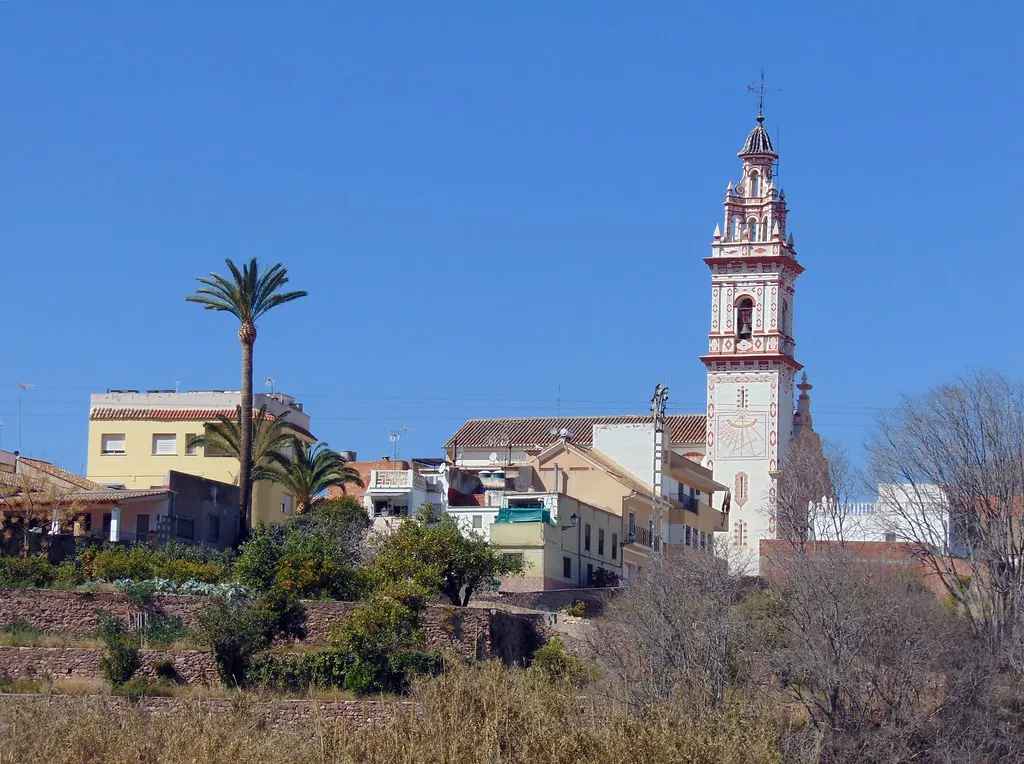
The urban core is compact and arranged around the parish church of San Pedro Apóstol. The building dates back to the 16th century, although later alterations are clearly visible. It is not a monumental church, yet it occupies the point that organises village life: the square, the streets leading out towards the fields and many of the collective celebrations all revolve around it.
The surrounding streets retain the scale typical of agricultural settlements in this part of the Comunidad Valenciana. Low houses line narrow roads. Some date from the late 19th or early 20th century, with wide gateways originally designed for carts and small rear courtyards. Simple wrought-iron balconies can still be seen, along with tiled eaves and façades painted in white or soft colours.
This is not a historic quarter shaped for tourism. It can be explored in a short time, yet it offers a clear sense of how these orchard villages have worked for generations. Home, storage space and farmland sit very close to one another. The layout reflects practicality rather than spectacle.
Walking slowly through the streets near the church gives time to notice these details. The architecture speaks of agricultural routines and modest prosperity linked to the citrus trade.
Tracks Through the Huerta
Step beyond the edge of the village and agricultural tracks begin almost immediately. These are narrow dirt paths or slim stretches of tarmac connecting plots of land, small field houses and irrigation channels. Many residents use them for walking or cycling, particularly in the evening.
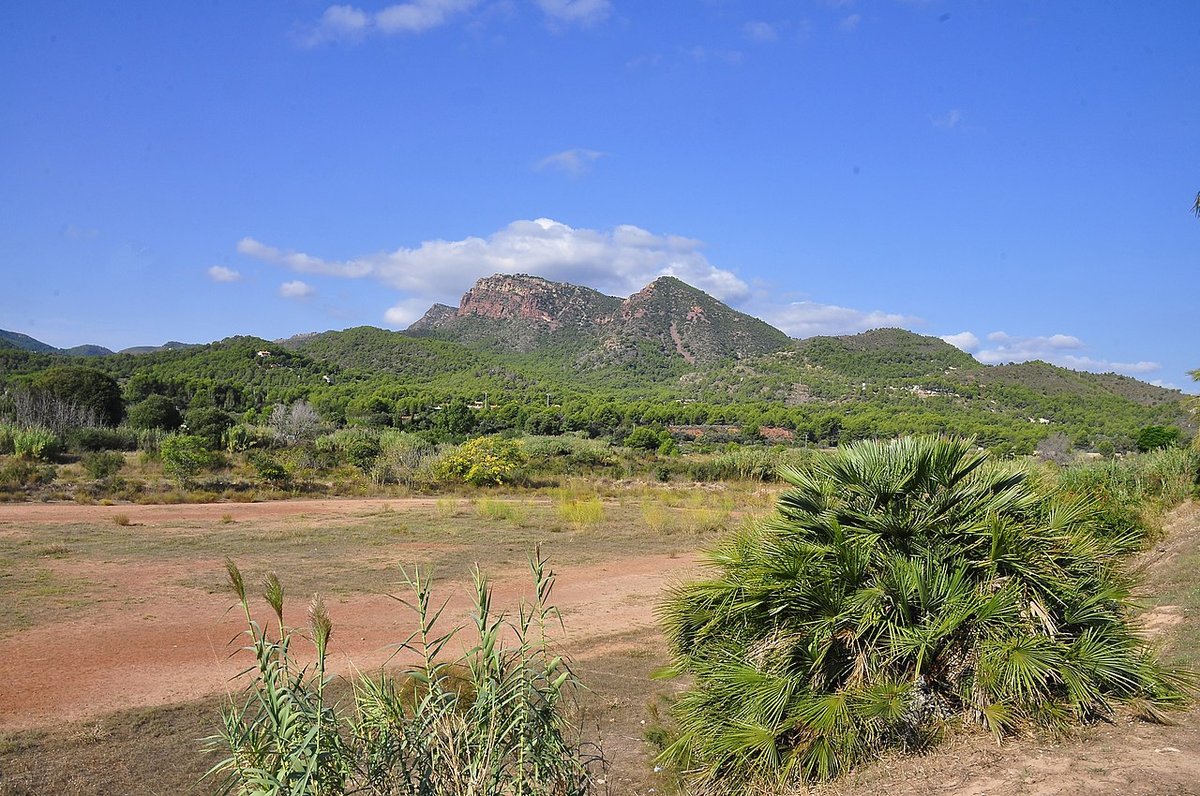
From these routes, the landscape of the inland Camp de Morvedre opens out. To the north, the outline of the Sierra Calderona rises at a relatively short distance. To the south, on clear days, it is possible to make out the surroundings of Sagunto and the band where the flat agricultural plain begins to edge towards the sea.
These are not mountain routes or formally signposted hiking trails. They are working paths that double as places to stroll and observe how the citrus-growing huerta is organised. The acequias run alongside some of them, carrying water through a system that has structured cultivation here for centuries. The fields change subtly with the seasons: blossom in spring, dense green foliage in summer, and fruit ready for picking in winter.
The experience is simple and grounded. There are no interpretation panels or visitor centres, just the steady geometry of orchards and irrigation lines, and the sense of a landscape still in use.
Festivals and the Agricultural Year
The main festivities in Petrés revolve around San Pedro Apóstol at the end of June. During these days, the centre of the village fills with religious events, communal meals and activities organised by local peñas and associations. Much of the programme takes place around the church and nearby streets, reinforcing their role as the social heart of the municipality.
As in many Valencian towns, there are usually also celebrations in August. This period often coincides with the return of people who live elsewhere for most of the year, giving the summer gatherings a reunion atmosphere. Semana Santa, or Holy Week, is marked by processions through the village streets. The format is simple and strongly linked to neighbourhood participation.
Alongside the religious calendar, the agricultural cycle still carries weight. The rhythm of citrus cultivation shapes conversations and working life. Flowering in spring and harvesting in winter are more than seasonal events; they structure the year in practical and social terms. Even for those not directly involved in farming, the cycle remains a shared reference point.
A Quiet Base in the Camp de Morvedre
Petrés works well as a calm stop within a wider visit to the Camp de Morvedre. Just a few kilometres away lies Sagunto, where the Roman theatre, the castle and the old town illustrate much of the region’s history. These sites provide a striking contrast to the modest scale of Petrés, placing the small agricultural village within a broader historical landscape.
The entrance to the Sierra Calderona is also nearby. Here the scenery shifts noticeably from the flat citrus plain to pine forest, steeper relief and mountain paths. The change in terrain underlines how varied this corner of the Comunidad Valenciana can be within a short distance.
In practical terms, Petrés is about 25 kilometres from Valencia. By car, the journey takes roughly half an hour, heading in the direction of Sagunto and then following regional roads. The village itself is small and easily explored on foot.
Those interested in vernacular architecture will find it worthwhile to wander slowly through the streets around the iglesia de San Pedro Apóstol before heading out along one of the tracks towards the huertas. The transition from compact streets to open fields happens quickly. Within minutes, houses give way to rows of orange and mandarin trees, and the everyday structure of this agricultural community becomes clear.
Petrés does not attempt to reinvent itself as a destination. It remains what it has long been: a small village shaped by citrus cultivation, close to Sagunto and within reach of Valencia, where the scent of azahar in spring and the winter harvest continue to mark the passing of time.