Full Article
about Bicorp
Famous for the Cuevas de la Araña and its World Heritage rock paintings, and the Río Fraile.
Hide article Read full article
A small village with prehistoric walls
Tourism in Bicorp often begins with a simple question: how can a municipality of just over 500 people preserve some of the best-known scenes of Levantine rock art? The answer lies in the landscape. Bicorp sits in the Canal de Navarrés, in a terrain shaped by ravines, limestone outcrops and Mediterranean scrubland, at the meeting point between the Escalona valley and the inland sierras of the Valencian Community. The rugged relief has always dictated where people could live, farm or simply pass through.
Human presence here goes back a very long way. Rock shelters carved into the surrounding cliffs provided refuge and, in some cases, a canvas for paintings that now form part of the Rock Art of the Mediterranean Basin on the Iberian Peninsula, recognised by UNESCO. Alongside this prehistoric legacy runs another thread that still matters to the local economy: beekeeping. Honey appears again and again in any conversation about Bicorp.
Rock art and village streets
The Cuevas de la Araña lie several kilometres from the village centre, in a rock shelter overlooking a ravine. One of the most widely reproduced scenes in Levantine art survives here: a human figure climbing lianas or ropes to collect honey from a hive. The paintings are usually dated to later Prehistory and belong to the Levantine pictorial tradition. The size of the shelter is less striking than its position. It occupies a high point from which the ravine can be observed and controlled.
Visits are generally guided. Protection of the paintings is one reason, and interpretation is another. Without explanation, many of the figures can easily go unnoticed against the rock surface.
Close to the urban centre, a small museum focuses on honey and beekeeping. It provides context for the honey-gatherer scene and shows why it does not feel remote to local residents. Collecting wild honey and keeping bees have formed part of working life in the surrounding hills for generations.
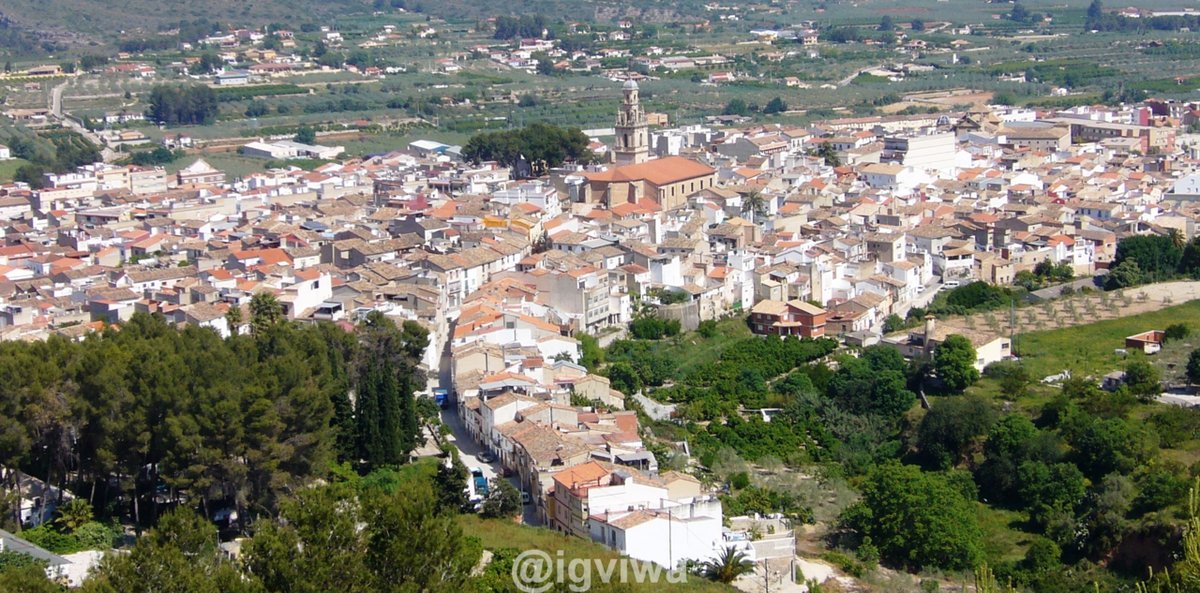
Bicorp’s old quarter is modest in scale. Short streets, some of them sloping, are lined with houses that mix masonry, rendered façades and later additions. The parish church of San Pedro dates back to the 16th century in origin, although the current building reflects later alterations. Its brick bell tower rises above the low rooftops of the village.
Ravines, river and Mediterranean hills
The territory around Bicorp is defined by ravines and low mountains. Aleppo pine, Mediterranean scrub and almond groves appear in the countryside around the village. Many rural tracks follow older routes that once linked corrals, cultivated plots and passes towards neighbouring valleys.
To the north, the river Júcar has cut deep gorges. The relief becomes more pronounced here, with sheer rock faces where birds of prey are often seen riding the air currents that rise from the valley. A short walk is enough to notice how quickly the landscape shifts between the bottom of a ravine and the drier ridges above.
This contrast in terrain helps explain the location of the painted shelters. They are consistently associated with rock faces that dominate their surroundings, positioned in places that offer both visibility and protection.
The area also attracts walkers and wildlife observers. In the nearby hills, tracks of wild boar are common, and roe deer can sometimes be heard at dawn. The cliffs along the Júcar are home to raptors adapted to this kind of rugged environment.
Winter and early spring bring a temporary change to the valley’s appearance. For a few weeks, the almond trees around the village blossom and alter the tones of the landscape.
Walking out to the Cuevas de la Araña
Access to the Cuevas de la Araña is on foot from a designated point on the edge of the municipal area. The path includes stony stretches and some changes in elevation. It is not especially long, but it is best taken at an unhurried pace. The route itself clarifies why the painted shelters are where they are. Each one is tied to a rock wall that commands a view over the terrain.
Guided visits usually require advance booking and operate at set times, so it is wise to check arrangements before travelling. The terrain is uneven, and suitable footwear is important. Water is close to essential in the hotter months.
Bicorp is a small inland municipality, and services reflect that scale. Many visitors arrive by car, as public transport options are limited.
Honey, San Pedro and local gatherings
The main celebrations in Bicorp take place in summer around San Pedro, the village’s patron saint. These festivities retain a strongly local character. Processions, community events and gatherings of neighbours fill the streets during those days.
Meetings related to honey and beekeeping also form part of the local calendar. Producers from the area come together with people interested in working with bees. This is no recent development. The connection between Bicorp and honey stretches far back, as the cave paintings themselves suggest.
From time to time, special events and guided days focus on the rock art. Archaeologists and heritage specialists working in the Valencian Community often take part, offering further insight into a body of work that links the village to a much wider Mediterranean story.
Bicorp does not present itself through grand monuments or large-scale attractions. Its interest lies in the relationship between landscape and survival, between steep limestone walls and human ingenuity. The honey hunter painted on the rock face above the ravine captures that link with unusual clarity. Thousands of years separate that figure from the present-day beekeepers of the Canal de Navarrés, yet the thread between them remains visible in the hills around the village.