Full Article
about Navarrés
Known for Lago de Playamonte and its natural water spots.
Hide article Read full article
A Hill Above the River
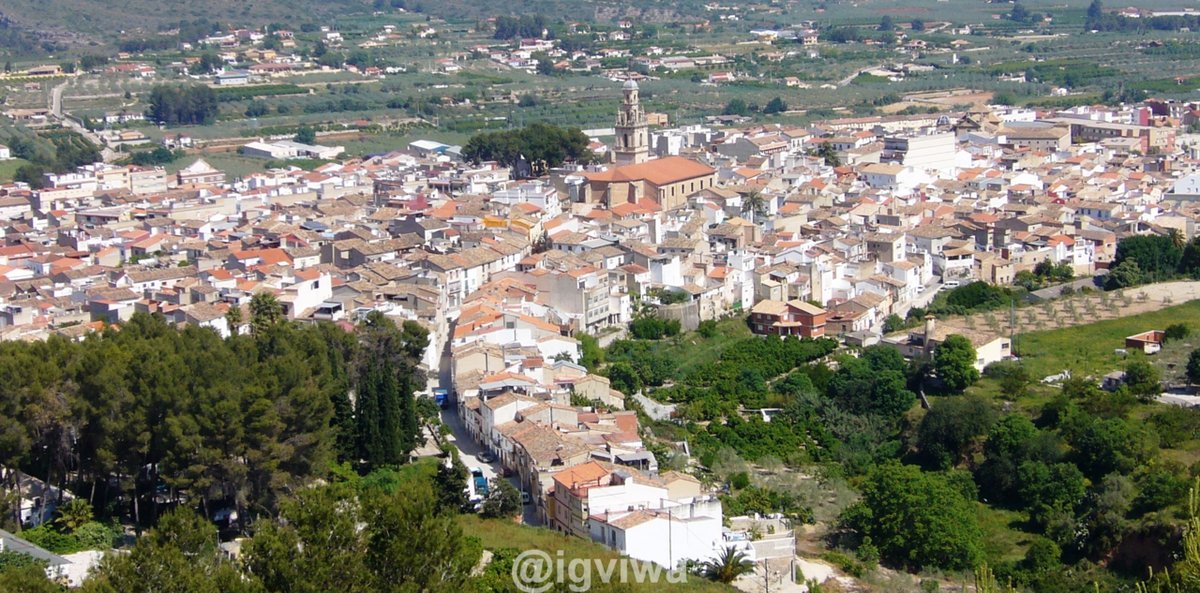
From the road, Navarrés appears as a limestone mound rising abruptly from the river plain, crowned by a white hermitage visible from far off. The image is no coincidence. This stretch of the Navarrés river has long functioned as a natural corridor, a route between inland territories and the coast. Archaeological finds at Las Fuentes suggest that people were passing through, and settling here, tens of thousands of years ago.
Geography explains much of what stands today. The hill offers wide views and a measure of natural defence. The river provides water and a way through the surrounding countryside. During the Andalusí period, a hisn, a small fortified enclosure, was built here to control the route between the interior and the coastal strip. Little remains in clear view, perhaps a section of rammed earth wall and the outline of the enclosure, yet its presence can still be felt in the old quarter. Streets climb in zigzags, easing the slope as they wind upwards.
At the top stands the Ermita del Santísimo Cristo de la Salud, built in the 18th century. It is not monumental in scale, yet it serves as the village’s reference point. From its atrium the view opens across the agricultural plain stretching south, today planted with orange and almond trees. At the base of the hill, several caves have been carved into the rock. For generations they were used as storage, shelter or even homes, and some have since been adapted as houses.
A Landscape Marked by Prehistory
Within a few kilometres of Navarrés, several prehistoric sites are concentrated in a relatively small area. At Las Fuentes, flint tools attributed to the Middle Palaeolithic have been found, associated with Neanderthal groups who inhabited this environment around 40,000 years ago.
Closer to the town centre, at La Ereta del Pedregal, archaeologists uncovered a Neolithic settlement with pottery and polished stone tools. On the castle hill itself, materials pointing to Bronze Age occupation have also been collected. This is not a large, purpose-built archaeological park. It is a landscape where different eras have left their trace, sometimes subtly, sometimes in fragments.
The rock art sites of Abrigo del Garrofero and Las Carasetas are more discreet and not always easy to visit. Access usually requires prior permission and, in some cases, a guide. These are not vast painted panels like those found elsewhere along the Mediterranean arc. Here, the images consist mainly of red signs and lines painted thousands of years ago, their meaning still uncertain.
Food Shaped by the Interior
Local cooking reflects a dry inland landscape and a farming tradition. Stews take centre stage. Gazpacho manchego is prepared here with flat, unleavened bread known as torta, game meat, usually rabbit, and aromatic herbs. It bears no resemblance to the chilled tomato soup associated with southern Spain.
Arroz al horno, oven-baked rice, appears on many tables during special occasions. In the past, families would carry their earthenware dishes to the communal village oven. Older residents still recall those collective celebrations when the oven became a meeting point as much as a place to cook.
In baking, recipes common across the area are repeated in Navarrés. Orilletas, thin strips of fried pastry, and almond rosegones are typical. Turrón de rosas, flavoured with orange blossom water, also features. There is torta fina, made with olive oil and a touch of aguardiente, and pastissos filled with sweet potato, usually prepared in winter. Traditional ovens in the village continue to produce these pastries, especially at weekends.
When the River Changes Mood
On the outskirts of Navarrés, the river forms a series of waterfalls known as Los Chorradores. A footpath leads down between vegetable gardens and citrus fields. Rather than a single dramatic cascade, the site consists of several rocky steps carved into the limestone, with small pools between each drop.
In summer, it is a popular spot for people from the village and nearby areas. When the flow runs clear and gentle, the pools serve as bathing places. In winter, the character of the river shifts. The water runs faster and more turbid, and the landscape takes on a different tone.
Further upstream lies the Pozo de las Aguas Quebradas, where the river narrows between rock walls. Traditionally this was both a bathing area and a place for fishing. Some local residents still remember when eels were caught along these stretches.
Exploring Navarrés at an Easy Pace
Navarrés lies inland in the province of Valencia, within the comarca of Canal de Navarrés, just over an hour by car from the city of Valencia following the A-7 and regional roads.
It is best to leave the car in the designated areas at the entrance to the town and continue on foot. The streets in the upper quarter are steep and narrow. On the way up towards the hermitage, small details reveal aspects of the village’s past: the Fuente de los 24 chorros in the square, coats of arms on the façades of older houses, and wooden galleries that still survive on certain homes.
A walk through the old quarter and up the hill can be done in a short time. Extending the route to include the path to Los Chorradores and the river landscapes beyond allows for a longer, unhurried visit. Navarrés does not present itself as a single landmark destination. It is better understood as a meeting point of hill and river, of prehistory and present-day village life, where the terrain itself explains why so many generations chose the same limestone rise above the plain.