Full Article
about Beniarrés
Municipality known for its reservoir and the Cova de l'Or, an important Neolithic site.
Ocultar artículo Leer artículo completo
The church bell strikes noon and nobody moves. Not because the village is dead—far from it—but because this is Beniarres, where the midday heat pins shutters closed and sends even the dogs hunting for shade. At 400 metres above sea level, the Comtat municipality feels the Mediterranean sun without the coastal breeze, a difference that shapes everything from building stones to lunchtimes.
A Working Village, Not a Film Set
British drivers arriving from the AP-7 expect another whitewashed stage set. Instead they find a place that still repairs tractors in front gardens and sells bread from ovens fired at 4 a.m. The population hovers around 1,078, swollen only in August when second-generation returnees fill the plaza until two in the morning. The architecture won't make guidebook covers: an eighteenth-century parish church with a serviceable baroque retablo, a handful of stone doorways carved with the dates 1762 or 1894, and a former town hall whose balcony now hosts the lottery results every Saturday. What matters is that every building has a purpose beyond being looked at.
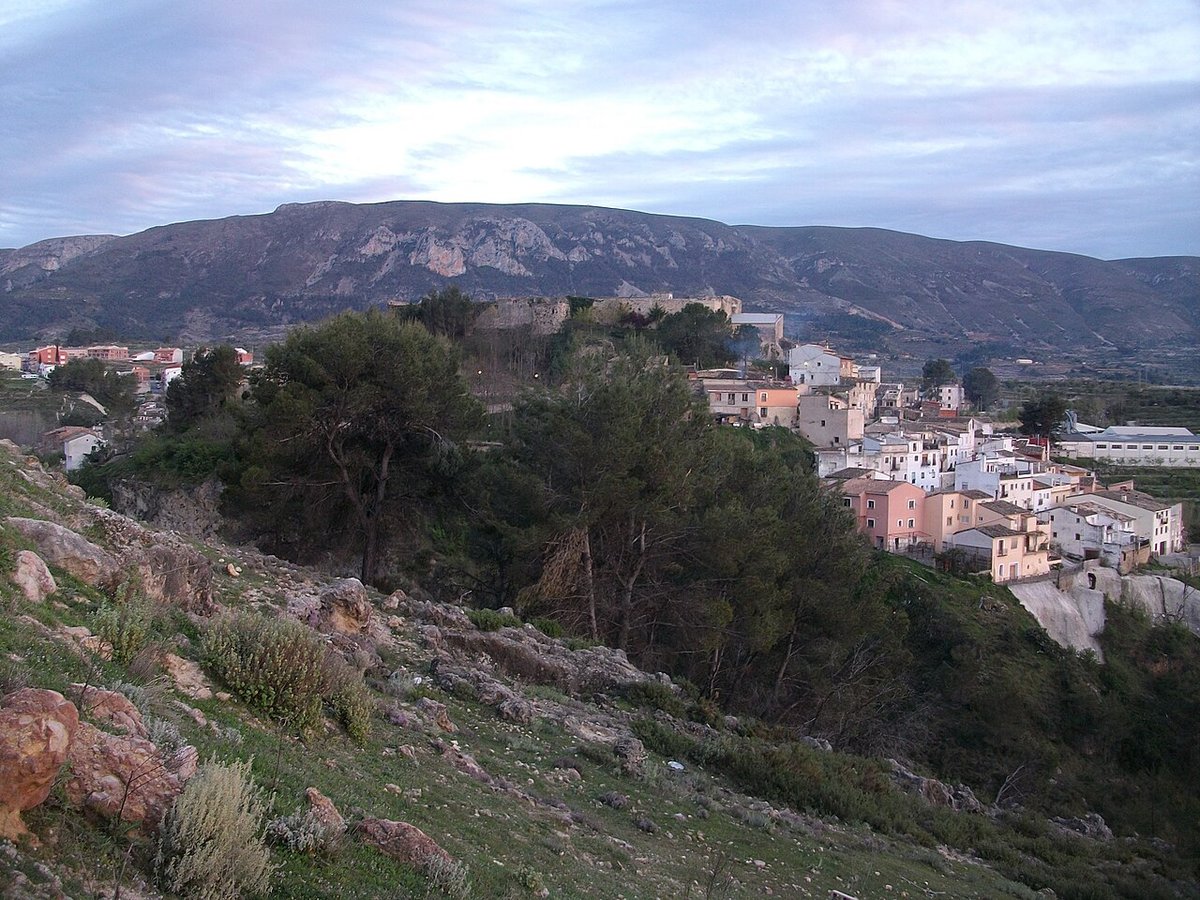
Calle Mayor climbs 120 metres from the riverbed to the cemetery, enough of a gradient to make supermarket trolleys rattle ominously. Along the way, house colour is dictated by whatever lime wash was on sale at the agricultural co-op. Pink clashes with ochre, mint green meets terracotta, and the overall effect is oddly cheerful—proof that nobody here wastes time coordinating palettes for tourists.
The Almond Calendar
Visit in January and the surrounding terraces look bleak: olive trunks silver against red clay, vines trimmed back to fists of wood. Wait six weeks and the same slopes blaze white. Almond blossom turns Beniarres into a snow globe without the cold, an event the village markets shamelessly as La Ruta de los Almendros. The two-hour footpath is signposted from the old railway station (trains stopped in 1984) and loops through orchards owned by the same families for three generations. Blossom scent drifts sweet and faintly bitter, exactly like marzipan nibbled too early in the day.
By October the nuts are drying in flat wicker baskets outside front doors. Children shell them after school, fingers stained mahogany, and the bakery turns out tarta de almendra sold by the quarter-kilo. Buy it while warm; the centre stays moist for roughly one car journey back to Alicante airport.
Eating What the Slope Provides
There is no restaurant row. The single bar on Plaza de la Constitución opens at seven for coffee, serves bocadillos until the bread runs out, then switches to beer and tapas when the first tractor driver clocks off. Thursday is paella day—rabbit and garrofón beans, properly smoky on the edges—and you need to order before 11 a.m. because the rice is cooked in one pan only. Prices feel stuck in the last decade: €2.20 for a caña, €8 for a plate of callos (tripe stew) that could floor a vegetarian at twenty paces.
Those requiring tablecloths drive five kilometres to Muro de Alcoy where El Canto serves roast lamb at weekends. The round trip is still quicker than queuing for a beachfront paella in Benidorm.
Walking Off the Pig Fat
Beniarres sits at the junction of two barrancs—mini-canyons carved by winter torrents that the locals call gota fría. A network of agricultural tracks follows the contours, paved centuries ago to let mules haul almonds down to the river. Maps are available from the tiny tourist office (open Tuesday and Thursday, 10–1), but the best route is simply to keep the village on your left and the cliffs on your right until hunger intervenes. Spring brings wild asparagus sprouting beside the path; sturdy shoes are advised because the same rain that triggers flowers loosens limestone shards sharp enough to slice boot soles.
Cyclists arrive with wider tyres and bigger appetites. The loop north to Gaianes and back is 38 km with 650 m of climbing, all on quiet tarmac that smells of pine and goat when the sun hits the resin. Winter mornings can start at 3 °C even if Alicante is 18 °C; pack arm-warmers and buy an extra coffee in Gaianes because the return leg is largely downhill and wind-chill matters.
When the Village Lets Its Hair Down
Fiestas are timed to agricultural lulls, not school holidays. The Immaculate Conception in early December mixes solemn procession with a mobile disco that thumps until the Guardia Civil suggest 3 a.m. is quite late enough. August brings the summer fiesta: foam party in the polideportivo, tractor parade, and a communal paella cooked outdoors by men who argue loudly about salt. Visitors are welcome but nobody organises anything for them; if you want to join in, carry chairs, buy raffle tickets, and accept that the brass band will play Eye of the Tiger at least twice.
Semana Santa is quieter—hooded nazarenos pacing the streets to drumbeats, shops shuttered, television volume turned low. Even the bar closes between the afternoon and evening processions. Respect the pause; it's the closest Spain comes to Remembrance Sunday.
Getting Here, Staying Here, Leaving
Alicante airport is 75 minutes by hire car; Valencia is ten minutes farther. There is no train, and the twice-daily bus from Alcoy demands precise timing. Road access is via the CV-700, a mountain highway engineered by someone who believed guardrails were for the weak. The final turn-off drops 200 metres in three kilometres; first gear and functioning brakes are non-negotiable.
Accommodation is limited. Ca Ramon offers three apartments carved from an almond warehouse, review average 4.1 on TripAdvisor, €70 a night in blossom season, €45 in July when everyone else is at the beach. Book by email—response time is erratic because Wi-Fi struggles with thick stone walls. Alternative bases are Alcoy (20 minutes) or the coastal town of Calp (40 minutes), but then you miss the 8 a.m. smell of wood-fired bread drifting across the gorge.
The Honest Verdict
Beniarres will not change your life. It has no Michelin stars, no souvenir shops, no sea view. What it does have is continuity: the same bakery smell since 1924, the same families shelling almonds on doorsteps, the same plaza where teenagers flirt and grandparents pretend not to notice. Come for the blossom, stay for lunch, walk it off among terraces that have fed the same village for six centuries. Leave before the church bell strikes noon and you will have missed the point entirely—because in Beniarres, the pause is the purpose.