Full Article
about La Pobla de Farnals
Town with an inland historic core and a beach area with a marina.
Hide article Read full article
A town in two halves
Some places feel as if they were built in separate pieces. La Pobla de Farnals works like that: an inland centre with the rhythm of an agricultural town, a beach area designed for summer, and between them a narrow stretch of fields that still holds its ground.
The municipality is small and everything sits close together on the map. In just a few kilometres you move from the church tower in the old town to the sand. The change of atmosphere happens almost without noticing, as if the town had slowly stretched itself towards the Mediterranean over the years.
The urban core, the beach district and that strip of huerta, the irrigated farmland typical of Valencia, are tightly packed. Acequias, the traditional irrigation channels, still mark out parts of the landscape. Even today there are moments when the scent of orange blossom drifts through the air. It is a reminder that this is not only a seaside destination but also part of the agricultural belt that surrounds the city of Valencia.
The town that went to the beach
One of the practical advantages of La Pobla de Farnals is how easy it is to move between the old town and the coast. You can arrive by metro to the station in the town itself and from there there is usually a bus down to the beach. The journey is short and passes through agricultural paths, irrigation channels and orange groves. It is not meant to impress, but it shows everyday life in the Valencian huerta, something that has disappeared in other areas.
The beach does not attempt to rival the wildest corners of the Mediterranean or the vast stretches of sand further south. The atmosphere here is different. Families come from Valencia, many people return summer after summer, and apartment blocks that have faced the sea for decades shape the skyline.
There is fine sand, a simple promenade and plenty of activity during high season. In the warmer months the social centre of gravity shifts towards the coast. There is even a church in the beach area that only opens during the peak of summer. It says a lot about how the town functions: half the population lives year round in the upper town, yet much of social life moves closer to the water once the heat sets in.
July and August bring the largest crowds. At the start of summer or when September arrives, the feeling remains distinctly seaside but with a little more breathing space.
From medieval ties to San José
Like many towns in the Valencian huerta, La Pobla de Farnals has a history shaped by medieval references, changes in lordship and agricultural growth. For centuries it depended administratively on El Puig. It was not until the seventeenth century that it achieved its own autonomy.
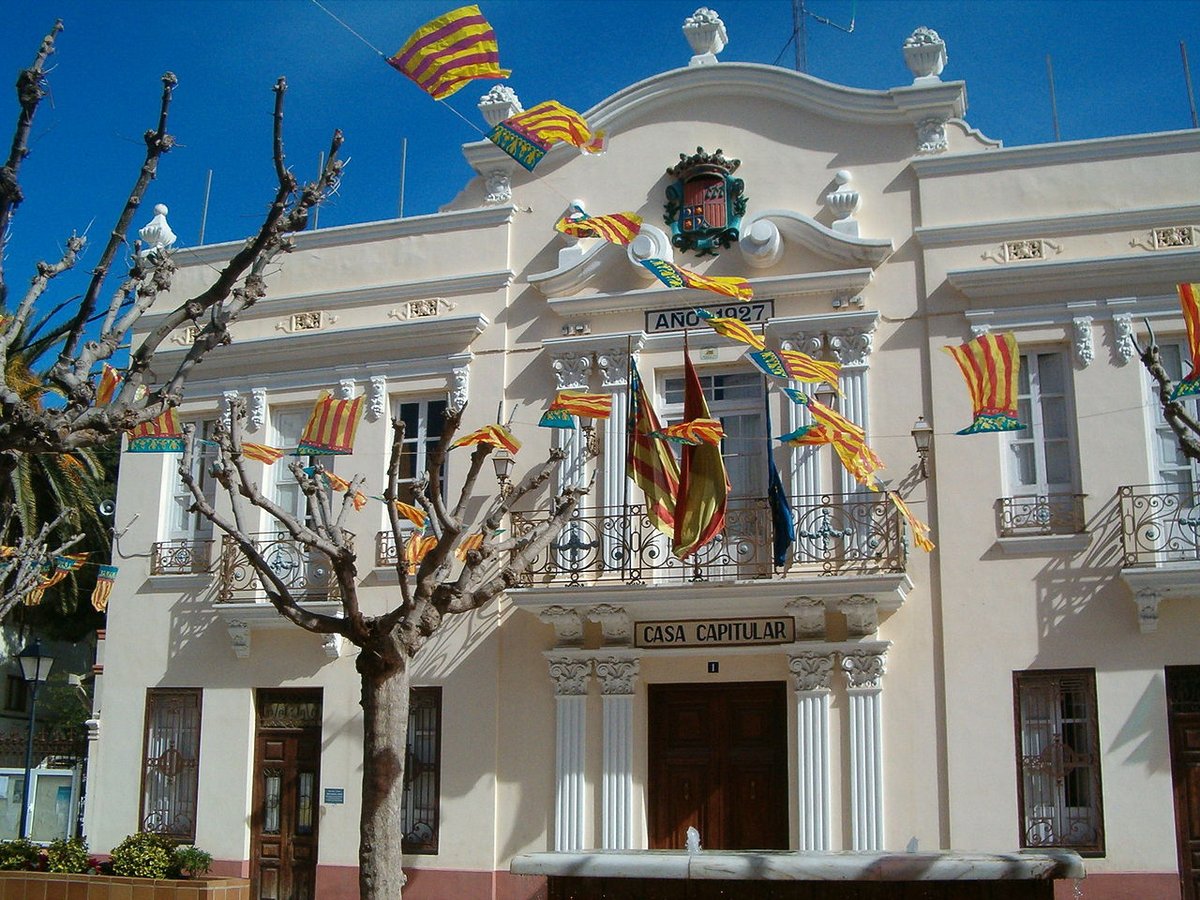
The Iglesia de San José, in the old nucleus, remains one of the focal points of local life. Several of the town’s celebrations revolve around it. In January, for example, the feast of San Antonio Abad fills the square with bonfires, animals brought for blessing and plenty of firecrackers. It does not reach the scale of festivities in the provincial capital, yet the tradition here is very much alive.
These celebrations help explain the dual character of the place. There is the beach, oriented towards summer visitors and repeat holidaymakers, and there is the inland town, where annual festivals and parish life still set the pace.
Rice at the centre of the table
Between the town and the beach, food plays a central role. Rice appears in almost every conversation. A banda, paella and fideuà all feature regularly, and each family defends its preferred version. Even the preparation of alioli, the garlic sauce that often accompanies these dishes, can spark debate.
The logic is simple. Valencia lies on one side, the Mediterranean on the other, and both sea and farmland are close at hand. Menus tend to combine seafood with produce from the huerta. It is a meeting point of ingredients shaped by geography rather than fashion.
After a rice dish, horchata with fartons often rounds things off when temperatures climb. The heat in this part of the Comunidad Valenciana tends to linger for many months, so cold drinks and light, sweet bites find their moment well beyond the height of summer.
A straightforward escape
La Pobla de Farnals is not a place for ticking off a long list of monuments. The appeal works differently. Its scale makes it easy to plan a simple day: rice at midday, a walk along the promenade, a quick swim and then back to Valencia before nightfall.
For those arriving by car, parking is generally easier in the town centre than in the beach area, particularly in summer. Public transport connects Valencia with the town, and from there the coast is only a short onward journey away. Distances are small enough that shifting between environments does not require much effort.
What defines La Pobla de Farnals is that compact mix. In the space of a short journey you pass from church square to orange groves, from farmland to sand. Half the life of the municipality looks inland, rooted in agriculture and parish festivities. The other half faces the Mediterranean, geared towards long, hot days by the sea.
It may not promise dramatic landscapes or headline attractions. Instead, it offers something more everyday: a slice of Valencian coastal life where rice, family summers and the steady presence of the huerta set the tone. Some days, that is more than enough.