Full Article
about Massalfassar
Market-garden village near the sea with an active industrial estate.
Hide article Read full article
Between Valencia and the Sea
Massalfassar sits on the northern edge of l’Horta de València, within the comarca of l’Horta Nord. It occupies a strip of farmland shaped for centuries by a historic network of irrigation channels that flow down from the séquia de Montcada towards the Mediterranean. The village lies just a few kilometres from the coast and very close to the city of Valencia. That setting explains its dual character: agricultural in origin, yet today home to many residents who work elsewhere and return each evening.
The urban layout is straightforward and compact. Straight streets run between low houses, usually two storeys high. Beyond the last row of buildings, cultivated plots begin almost immediately. For generations, these fields have set the rhythm of daily life.
Massalfassar forms part of the traditional Valencian huerta, the irrigated farmland that surrounds the city. Although modern changes are visible, the structure of this historic landscape still makes sense on the ground.
A Name from the Andalusi Period
The name Massalfassar is usually linked to Andalusi Arabic. Across the Valencian huerta, many place names begin with “Mass-” or “Mas-”, derived from manzil, a term referring to a stopping place or small rural settlement. After the Christian conquest in the 13th century, medieval records already show forms close to the present name, as these alquerías, rural farmsteads under Islamic rule, were reorganised into agricultural villages connected to the city of Valencia.
The countryside around the village centre reflects that inherited system. Agricultural tracks run alongside secondary irrigation channels, and long, narrow plots follow the traditional division of land. Not everything has survived intact, yet the overall logic of the historic huerta remains easy to read. Water, paths and fields align in a pattern that has shaped this part of l’Horta Nord for centuries.
The Parish Church and Village Centre
The parish church stands at the most recognisable point in the urban area. The current building largely dates from reforms carried out in the early modern period, probably between the 17th and 18th centuries. Such rebuilding was common in the villages of the huerta, where medieval parish churches were expanded or reconstructed as communities grew and resources allowed.
The architecture is restrained and practical rather than monumental. In a flat landscape, a church of this scale served several purposes at once. It functioned as a religious centre, a meeting place and a visual landmark. From the streets that lead away from the square, the tower is almost always visible above the low rooftops.
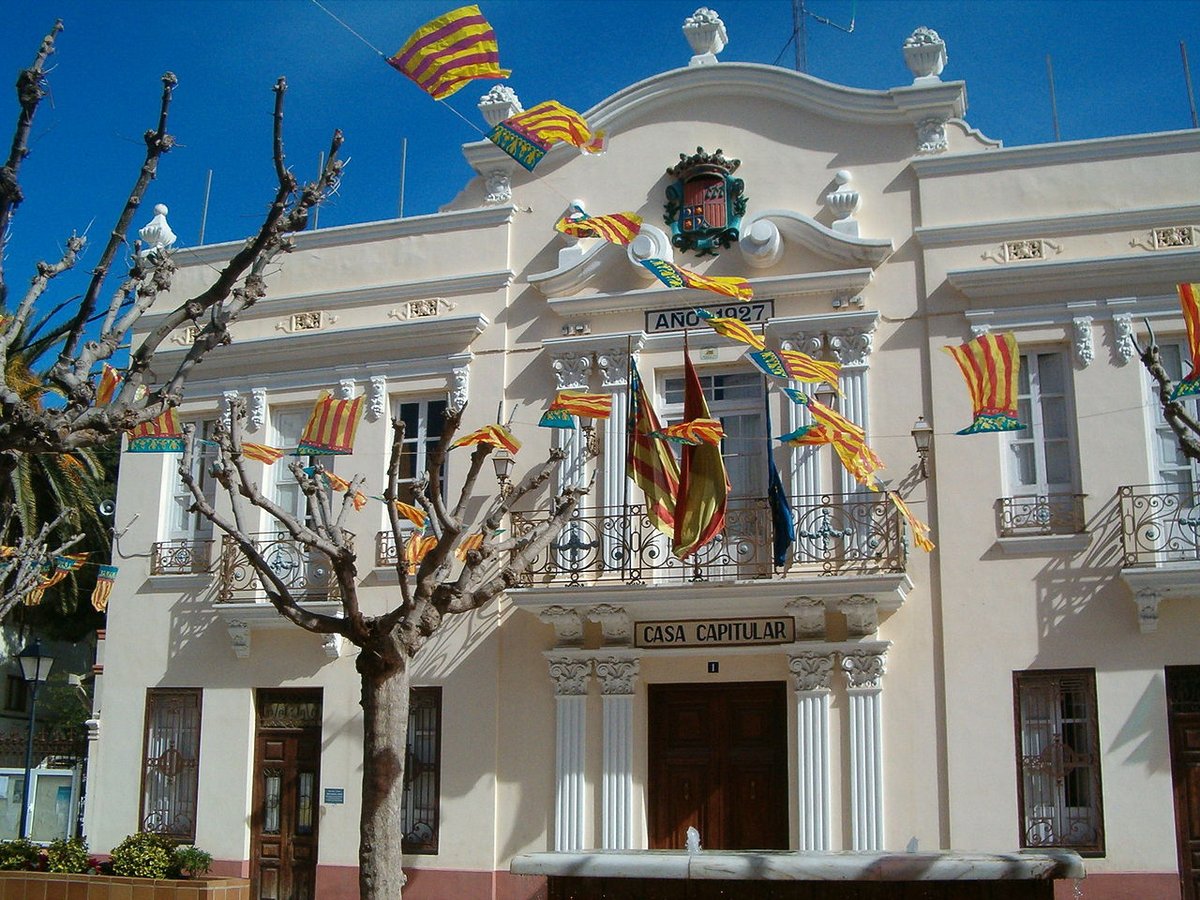
Municipal buildings and small squares cluster around the church. These are the spaces where everyday life unfolds. Older residents sit in the shade, conversations stretch on, and children cross from one street to another on bicycles. The atmosphere reflects a village that continues to operate at a human scale, with daily routines on display.
The Huerta at the Doorstep
It takes only a few minutes to leave the built-up area of Massalfassar behind. Dirt tracks quickly replace paved streets, leading into the agricultural partidas, the named sections of farmland that structure the huerta. Early in the day, small tractors move along these paths, vans carry crates, and farmers check irrigation systems.
Citrus remains the dominant crop, especially clementines and oranges. Some plots rotate with seasonal vegetables. The proximity to the sea moderates the climate, which helps explain why this stretch of l’Horta Nord has historically been so productive.
The séquia de Montcada is one of the major medieval hydraulic infrastructures of the Valencian huerta. It irrigates part of Massalfassar’s fields through a network of secondary branches. Walking beside one of these acequias offers a clear sense of how the territory was organised. Water flows along a channel, paths run parallel, and fields line up in orderly strips. The system is practical, but it also reveals a long continuity in land management.
Although modern machinery and vehicles are part of the scene, the essential framework remains agricultural. The huerta here is not a decorative backdrop. It is working land, shaped by irrigation and cultivation.
A Small Village Without a Tourist Stage Set
Massalfassar has just over two thousand inhabitants and retains a calm scale. It is not a destination for specific monuments or a spectacular historic centre. Instead, it functions as a huerta village where daily life is clearly visible.
Local festivals, as in many towns across the comarca, combine religious events with neighbourhood activities and shared meals. The exact programme varies from year to year depending on local associations and organising groups. The emphasis rests on community participation rather than on attracting outside visitors.
This absence of a staged tourist image defines the experience of Massalfassar. The interest lies in observing how a traditional agricultural settlement has adapted to its proximity to Valencia. Many residents commute, yet the physical and cultural framework of the huerta still shapes the place.
Getting There and Moving Around
Massalfassar is about fifteen kilometres from Valencia. It can be reached by local commuter train and also by road within a short drive. The connections reflect its position within the wider metropolitan area, close enough to the city for daily travel while remaining distinct in character.
The urban centre is small and completely flat, so it can be explored quickly on foot. Those who want to understand the setting more fully should allow extra time to walk along the agricultural tracks that leave the village. As one moves towards the coast, the landscape gradually shifts, though distances remain short.
In this part of l’Horta Nord, everything connects through a dense network of rural paths. These routes link fields, irrigation channels and neighbouring settlements. They also make clear how Massalfassar fits into a broader agricultural system that extends across the northern fringe of Valencia.
Massalfassar does not rely on grand landmarks to define itself. Its identity emerges from its geography: a compact village, a historic irrigation network and fertile land stretching towards the sea. For anyone curious about how the Valencian huerta still functions today, this small settlement offers a direct and unembellished view.