Full Article
about Rafelbunyol
A market-garden town with an industrial estate and lively local festivals.
Hide article Read full article
Where the huerta shapes everything
Rafelbunyol sits in l’Horta Nord, a few kilometres north of Valencia. Its layout, and much of its history, is dictated by the huerta—the irrigated farmland that surrounds it. The Moncada irrigation canal, a medieval system, still runs through here. You see its influence in the straight, practical streets that give way, abruptly, to orange groves.
The town is compact, just over four square kilometres for its nearly ten thousand residents. This density means you can walk from the plaza mayor to the edge of the fields in ten minutes. In late winter, the scent of azahar from the blossoms hangs over the last houses. The transition isn’t gradual; one street ends, and the orchard begins.
From Islamic alquería to agricultural town
The name suggests its origin: Rahal, from the Arabic for a rural farmstead or estate. Medieval records call it Rahal‑Bunyol. That agricultural foundation is visible in its oldest structures.
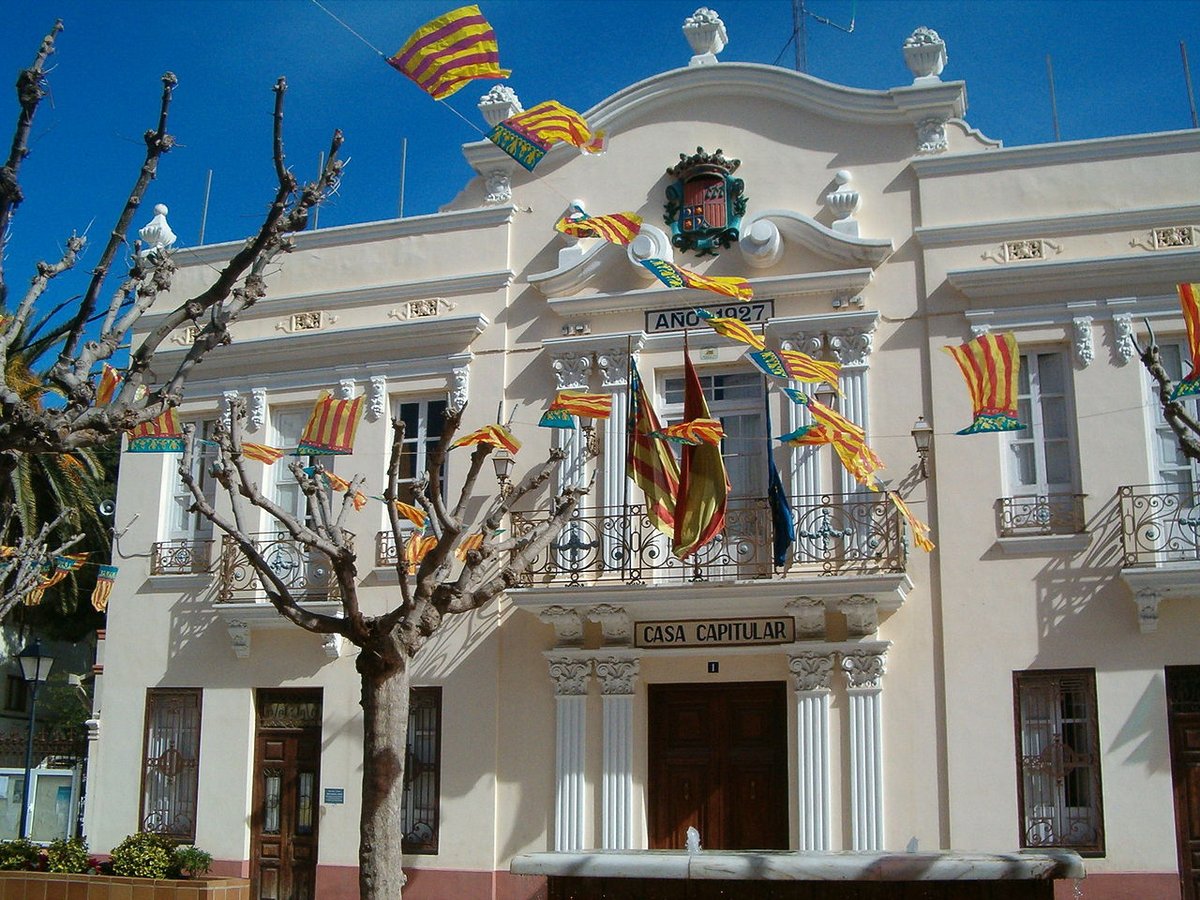
The Casa Vella, a fortified medieval tower house, stands as the most tangible link to that past. Its later neighbour, the Casa Nova, with its interior courtyard and heraldic shield, speaks of a different era—when local landowners administered estates from a more domestic seat of power. The parish church of Sant Miquel, largely reformed in the 18th century, completes this central group. It’s a functional building, its scale suited to a community whose life was organised around the parish and the adjacent fields.
The Carraixet and the logic of irrigation
To the west, the barranco del Carraixet acts as a dry riverbed for most of the year, a geographical seam between municipalities. The paths along its course are the best way to read the huerta’s logic.
You can follow the secondary irrigation channels—the sequiols—as they branch off to feed individual plots. Look for the small water reservoirs and the scattered barraques, simple field huts for tools. This isn’t a museum landscape. On a weekday morning, you’ll likely hear the sound of pruning shears or a small tractor among the citrus trees. Water distribution here is still managed by the centuries-old Comunitat de Regants, a system that orders both the land and the daily work upon it.
A calendar built around local life
The town’s festivities follow a rhythm that feels integrated rather than staged for outsiders. There isn’t one single major festival; instead, several smaller events punctuate the year.
San José, in mid-March, fills the streets with processions and communal meals. The winter celebration of Sant Antoni, with its traditional blessings of animals, retains its link to rural life. Other events, like food fairs or cultural weekends, are often organised by the local sociedades and clubs. This creates a scattered calendar of activity, typical of towns across l’Horta Nord, where celebrations are woven into the fabric of local association life.
Eating from the surrounding land
What you eat in Rafelbunyol is often a direct product of what grows nearby. Vegetable paellas and savoury cocas are staples at community gatherings, especially during harvest times. Dishes like all i pebre appear in home kitchens, though the eel traditionally comes from the Albufera lagoon, not local streams.
The connection is more about provenance than unique recipes. Bakeries sell fartons, the sugar-dusted pastries meant for dipping in horchata, a tradition shared across the region. The distinction lies in the short distance from field to table: citrus for juice, tomatoes for stew, olive oil from nearby mills—often from plots visible from the town's outskirts.
A short walk through town and fields
You can grasp Rafelbunyol in an afternoon on foot. Start at the church of Sant Miquel, then pass the Casa Nova and Casa Vella to see the historical core. From there, head west on any main street; they all lead to the huerta.
The interest here is in the functional details: the way an irrigation channel defines a property line, the construction of a barraca, the order of trees in a grove. These elements tell you more about the place than any monument could. The walk confirms the primary fact: this is a town where urban streets dissolve into working farmland, and where the year is still measured by crops and water.