Full Article
about Tavernes Blanques
Municipality bordering Valencia, home to the Lladró factory.
Hide article Read full article
The sat nav insists you’ve arrived, yet the setting feels wrong. A wide avenue lined with petrol stations and industrial units does not match the idea of a traditional Valencian village. Then the sign appears: Tavernes Blanques, a municipality of just under ten thousand residents. That is the first lesson of tourism in Tavernes Blanques. This is not a picture-postcard village. It is a working town.
Set next to Valencia city in the region of l’Horta Nord, Tavernes Blanques blends market garden land, residential neighbourhoods and industrial activity. At first glance it can seem ordinary. Spend a little time here, though, and the contrasts begin to stand out.
The porcelain factory recognised around the world
One sight feels particularly unexpected. Between blocks of flats, schools and fairly typical streets stands a porcelain factory whose figurines have filled display cabinets across the globe for decades.
Anyone who grew up seeing delicate porcelain angels under glass domes in a relative’s home has probably encountered pieces made here.
The factory museum can be visited and, when it is open to the public, part of the production process is visible. The atmosphere leaves a strong impression. Workshops are quiet. Artists work with extremely fine brushes, concentrating on details so small that the comparison with miniature surgery does not feel exaggerated. Painting eyelashes or tiny decorative elements onto a porcelain figure requires remarkable precision and patience. It has a strangely hypnotic quality.
It is striking to think that from a town of this size, pieces travel to homes in half the world. That contrast stays with you: everyday neighbourhood life outside, meticulous craftsmanship within the factory walls. Few places combine such a local routine with such international reach.
Horchata and fartons: breakfast taken seriously
By mid-morning the town smells of chufa, the tiger nut used to make horchata. That is not poetic licence. Tavernes Blanques sits firmly in l’Horta Nord, and the surrounding agricultural land shapes daily habits in simple ways, starting with breakfast.
Several streets are home to long-established horchaterías. People come and go steadily. The clientele is not limited to visitors. Many customers work in the nearby industrial estates or live locally and stop off before heading home.
The scene repeats itself: a large glass of very cold horchata, a couple of fartons, sometimes three, and a conversation at the counter. Fartons are elongated, soft pastries designed for dipping into the drink. The mix of people is part of the interest. At one table someone might have a shirt and laptop open, while next to them another customer has just finished a night shift.
The so-called Ruta de la Horchata runs through this area of l’Horta. Do not expect grand mansions or major monuments along the way. The appeal lies in linking villages by bicycle or short car journeys. From Tavernes Blanques to Alboraia, for example, it is only a brief ride between cultivated fields and secondary roads.
Parking, on the other hand, can turn into a minor test of precision. Streets are short, local traffic is steady, and it becomes clear why so many residents choose to move around by bike or motorbike instead.
Fallas, neighbourhood style
Las Fallas, the famous Valencian festival held in March, take on a different tone here compared with the capital. Everything feels closer and more familiar.
The fallas commissions know one another. The large satirical monuments are usually erected in squares or streets where the participants themselves live. The atmosphere resembles a very large neighbourhood celebration rather than a vast urban spectacle.
On the night of the cremà, when the monuments are set alight, the smell of gunpowder hangs over the entire town. Children set off firecrackers. Groups of neighbours sit on folding chairs. Conversations continue for hours in small circles. When a falla burns, a significant part of the municipality is there to watch.
It is not the enormous show staged in Valencia city, yet it carries a strong sense of shared festivity that can be diluted in bigger places. The scale allows people to recognise faces in the crowd and feel part of the occasion.
Fiestas del Roser: when everyone returns
In October, Tavernes Blanques celebrates the Fiestas del Roser in honour of the Mare de Déu del Roser. During those days the rhythm of the town shifts noticeably.
Peñas, local social groups, appear wearing matching T-shirts. They push carts loaded with drinks through the streets. Stages are set up for evening music. Alongside these lively scenes, more traditional events take place, including a procession that draws many residents.
Neighbours often comment that taverners who live elsewhere, in Valencia city or further afield, return home for these festivities. As a result, the atmosphere becomes livelier than one might expect for a town of this size.
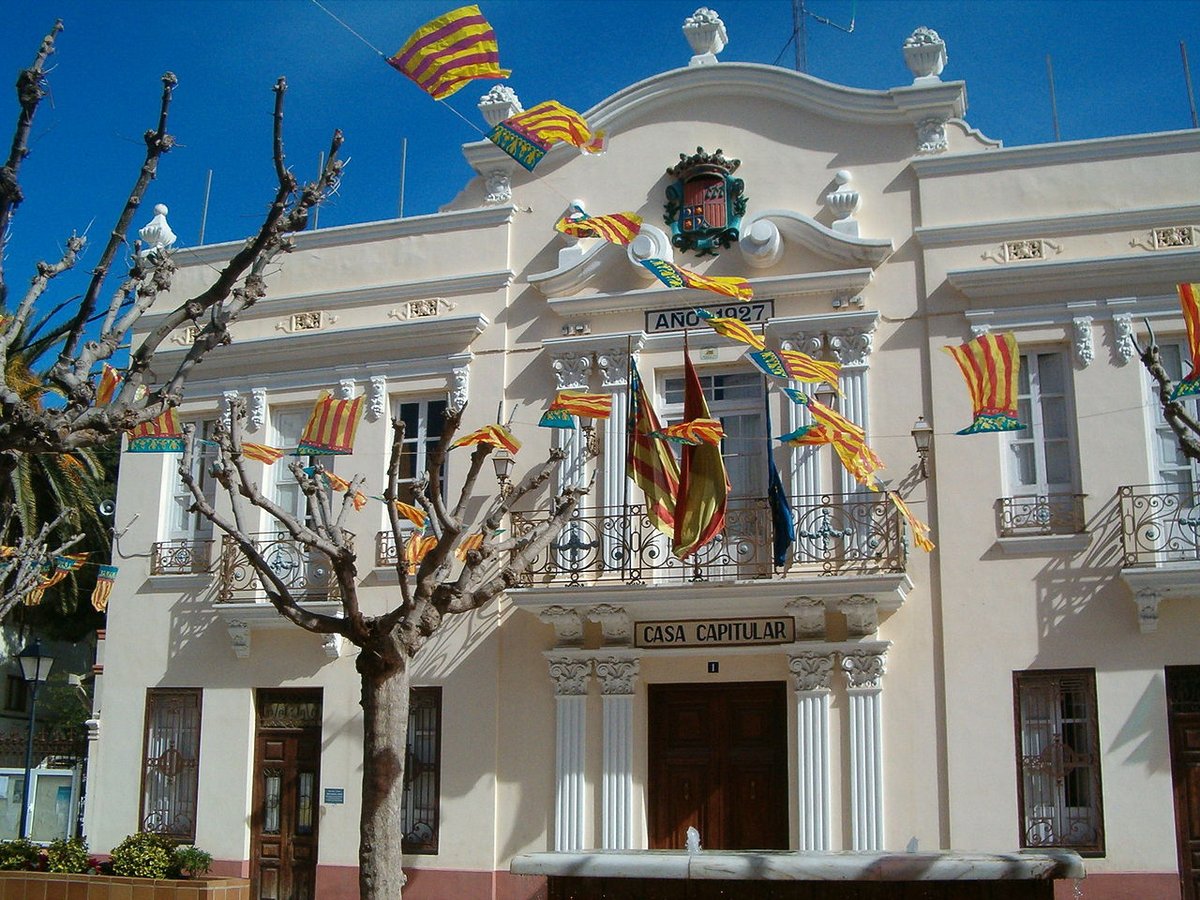
Balconies are decorated with bunting. Lights stretch across streets. At almost every corner someone seems to know someone else. The feeling is that of a community temporarily swelling as former residents come back to reconnect.
Is Tavernes Blanques worth a stop?
The answer depends on what you are looking for.
Travellers in search of medieval old quarters or cobbled lanes will not find them here. Tavernes Blanques offers something different: a municipality next to Valencia where market gardens, residential areas and industry exist side by side.
For anyone curious about how this part of l’Horta Nord functions, a short stop makes sense. A visit to the porcelain factory, a relaxed mid-morning horchata and a brief walk through the town can all fit comfortably into a few hours.
It works particularly well as part of a wider route through the huerta. Alboraia lies very close by. Valencia city is only a short hop away. The beach area of La Patacona can also be reached within a few minutes by car.
Seen this way, Tavernes Blanques offers a perspective on everyday Valencia. This is the Valencia of people who wake early for work, cycle across the huerta and treat horchata as a normal Tuesday breakfast rather than a novelty. It may not dominate guidebooks, yet it reveals a side of the region that feels entirely authentic to those who live it.