Full Article
about Chelva
Historic town with the Ruta del Agua and well-preserved Jewish, Arab, and Christian quarters.
Hide article Read full article
A village that wakes gently
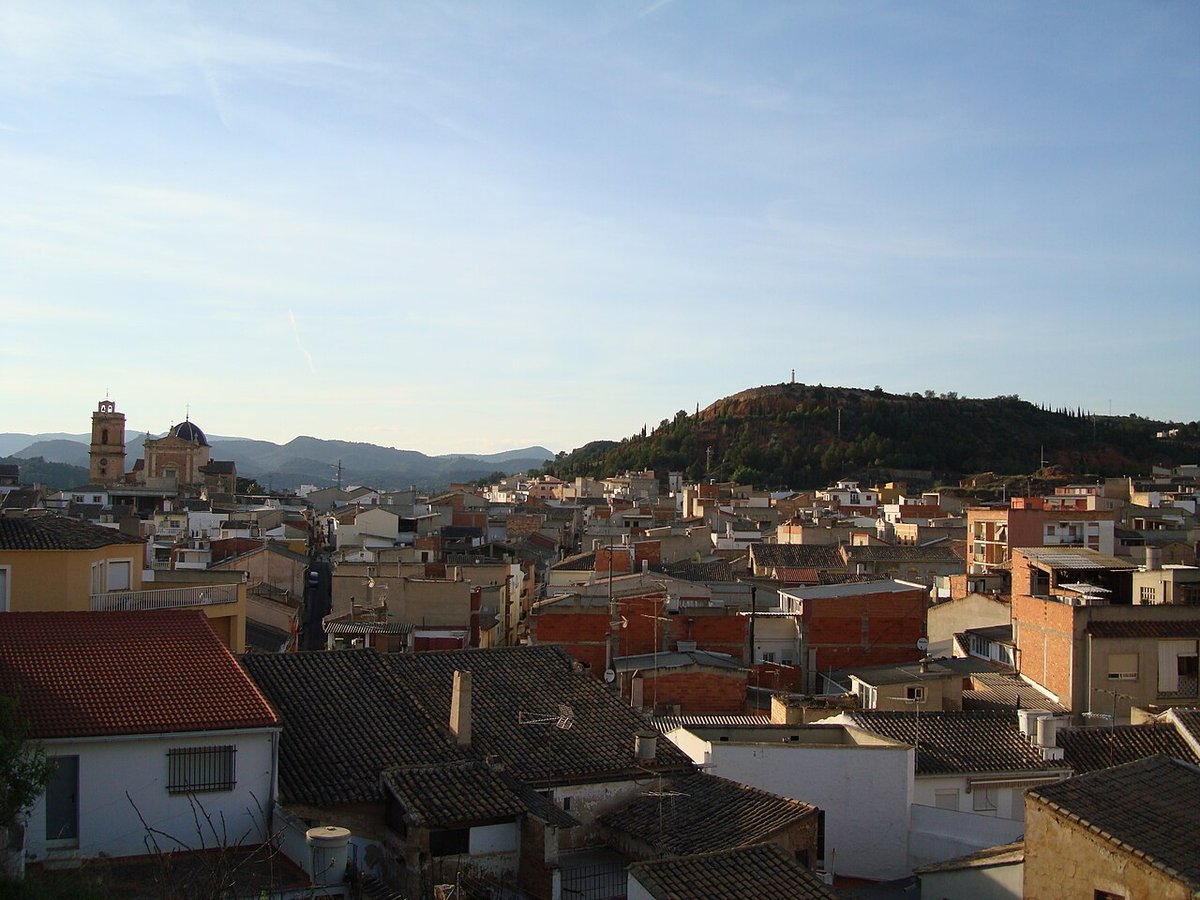
By mid-morning, when the sun begins to touch the upper façades, much of Chelva still sits in partial shade. There is a faint smell of bread and old wood. A window opens somewhere. This is how time tends to begin here, walking slowly along Calle Mayor while footsteps echo off stone and the village keeps its unhurried rhythm.
Chelva lies in the comarca of Los Serranos, inland from the province of Valencia. The town spreads down a slope facing ravines filled with almond and olive trees. Distances can be misleading. On a map everything looks close, yet the inclines make each stretch feel longer and ask for a slower pace.
Layers of history in the old quarters
The historic centre is made up of narrow, uneven streets. Some houses still have thick walls and dark iron balconies. After several tight alleyways, Plaza Mayor opens out suddenly. At certain times of day, there is little more than the sound of a fountain and the occasional brief conversation.
The Iglesia de Nuestra Señora de la Asunción marks the centre quite clearly. Its bell tower can be seen from many points across the town. Around it, the street layout retains an older pattern, especially in the Barrio Morisco, where the curves seem to follow the shape of the land itself.
Near the Puerta de San Juan, parts of the old defensive boundary can still be made out. It is not a complete wall, yet these remains help to sketch how the settlement was organised centuries ago. Following a few of the side streets leads to the antiguos lavaderos, the old public washhouses. They sit beside a spring and still hold that cool dampness that clings to the walls.
Following the sound of water
The water is heard before it is seen. First a murmur through trees, then the course of the río Chelva appears.
The Ruta del Agua begins close to the town and follows the river for several kilometres. Along the way, the path crosses stone bridges, passes sections cut directly into rock and runs alongside the remains of old mills. In places, the trail narrows and the ground becomes uneven.
It is worth wearing footwear with a firm sole. After rain, the surface can be slippery. In summer, the heat builds during the middle of the day, as much of the route is enclosed between rock walls that hold the warmth.
The carved line of Peña Cortada
A few kilometres further on lies one of the best-known sights in the area, Peña Cortada. This is a section of a Roman aqueduct carved straight into the rock, once part of a hydraulic system that extended towards the coast.
From below, it appears as a clean, straight line cut across the mountain. As the approach gets closer, the scale of the cut becomes clearer. The path leading there includes some narrow stretches and noticeable changes in level, so it is best taken at an unhurried pace and outside the hottest hours.
Ravines, rock walls and still water
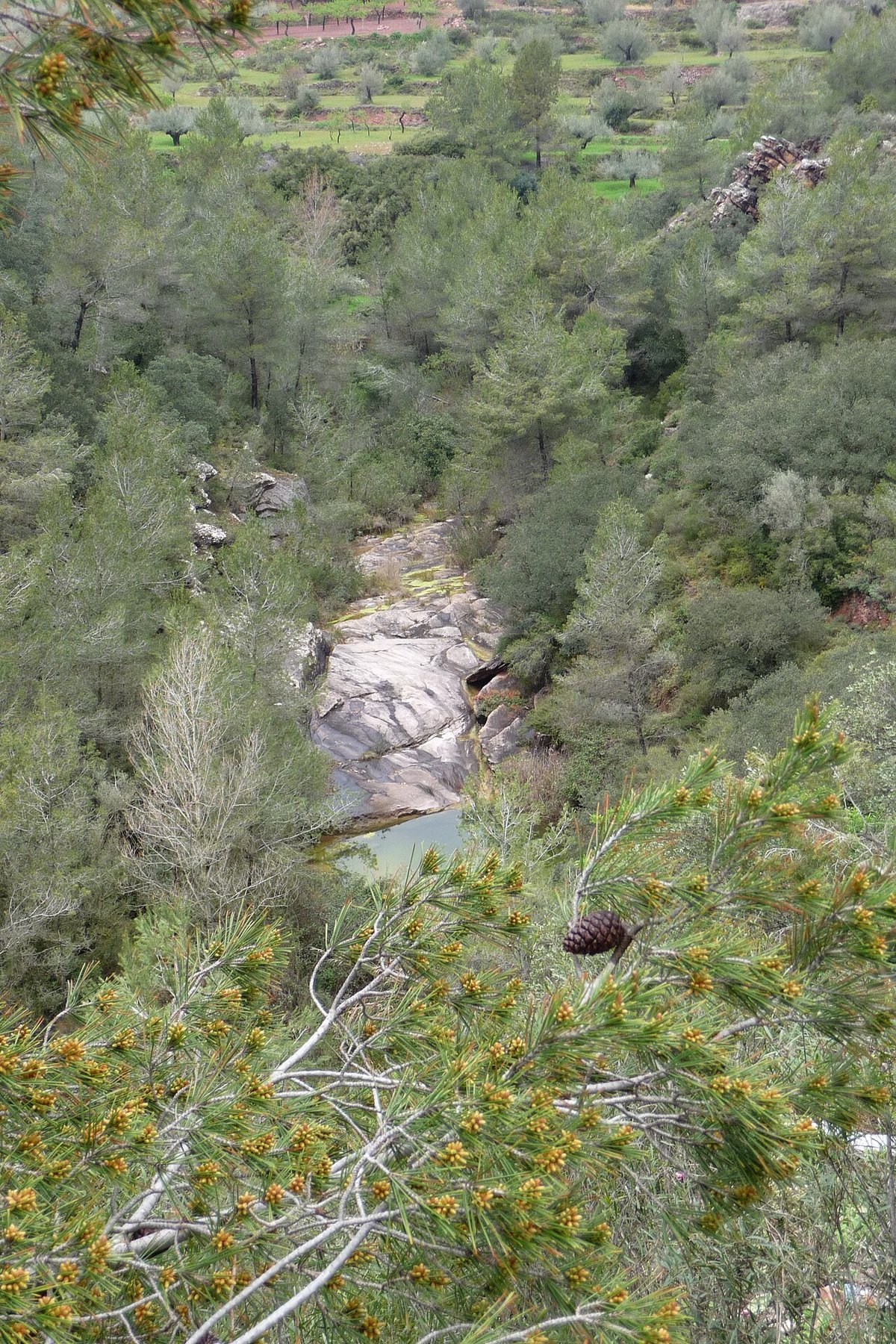
The landscape around Chelva is shaped by ravines. Some are covered in low pines and scrub, others are steeper and more abrupt.
The Barranco de la Hoz is often chosen by walkers who want to move between high rock walls. In certain sections, water collects in dark pools where the surface remains almost completely still.
Summer images sometimes show people bathing here, though the flow of water changes considerably depending on the time of year. There are periods when levels drop and the bottom becomes visible, with stone and sand replacing the darker depths.
Traditions that continue quietly
Local life still follows the rhythm of the festive calendar. In summer, the patronal celebrations in honour of the Virgen de los Remedios usually take place. Processions move through neighbourhoods such as El Raval and La Ermita, with residents accompanying the route through narrow streets.
In winter, the tradition of San Blas continues. It is common to see blessed bread and people walking out towards the ermita on the outskirts. These are simple celebrations, closely tied to the community rather than large-scale events.
Before setting out
Chelva is not a place to rush. The slopes are more demanding than they first appear, and parts of the old town are paved with uneven stone.
At weekends or in the height of summer, arriving early tends to make things easier. Parking near the centre can become difficult when visitors come to walk the Ruta del Agua.
It is also sensible to bring water and protection from the sun if heading onto the trails. Even with the river nearby, much of the surrounding terrain is dry and stony. The landscape sets the pace here, and most visits end with more walking, and more time taken, than originally planned.