Full Article
about Pedralba
Farming village on the Turia with irrigated and dry-land fields.
Hide article Read full article
A small town by the Turia
Tourism in Pedralba is not a full-day plan. It is the sort of place you can walk around fairly quickly. Park first, then decide if you feel like stretching your legs.
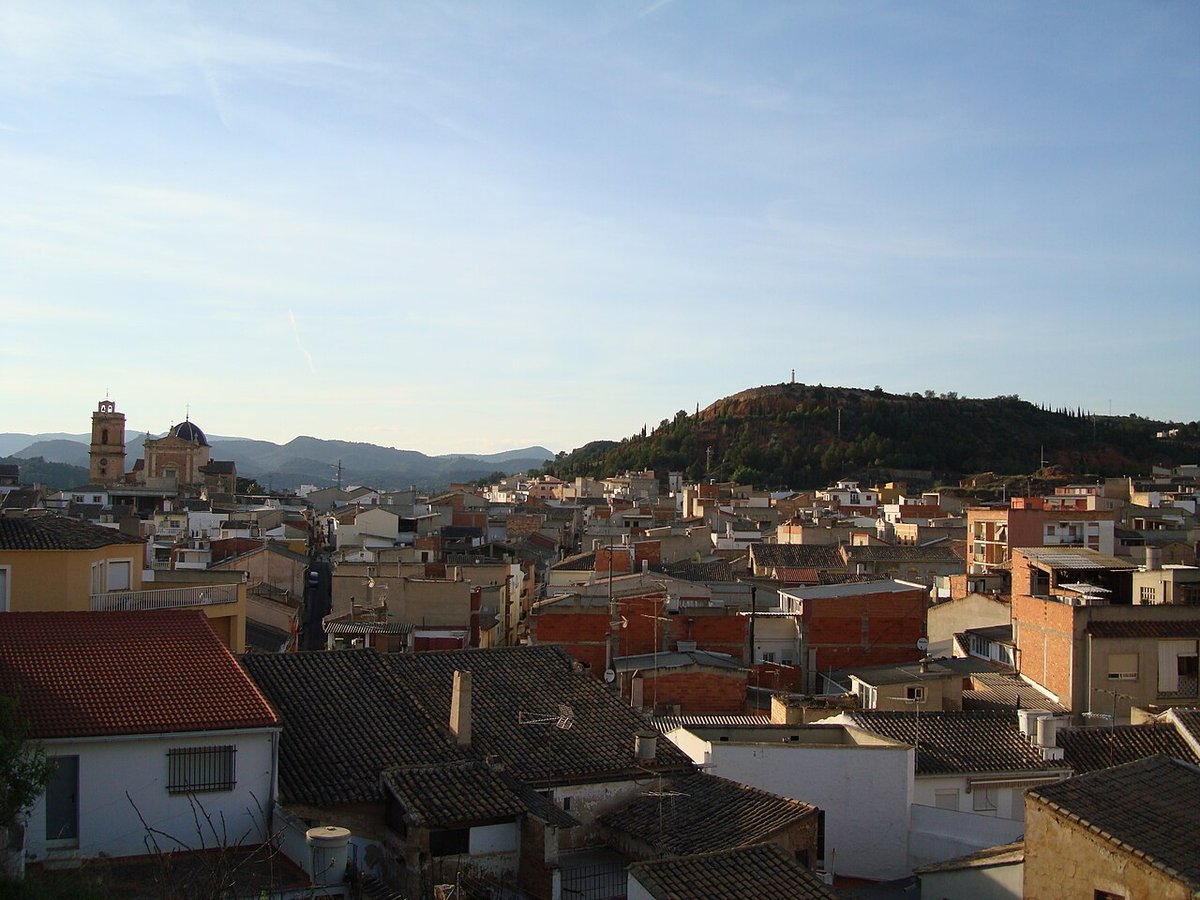
This town of just over three thousand residents sits in the valley shaped by the River Turia, in the inland comarca of Los Serranos, within the Comunidad Valenciana. The river runs close by and defines both the landscape and the local economy. Much of life here revolves around the irrigated fields along the Turia, especially orange groves. The surrounding land is flat near the river, then rises gently towards low hills.
There are no headline attractions or major landmarks that draw crowds from afar. Pedralba remains a working town with a steady, everyday rhythm. If you are travelling through Los Serranos or following the course of the Turia, it makes sense as a short pause rather than a destination in its own right.
Arriving and finding a space
The usual approach is via the CV‑35 from the direction of Vilamarxant. In the final kilometres, the road runs between cultivated fields and scattered housing developments. The town appears without much build-up.
Once inside, there are no parking meters or regulated blue zones. You park on the street wherever you find a space. Calle Mayor tends to attract plenty of cars. On Sunday mornings, when the weekly market takes place, it can be harder to find a spot. At those times you may need to leave the car on the edge of town and walk in for a few minutes.
Pedralba is compact. After parking, most of the central area can be covered on foot without difficulty.
The heart of Pedralba
Start at the Iglesia de la Purísima Concepción. For a town of this size, it is a sizeable church. It was built in the 18th century on the site of a former mosque, and the bell tower comes from the old minaret. That detail hints at the long sequence of cultures that have passed through this part of inland Valencia, even if what you see today is mainly later in date.
The church is the most striking building in Pedralba and does not take long to visit from the outside. From there, head down Calle de la Acequia. The irrigation channel runs directly alongside the houses. In some cases, residents have built small stone bridges from the street to their front doors so they can cross the water. It is a practical solution that has become a distinctive feature of the town’s layout.
This acequia, or irrigation canal, reflects the agricultural basis of the area. Water from the Turia has long been channelled through networks like this to feed orchards and market gardens. In Pedralba, that system is not hidden away. It forms part of the streetscape.
Continue towards the Plaza del Ayuntamiento. The square is simple, with benches and a kiosk. It functions as a place to sit for a while and get your bearings. Even at weekends, the atmosphere is calm. On Sunday mornings the market adds a little more movement to the centre, but the overall tone remains relaxed.
There are no major museums or formal visitor centres mentioned here. The appeal lies in observing how the town fits together: church, canal, square, daily life moving at an unhurried pace.
Up to La Torreta
If you feel like a walk with a bit of height, La Torreta stands on top of a nearby hill. The path usually begins behind the sports centre. The climb takes around half an hour.
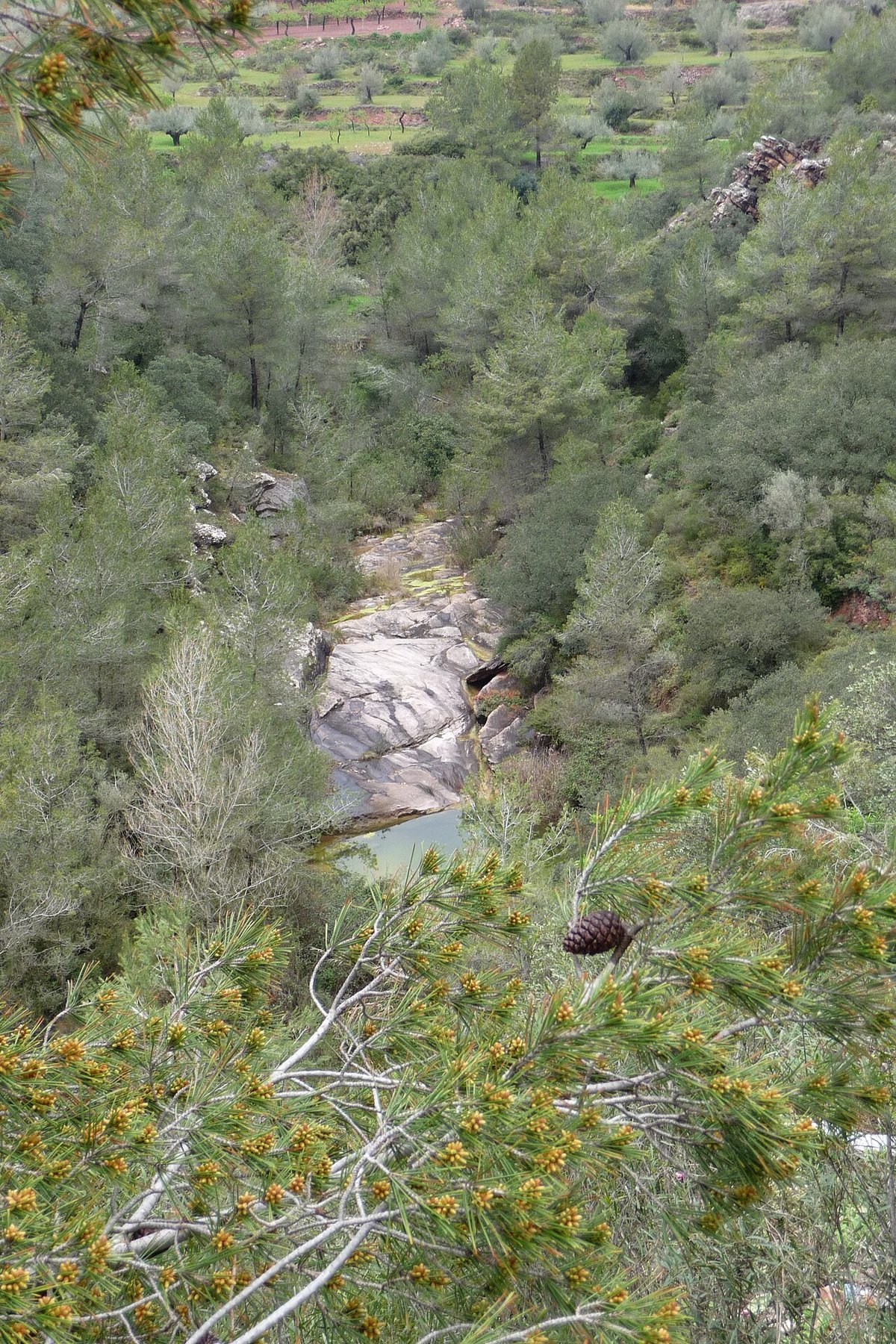
At the top are the remains of an old defensive tower. What makes the ascent worthwhile are the views across the Turia valley and the natural park that follows the course of the river. From here you can see how the river corridor cuts through the landscape, with cultivated land near the water and more rugged terrain beyond.
It is worth taking water, as there are no fountains along the way and shade is not constant during the climb. The route is straightforward rather than dramatic, and the hill is close enough to town to combine easily with a short visit to the centre.
Local tradition also places the bandit Santacruz in this area. He forms part of the popular storytelling of the region, although there is little firm evidence behind the tales. The name still circulates as a piece of oral history tied to these hills.
The Ermita de Luján
About two kilometres from the town centre stands the Ermita de la Virgen de Luján. Its background is unusual. In the late 1960s, several residents of Pedralba who had emigrated to Argentina returned with a replica of the Virgin of Luján, whose main shrine is in Buenos Aires. They built this hermitage to house the image.
You can reach the ermita on foot along a path that starts from the Barranco de la Pedrera. The walk takes roughly three quarters of an hour. The building itself is simple. It is not always open, as access depends on whether someone from the town comes to unlock it.
The story behind the hermitage speaks of migration and return, a pattern familiar in many Spanish rural communities during the twentieth century. Here it has left a visible mark in the landscape, linking Pedralba with Argentina through a shared devotion.
When to come and what to expect
Spring and autumn are the most comfortable seasons to visit. In summer the heat can be intense, and many streets offer limited shade. In winter the valley sometimes wakes under a layer of fog.
Sunday morning brings the weekly market and a livelier feel in the centre. Even so, Pedralba remains a quiet place. There is no beach and no large-scale attraction. You will not find destination restaurants; what you can expect are everyday bars serving set menus and catering to local routines.
This is a stop of a couple of hours. Step inside the church, wander along the acequia, sit briefly in the square. If you have the energy, make the climb to La Torreta for a view over the Turia valley. After that, continue your journey through Los Serranos or along the river. In a short time, you will have a clear sense of what Pedralba is about.