Full Article
about Titaguas
Mountain village, Starlight reserve, known for its Mojiganga
Hide article Read full article
Early Hours in the Old Streets
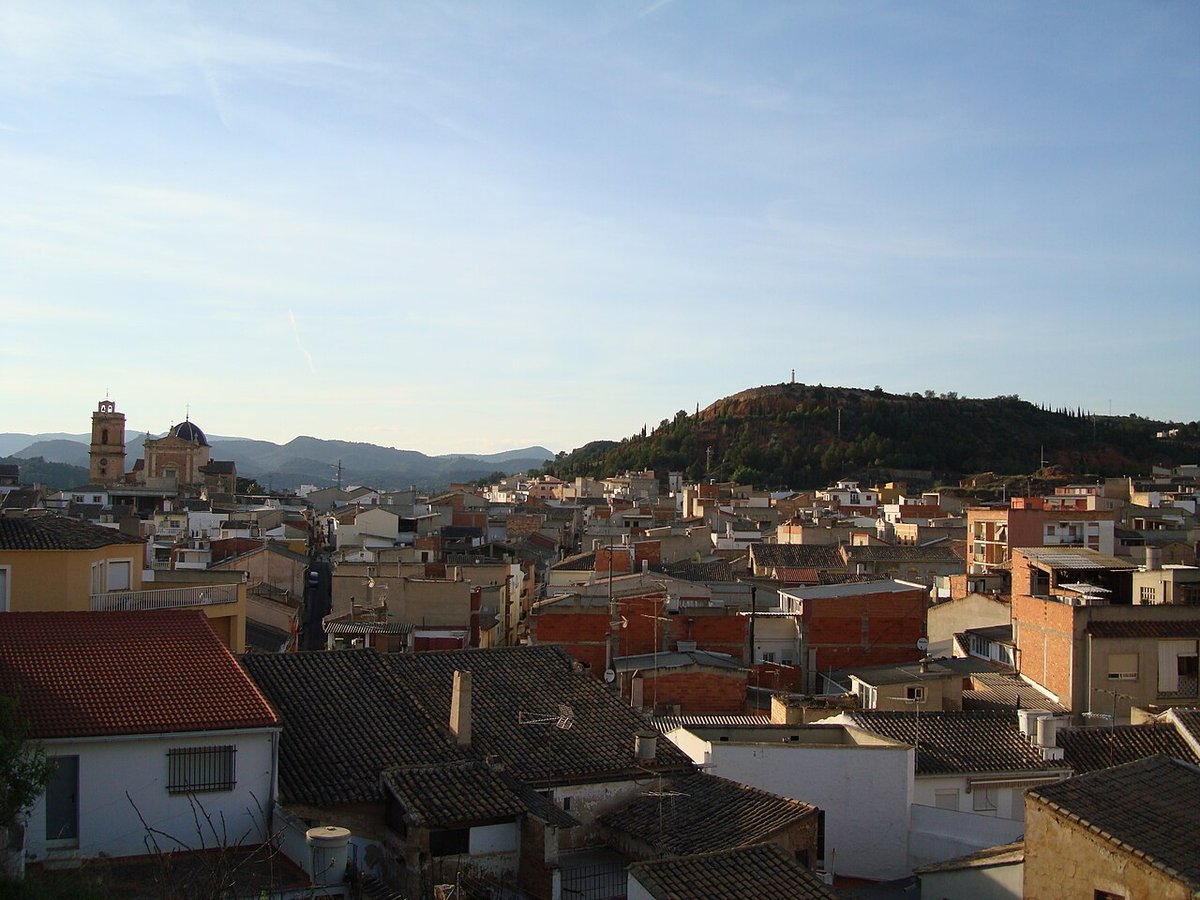
At that early hour on Calle Mayor, footsteps still echo. The stone holds on to the night’s chill and the rough, muted façades begin to pick up colour as the sun edges above the rooftops. Tourism in Titaguas often starts like this, with an unhurried walk through the centre while the village is still waking up and only a sparrow breaks the quiet from the overhead wires.
Up here the streets are narrow and sometimes tilt without warning. Old doors keep their worn knockers. Some windows have pots where rosemary dries in the sun. The historic centre is not large. It can be crossed in a matter of minutes. Even so, it rewards a slower pace, because the details sit at the edges: a low arch, a stretch of uneven stonework, a cool patch of shade where the air carries a faint scent of firewood.
There is no grand set piece demanding attention. The interest lies in textures and small shifts in light. As morning advances, the tones soften and the village feels more open, though the layout remains compact and easy to navigate on foot.
The Upper Quarter and San Bartolomé
From the main square, a cobbled slope climbs towards the parish church of San Bartolomé. The building was raised several centuries ago, probably in the 16th century, and it still defines the village skyline. Its tower acts as a reference point when moving through the surrounding streets.
By mid-morning the light falls sideways across the stone, bringing out its texture. Iron grilles cast thin shadows over pale walls. In the doorways there are small benches where people sit once the heat begins to ease later in the day.
The upper quarter feels slightly more exposed, with wider views over the roofs and the land beyond. Yet distances remain short. Within a few minutes the streets fold back into one another and the tower reappears between chimneys and tiled eaves, guiding the way without effort.
Terraces and Changing Seasons
Step beyond the last houses and the landscape shifts quickly. Terraced fields supported by dry stone walls spread out around the village. Some are still cultivated. Others have been gradually reclaimed by grass and low scrub.
In March the almond trees cut through the brown tones of the fields with their blossom. Autumn brings a more subdued palette, and the air carries the smell of dry leaves. Nearby pinewoods make their presence felt as well. When the wind blows towards the village, the resinous scent drifts in and mingles with chimney smoke in winter.
The setting changes with the seasons rather than through dramatic landmarks. Light moves across the terraces, revealing their geometry at certain hours and flattening it at others. The dry stone walls trace lines across the slopes, marking years of work that shaped the land into narrow platforms.
Walking here does not require long distances to notice these transitions. A short stroll from the centre is enough to leave behind the compact streets and enter open ground, where the horizon feels broader and the silence deepens.
The Path to Los Chorradores
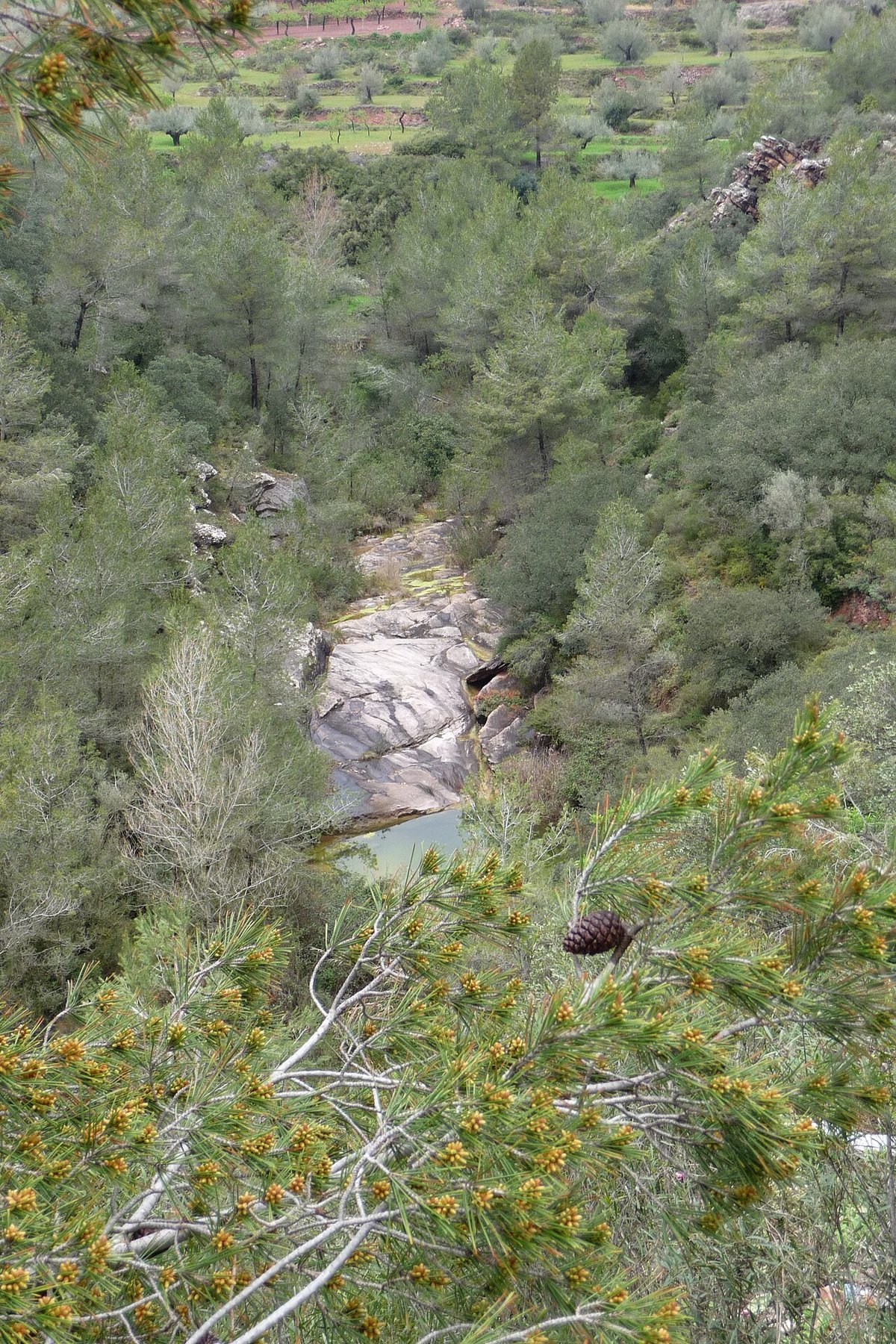
Behind the cemetery begins the path that leads to Los Chorradores. It is a clear trail running between pines and rocky stretches. There are no major climbs, although parts of the ground are uneven.
The waterfall appears at the end of the route, tucked between damp rock faces where moss and ferns grow. It usually carries more water after periods of rain. In summer the flow can drop considerably, which is typical in this part of Los Serranos, the inland comarca of the province of Valencia where Titaguas is located.
The walk itself alternates between shade and more exposed sections. When the sun is high, some stretches receive full light. Setting off early is sensible in hot weather. Even on warm days, the final approach feels cooler, with moisture in the air near the rock walls.
Los Chorradores is not presented as a vast cascade. Its appeal lies in the contrast between dry terrain and the sudden presence of water, especially after rain. The sound of falling water replaces the wind for a while, then fades again as the path retraces its steps towards the village.
Birds, Wind and Quiet
The surrounding hills seem still at first glance, but there is constant movement among the trees. Great tits and blue tits can be heard through much of the year in the pines. In clearings, other small species appear, searching for seeds or insects.
No specialist equipment is needed to notice this. It is enough to pause for a few minutes at the edge of the path. Once the faint noise of the village has dropped away, the most consistent sound is often the wind moving through the pine tops.
This quiet is part of daily life rather than a staged experience. The rhythm depends on weather and season. Some days carry more birdsong, others more wind. Either way, the sense of space remains close at hand, only a short distance from the last row of houses.
Local Produce on the Table
In Titaguas, products from the surrounding land continue to shape what appears on the table. Honey comes from hives scattered across the sierra. Embutidos, Spanish cured sausages and meats, are linked to the traditional winter pig slaughters that once took place when low temperatures helped preserve the food.
Olive oil remains the base of many simple dishes. Almonds and walnuts also feature, particularly when colder weather sets in. On the hardest winter days, hot soups and vegetable stews still hold their place in many homes.
These are foods tied to climate and terrain. The dry air, the terraces and the pine-covered slopes all form part of the same cycle that ends in the kitchen. Meals reflect practicality and season rather than elaborate preparation.
When to Visit and Getting Around
Spring and autumn are often the most comfortable times for walking in the surrounding countryside. Light shifts quickly across the terraces and the air keeps a degree of freshness.
Summer brings intense heat in the middle of the day. The sensible approach is to head out early or wait until late afternoon, when the slopes begin to turn golden and the village regains its movement.
Winter here is dry and can be deceptive. In the sun it feels pleasant. Once evening falls, temperatures drop quickly. Anyone planning to walk the paths or remain outdoors for a while will want an extra layer in a backpack.
Titaguas is small enough to explore on foot without complication. The centre can be covered in minutes, while the surrounding trails begin almost at the edge of the last houses. The experience is shaped less by distances and more by attention: to stone, to light, to wind in the pines.