Full Article
about La Vall d'Ebo
Remote valley known for the Cueva del Rull and its karst landscapes
Hide article Read full article
A village shaped by the mountains
At ten in the morning, light slips through the narrow openings of the church of the Asunción and draws pale lines across the floor. Outside, there is barely any traffic. A door opens somewhere along the street, footsteps tap against stone, a brief exchange drifts down from an upstairs window. La Vall d’Ebo moves at the pace of an inland village where the weight of the surrounding sierra matters more than the calendar.
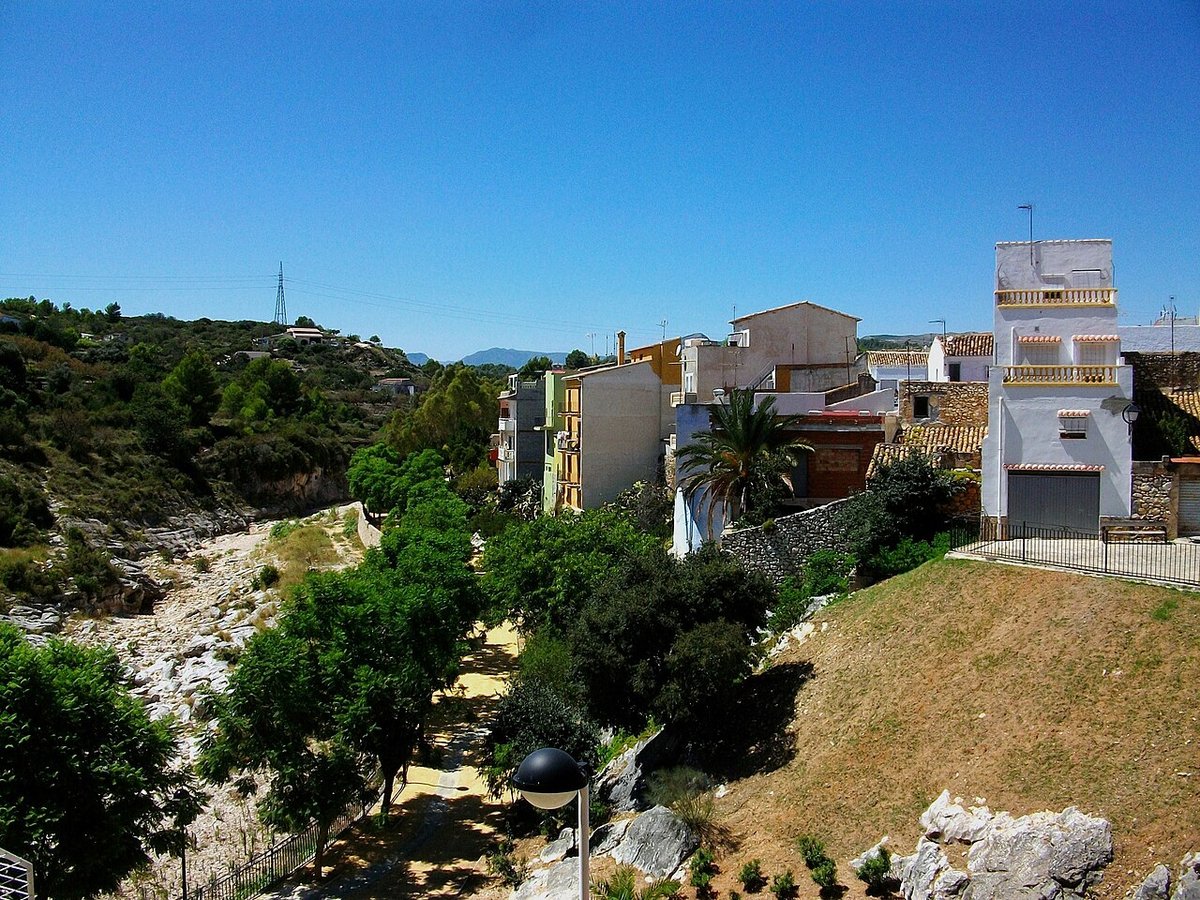
This small municipality of around 230 residents lies in the interior of the Marina Alta, in the province of Alicante, within the Comunidad Valenciana. It sits cupped between mountains at roughly 400 metres above sea level. The altitude is noticeable. The air feels drier than on the coast, and even when the Mediterranean towns are sweltering, nights here tend to cool down.
Around the compact centre, terraces step down the slopes, held in place by dry stone walls built without mortar. Many still support old olive trees, almond trees that turn the hillsides white at the end of winter, and the occasional carob tree casting dense shade over the reddish soil. Walking through the steep streets gives the sense that the village adapted itself to the gradient, rather than reshaping the land. Whitewashed houses, wooden doorways and the odd vine climbing a façade line the narrow lanes. The stone walls, many raised by hand generations ago, continue to trace the pattern of terraces that define the valley.
The heart of the village and the land beyond
Life in La Vall d’Ebo revolves around the parish church of the Asunción, built in the 16th century. It is a sober structure with thick walls, designed with practicality in mind rather than decoration. The square around it gathers what little daily movement there is: neighbours greeting one another, a car parked in the shade, the bells marking the hours.
Yet what truly defines La Vall d’Ebo lies beyond the urban centre. Step out along any of the streets that slope down towards the valley and the stepped terraces begin to unfold. Many are no longer cultivated, but the dry stone walls remain firm. In spring, grasses push up through the cracks, and the landscape becomes uneven and varied, a patchwork of different greens.
The Sierra de Ebo encircles the municipality, crossed by several marked paths. One of the best known routes in the area is the PR‑CV 151, which allows walkers to explore the surroundings without straying too far from the village. From certain higher points, the valley suddenly opens out. Rugged mountains, pine-covered slopes and, on very clear days, a distant strip where the Mediterranean can just be made out.
Along these paths, springs and old stone washhouses appear unexpectedly. For decades they were essential stops in the daily routine of the village. Today they remain as quiet pauses along the trail, accompanied by the steady sound of water falling into a basin.
In summer, it makes sense to begin walking early. The slopes receive direct sun, and heat clings to the stone for hours.
Walking the valley, reading the terrain
Hiking is the most natural way to experience this part of the inland Marina Alta. Footpaths cross former farmland, areas of young pine forest and patches of aromatic scrub. As the sun warms the ground, the scent of rosemary and thyme rises, mixing with the dry dust of the track.
Some routes link up with well known natural sites in the area, such as the Barranc de l’Infern. This ravine is popular with experienced hikers. It is not a short stroll, and the terrain can be demanding. Anyone considering the route should check conditions carefully beforehand and keep an eye on daylight hours.
Those who walk at a slower pace tend to notice the smaller details: dark stones polished smooth by the passage of water, the twisted trunks of old olive trees, the long shadows stretching across the terraces as afternoon turns towards evening.
There are also forest tracks used by some for mountain biking. The gradients are not gentle and the surface can be uneven, so it is not terrain for rushing.
When the landscape changes colour
At the end of winter and the beginning of spring, the almond trees come into blossom and the valley shifts in tone for a few weeks. The exact timing varies from year to year, depending on how cold the winter has been, but when it happens the pale flowers stand out against the darker slopes.
Autumn is generally calm, with milder temperatures and lower light that draws out the ochre shades of the hillsides. The air feels softer, and the mountains appear more textured in the angled sun.
Summer can be intense at midday. If visiting during the hotter months, the most sensible approach is to head out early, pause during the peak heat and resume walking when the sun begins to drop behind the sierra. Shade is limited in many stretches, and the sun, when it bears down here, does so without much cover.
A small place, best taken slowly
La Vall d’Ebo is compact. The urban centre can be covered quickly, and the real interest lies in its surroundings. It is worth allowing enough time to walk through the valley or to combine the visit with other villages in the interior of the Marina Alta.
The streets are steep, and the ground can be uneven in places. Comfortable footwear makes a difference, particularly if the visit continues along rural paths.
One simple detail: bring water from the start of any route. In the mountains, distances can be deceptive, and when the sun tightens its grip, there is often little shade to retreat to.
La Vall d’Ebo does not compete with the coastal resorts for attention. Its appeal lies elsewhere, in the dry air at dusk, in the geometry of stone terraces climbing the slopes, in the quiet that settles once the bells have finished ringing. It is a place shaped by effort and by terrain, best understood on foot, at a steady pace, with time to look at the ground as much as the horizon.