Full Article
about Benimantell
Village with spectacular views over the Guadalest valley; steep streets and mountain cuisine
Hide article Read full article
A Small Village Under Aitana
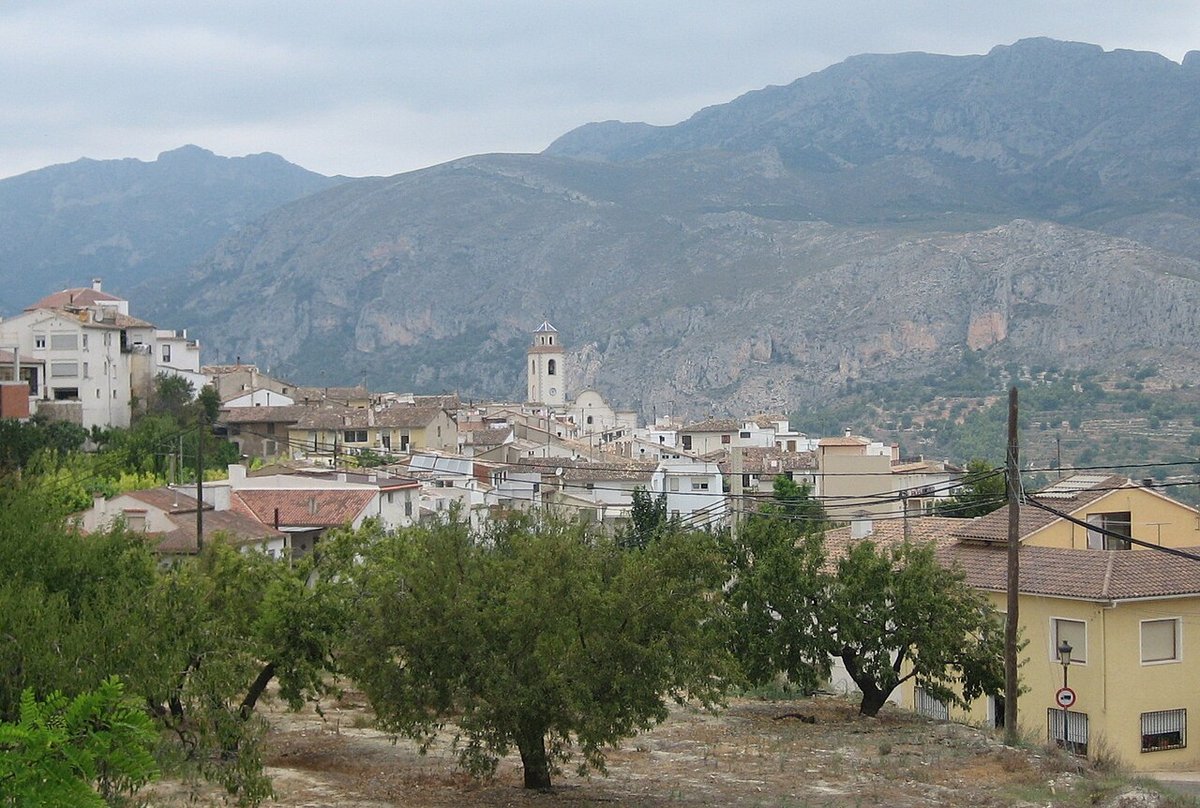
By the time the sun falls directly onto the square, the pale stone throws back an almost white light. Opposite the church of San Vicente Mártir, hardly anyone passes. A door opens, someone crosses slowly, and silence settles again. Tourism in Benimantell happens like this, without fuss.
This is a small village of just over five hundred residents, set on the slopes of the Sierra de Aitana at around 547 metres above sea level. The mountain is always present, even when it is out of sight behind the houses. It shapes the light, the air and the rhythm of daily life.
From the main square, the streets branch out in short curves. The ground is paved with uneven stone. Whitewashed façades line the way, with dark iron balconies above. By mid-morning, a conversation drifts from an open window and a shutter is lifted with a sharp knock. There is little traffic. In some stretches, a car barely fits, so it is often more practical to leave it at the entrance to the village and continue on foot.
The Square and the Church
The church of San Vicente Mártir sets the tone in the centre. It has undergone several renovations over time, something visible in its walls and proportions. It is not a large building. Inside, light filters through and creates areas of shadow that seem to lower voices naturally.
Around it lies the old quarter, organised in narrow streets with wooden doorways showing layers of older paint. The layout feels compact, built more for walking than for vehicles. Life revolves around the square, even if that life is quiet for much of the day.
Looking up between the houses, the Sierra de Aitana appears. Its peak reaches 1,558 metres and dominates the horizon across this part of the Marina Baixa, a comarca in the province of Alicante. The sense of height is constant. The village sits at the foot of something much larger.
Streets Facing the Sierra
At the edges of Benimantell, the land opens out into terraces of almond and olive trees. These bancales, stepped plots carved into the hillside, have shaped the landscape for generations. Towards the end of winter, when the almond trees blossom, the slopes fill with white and pale pink patches. Later, the colours shift back to the muted greens of Mediterranean scrub: scattered pines, low shrubs and pale rock.
At dawn, the mountain often appears bluish. In the afternoon, especially on clear days, its outline hardens and turns orange. The changes are gradual but noticeable, and they define the way the village looks at different hours.
Even when the sea is not visible, the light sometimes hints at it. From certain dirt tracks above the village, the landscape briefly opens and the Mediterranean can be glimpsed in the distance. Yet the overall feeling remains that of the interior, shaped by agriculture and mountain weather rather than by the coast.
Walking to Springs and Ravines
Several rural paths leave Benimantell and head into the sierra. Some are used daily by local residents moving between terraces or reaching small plots of land.
One of the better-known walks in the area leads to the Font del Molí. The route is straightforward, following rural tracks through low vegetation. The sound of water is heard before it comes into view, which is unusual in a mountain range where many springs are seasonal. The presence of flowing water here feels distinctive.
Climbing towards Aitana itself is another matter. The ascent is noticeable and it is advisable to carry water and set off early, particularly in the warmer months. In summer, the sun is strong and many sections offer little shade. The exposure becomes part of the experience, and the scale of the mountain is more evident with every step.
The ravines in the area attract people who practise canyoning, although this is not something seen every day in the village. They tend to be organised groups familiar with the terrain. Mountain biking also makes use of the dirt tracks, which rise and fall between abandoned terraces and small plots still under cultivation.
In autumn, when conditions are damp enough, some local residents head into nearby pine woods to look for wild mushrooms. It is a low-key activity, closely tied to knowledge of the land and the right places to search.
Food from the Mountain Interior
The cooking in Benimantell follows the traditions of an inland mountain village. When colder weather arrives, spoon dishes become common, filling and warming. The rice dishes here are more substantial than those found along the nearby coast.
Arroz con conejo y verduras, rice with rabbit and vegetables, appears frequently. There are also thick stews that make use of whatever the terraces and the season provide. Almonds play an important role in traditional baking, and many sweets are based on this ingredient.
These recipes are often prepared in private homes during festivals or family gatherings. The link between agriculture and the table remains clear, especially in a place where small-scale cultivation still shapes the surroundings.
Festivals and the Rhythm of the Year
At the end of January, Benimantell celebrates festivities dedicated to San Vicente Mártir. Given the size of the village, any event brings together a large part of the population in the square and nearby streets. The scale is modest, but participation is high.
In August, more summery celebrations take place, with music and evening activity. When the heat of the day subsides, people come out into the streets and the atmosphere shifts noticeably compared with the rest of the year.
Holy Week is marked by slow processions through the old quarter. In September, during festivities linked to the Virgen del Rosario, the custom of blessing nearby fields and orchards continues. It is a reminder of how closely the village’s life has always depended on the land.
For those looking to walk and take in the sierra at an unhurried pace, spring and early autumn are usually the most pleasant times. In high summer, the heat presses down during the middle of the day and many paths lie exposed to the sun. Here, the landscape is best appreciated early on, when the air still carries a trace of coolness drifting down from Aitana.