Full Article
about Alginet
Major farming hub with Art Nouveau buildings and a traditional market.
Hide article Read full article
Where the Day Begins with Scent
At six in the evening, as the sun drops and the shadows of orange trees stretch across turned soil, Alginet begins with a smell: orange blossom mixed with warm earth. An older man waters his smallholding with a hose, the stream hitting the ground heavily and lifting a fine mist of dust that carries hints of manure and freshly cut leaves. He glances over and, without stopping, says in Valencian: “If you’ve come to see flowers, you’re late. The oranges are still green.”
This sets the tone. Alginet does not present itself all at once.
A Landscape That Lives Outside the Streets
There is no postcard-style old quarter here. The town spreads out flat and wide, with low houses and whitewashed façades that crack gradually under years of sun. What matters lies beyond the buildings: market gardens, irrigation channels, and neat rectangular plots of orange trees that shift colour with the seasons.
Life still follows the rhythm of the land. In March, when artichokes are at their best, people bend over the rows, cutting them with knives that have been sharpened so many times the blades are thin. Early mornings are cold enough to leave fingers numb and purple. Some work in rubber boots because the dew soaks through the soil.
Around the town, agricultural tracks stretch between the fields. Locals use them for walking or cycling, though they are not formal tourist routes. They are simply dirt paths, edged by irrigation ditches, where a tractor might pass slowly now and then. After rain, the mud clings to your shoes and forces a slower pace. In return, the quiet feels clean: birds, the distant hum of a small motorised cultivator, and church bells marking the hour from somewhere behind you.
Food That Follows the Calendar
Cooking here remains tied to the seasons. It is not presented as gastronomy. It is simply what appears on the table depending on the month.
In January, around the feast of San Antonio Abad, the streets fill with animals brought for blessing—dogs, horses, and the occasional patient donkey. The air often smells of burning rosemary and meat cooking on a grill. One of the dishes prepared at this time is olla de cardet, a thick stew made with white cardoon that simmers for hours. It carries a slightly bitter note that lingers on the tongue.
When orange and artichoke season arrives, usually in spring, an agricultural fair often fills the main square. There are stalls, freshly squeezed juice, and piles of artichokes still carrying traces of soil on their stems. An older woman once explained that the best ones sound hollow when tapped with a finger. Whether that is science or habit is unclear, but it is still repeated.
Sunday arroz al horno does not come with ceremony. It is cooked in a clay dish, with pork belly and blood sausage, roasted until it sticks slightly to the bottom. A window stands open, and somewhere in the background a television is on.
Places That Remain
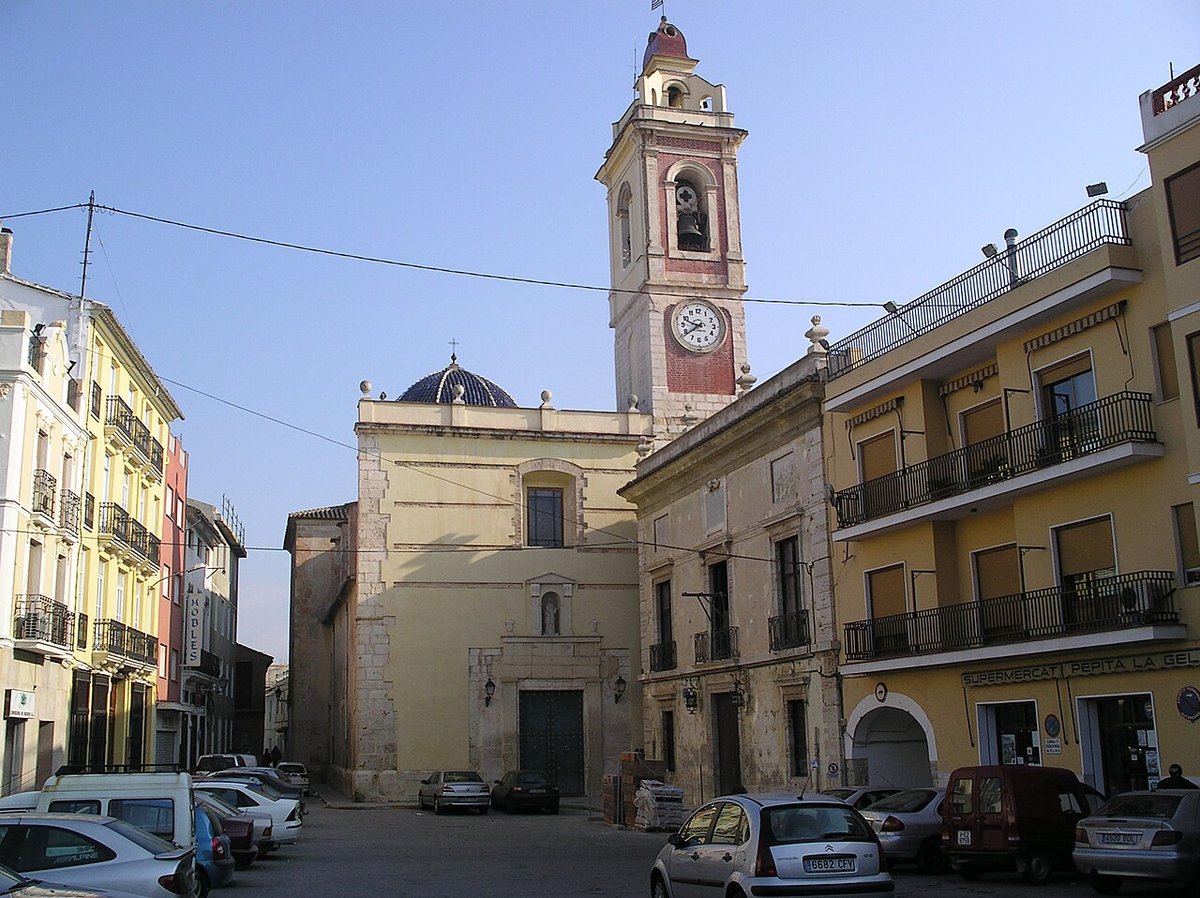
The church of San Lorenzo is one of the quieter points in the centre. Its exposed brick bell tower can be seen from several streets away. Inside, the smell is familiar: wax, old wood and cool stone. Mass is still held in Valencian, and on Sundays, people linger under the porch afterwards, chatting with their hands clasped behind their backs.
The so-called Castillo de Cabanilles is not exactly a castle. It is closer to an old manor house with decorative towers, now used for cultural purposes. From the outside it appears austere, but in the mornings, when classes take place, notes from a clarinet or trumpet drift out through open windows.
At the Museo Valenciano de Historia Natural—a small space that usually opens on some weekends—fossils found in local clay pits are kept on display. One trilobite, dark and remarkably well preserved, resembles a stone cockroach. A man in the room once shone a torch on it and said, in Valencian, “This creature had calcite eyes.”
When to Arrive
Alginet does not revolve around tourism. There is no historic centre designed for crowds. What stands out tends to happen within everyday rhythms: children leaving school at midday, shutters rising after the afternoon break.
In August, during the Moros y Cristianos festivities, the atmosphere shifts completely. There are parades and firecrackers; streets stay busy late into the night. The town smells more of gunpowder than orange blossom then.
Visiting from late winter into spring gives a clearer sense of how this place works. Closed shoes are useful—the soil is often damp and artichokes can prick if handled carelessly. And if you come in January and see a horse walk into a church for its blessing during San Antonio, it’s not a spectacle. Here it’s just something that happens