Full Article
about Alzira
Capital of the Ribera Alta with a walled historic center and the natural area of La Murta
Hide article Read full article
In the 11th century, the Andalusi poet Ibn Jafaya described the market gardens of Alzira as “a garden floating between two waters”. The image still makes sense. The city stands on a meander of the Xúquer and for centuries it was, quite literally, an island, hence its Arabic name, al‑Yazira. Over time the river was channelled and the territory reshaped, yet the agricultural landscape continues to define the place: fertile huerta, irrigation channels and orange groves spreading across the Ribera Alta.
Alzira does not reveal its history at first glance. Twentieth‑century expansion left straight streets, brick apartment blocks and functional avenues. Beneath that layer, fragments of the old Islamic medina and the medieval Christian city that followed still surface, sometimes in unexpected ways.
A Wall Among Modern Buildings
Right in the urban centre, surrounded by relatively recent constructions, stands one of the most visible remains of the former Islamic fortification. It is a long stretch of wall, often said to preserve more than two hundred metres, built between the 11th and 12th centuries to protect the medina.
This is not a monumental rampart. The construction is simple, using stone and rammed earth, with irregular battlements and defensive elements that can still be recognised. What makes it striking is its setting. The wall came to light during urban works in the 1970s and, rather than being removed, it was integrated into the new public space.
Today it forms part of everyday life in the centre. There are benches and trees, and people pass by or sit nearby without paying it much attention. History here survives almost by accident, woven into the routine of the city.
The Murta Valley and Its Monastery
A few kilometres from the town centre, the landscape shifts. The Murta valley opens between the mountains of the Sierra de Corbera, creating a natural enclosure that explains why it attracted a monastic community.
At the bottom of the valley stands the Jerónimos monastery of Santa María de la Murta. Its origins lie in the Late Middle Ages, when the Order of San Jerónimo settled here and gradually expanded the complex over the following centuries. From that period remain the dovecote tower, parts of the cloister, the church and several agricultural dependencies.
Not everything has survived intact. After the 19th‑century confiscations, when many ecclesiastical properties in Spain were secularised and sold, the monastery was put to very different uses and suffered considerable deterioration. Even so, artistic elements and decorative remains are still visible inside, recalling the importance the monastery once held in the Ribera.
Local tradition links the name of the valley to myrtle bushes, murta in Valencian, among which a Marian image is said to have appeared. Whether legend or not, the story sits comfortably in a place where landscape and spirituality have long been intertwined.
Beyond the buildings themselves, the setting is part of the appeal. Simple footpaths run through the valley and climb towards viewpoints that clarify the geography of the area. From these higher points, the transition becomes clear: the cultivated plain of the Xúquer gives way to the mountain ranges that enclose the comarca.
Santa Catalina and the Memory of the Main Church
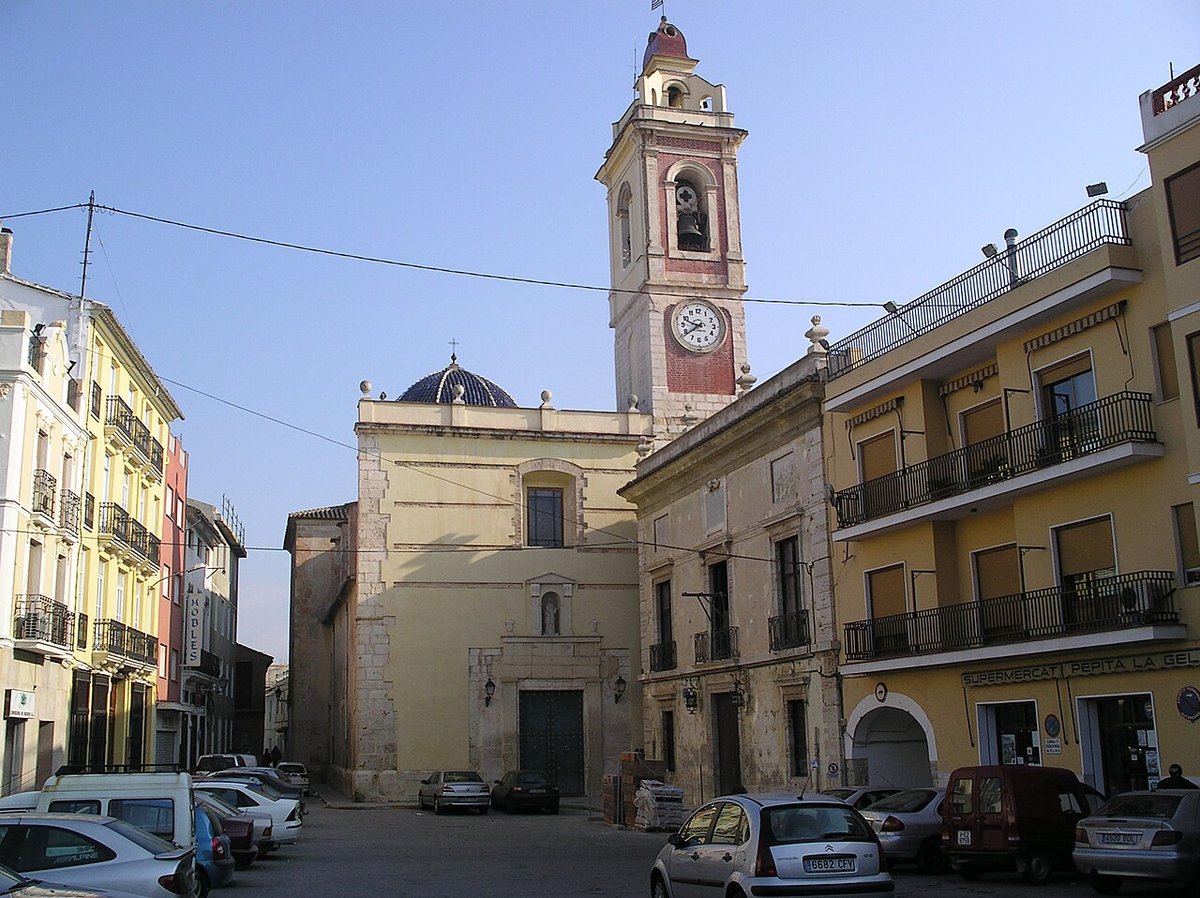
The Plaza Mayor concentrates two of Alzira’s most significant buildings: the Renaissance town hall and the church of Santa Catalina. The church was built after the Christian conquest in the 13th century on the site of the medina’s main mosque, a common transformation in the territories incorporated into the Crown of Aragon.
The bell tower draws attention because it preserves features reminiscent of an earlier minaret. It is not an isolated example in the Valencian territory, yet here it offers a clear illustration of how religious spaces were adapted after the shift in power.
Behind Santa Catalina lies a less visible chapter of the city’s history. The church of Santa María once stood there, considered for centuries the main church of Alzira. It was a medieval temple that grew over time through successive enlargements. By the mid‑20th century, however, its structural condition led to a decision that would permanently alter the historic landscape: demolition.
Some remains of the complex were preserved, above all the apse, and today they form a small open‑air archaeological space. Old photographs of the demolition still circulate in the city and often spark conversation among residents. It is remembered as one of those moments when the urban planning of the period reshaped heritage in an irreversible way.
The Bridge and the River
For centuries the Xúquer dictated daily life in Alzira. Periodic flooding could isolate the city and repeatedly forced the reconstruction of bridges.
The current Puente de Hierro, built at the beginning of the 20th century, replaced earlier structures that were far more vulnerable to floods. Its metal framework, inspired by the railway engineering of the time, marked a significant change. It provided a more stable crossing between the two banks and improved connections with the rest of the comarca.
From the middle of the bridge, the local geography becomes easy to read. On one side lies the historic city. On the other stretches the agricultural plain of the Ribera. To the west, the mountain ranges begin to rise towards the valleys of the Murta and the Casella, framing the territory that has shaped Alzira’s history.
Food from the Huerta
The cooking of Alzira belongs to the Ribera. It is straightforward and closely tied to the market gardens and the river. Many dishes continue to be prepared in homes rather than appearing as formal specialities, rooted in local produce and seasonal rhythms.
The presence of the huerta and the Xúquer has traditionally defined what arrives at the table. Recipes reflect that connection to cultivated land and freshwater, maintaining a culinary identity that mirrors the surrounding landscape.
In the end, Alzira is best understood through these layers: an island that is no longer an island, Islamic walls standing among modern buildings, a monastery set in a secluded valley, churches that carry the memory of earlier faiths, and a river that has both threatened and sustained the city. The garden between two waters remains, even if its outlines have changed.