Full Article
about Villanueva de Castellón (Castelló)
Commercial and farming town with a traditional market and Moors and Christians fiestas.
Hide article Read full article
Where the River Shapes the Land
Tourism in Castelló, in the Ribera Alta of the Comunidad Valenciana, begins with geography. The town stands on the alluvial plain of the Xúquer River, one of the most fertile agricultural areas in inland Valencia. This is a landscape formed by water and cultivation, where irrigation channels, market gardens and rural tracks define both the view and the rhythm of daily life.
Castelló developed among acequias, the traditional irrigation canals that distribute river water across the plain, and along paths linking scattered alquerías, rural farmsteads typical of this part of eastern Spain. For centuries the local economy revolved around farming. Cereals and mulberry trees were once central crops, later replaced in large part by orange groves. The irrigation network has always structured the territory, shaping fields and determining how the land could be used.
The name Castelló comes from the old castle that once dominated the area. That small fortified enclosure controlled movement through the river valley, a strategic point between Xàtiva and the plain that opens towards València. Although only remains survive today, the memory of the castle endures in the place name itself. Over time, the settlement grew at the foot of that hill, gradually organising itself into the town seen today.
Streets Built for Work
The layout of the historic centre reflects practical growth closely tied to agricultural labour. Streets are relatively straight, houses generally rise to two storeys, and many properties include back patios that were long used to store tools or keep animals. The architecture speaks of function rather than display.
Even now, the transition from town to countryside is immediate. A short walk from the last row of houses brings rural tracks and citrus plots into view. There is little sense of separation between urban space and farmland. The orchards begin almost where the pavements end, reinforcing the idea that Castelló is inseparable from its surrounding huerta, the irrigated market garden landscape characteristic of this region.
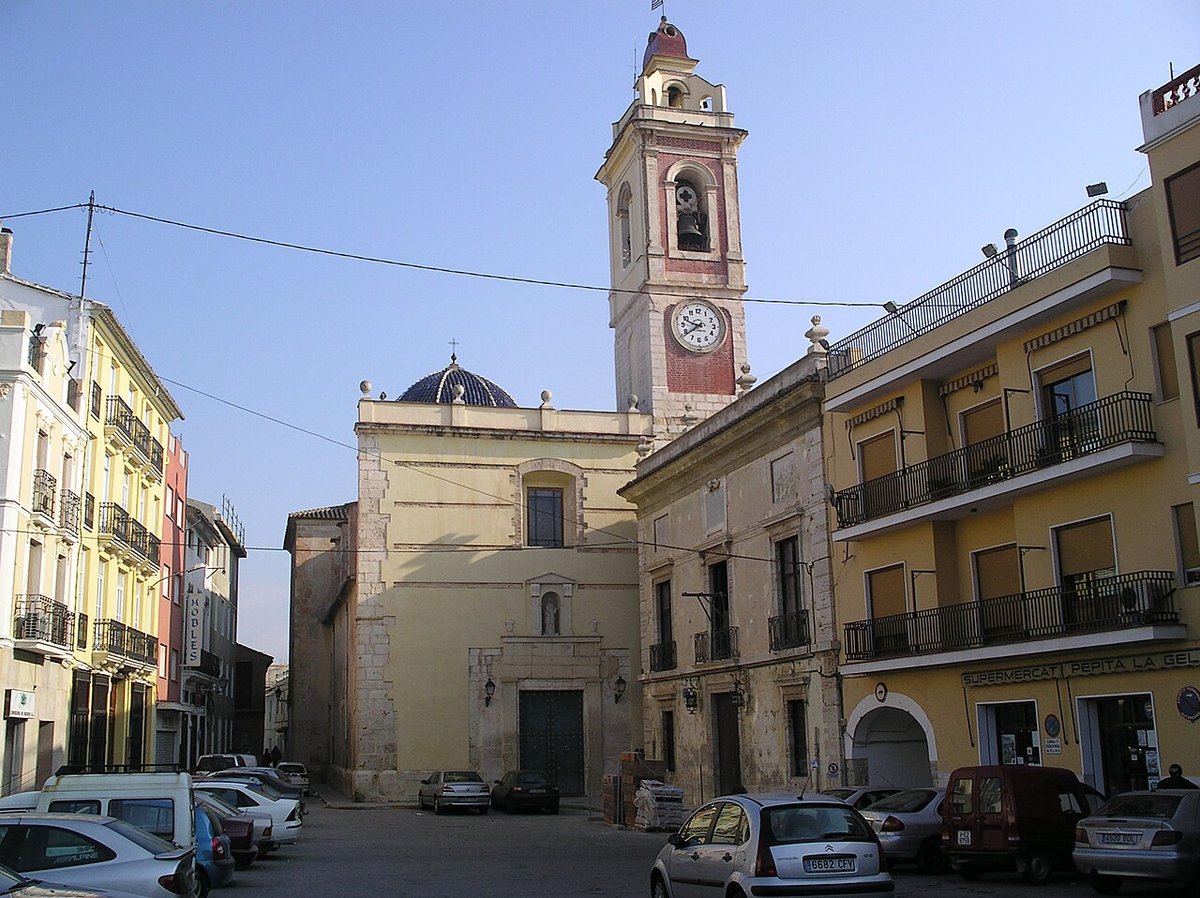
At the centre of the municipality stands the parish church. The current building is the result of successive reforms carried out over the centuries. This pattern is common in the Ribera, where many churches were expanded between the eighteenth and nineteenth centuries as populations increased. More than its size, what stands out is its role in everyday life. The square around it remains one of the main meeting points in town, a social space that continues to anchor local routines.
The Hill and the Castle’s Memory
A small hill overlooking Castelló holds the remains of the castle that gave the town its name. It is not a monumental fortress, but a modest enclosure that once formed part of the defensive network controlling the Xúquer valley in medieval times. Its importance lay in position rather than scale.
From the top, the reason for that choice becomes clear. The view extends across much of the Ribera plain, offering a wide perspective over fields and waterways. The river corridor between Xàtiva and the direction of València could be observed from here, which explains its strategic value in earlier centuries.
The walk up to the castle area is short and straightforward. It also provides a way to read the landscape in context. The patchwork of cultivated plots, the acequias cutting across the huerta and the agricultural tracks linking one field to another illustrate how this comarca, or county, has functioned historically. The system is visible without the need for interpretation panels. The organisation of land and water tells the story on its own.
A Town Marked by the Xúquer
Although the urban centre does not sit directly on the riverbank, the Xúquer has always shaped life in Castelló. Floods have left their mark on the collective memory of the Ribera Alta and influenced how people built their houses and managed their crops. The relationship with the river has been both productive and cautious.
In the orchards closer to the river, citrus trees often alternate with other seasonal crops. This flexibility reflects a long tradition of adapting to water levels and soil conditions. The agricultural landscape remains active and recognisable, rooted in established practices rather than large-scale transformation.
Along the paths that follow the acequias, it is common to see residents walking or cycling in the late afternoon. The setting is not monumental, yet it is highly representative of traditional Valencian agriculture. The irrigation channels, the geometry of the fields and the steady presence of orange groves form a coherent scene that explains the town’s origins and continuity.
Exploring Castelló at an Unhurried Pace
Castelló’s centre can be covered easily and without steep slopes. Distances are short and the overall scale is manageable on foot. The greater interest, however, lies just beyond the urban streets. The orchard tracks leading out from the town offer a clearer understanding of how closely linked Castelló is to its territory.
Walking these rural paths reveals the immediate dialogue between settlement and cultivation. Houses give way to fields within minutes, and the pattern of acequias becomes increasingly evident. The experience is less about individual monuments and more about observing how a community has organised its environment over centuries.
Castelló has a railway station on the line connecting València with Xàtiva, making it accessible without a car. For those arriving by road, it is usual to leave the vehicle in a quiet street and continue on foot. The pace here is slow, and there is little need for anything else. The town’s scale, its agricultural setting and the presence of the Xúquer combine to create a place best understood by walking and looking carefully at the land that sustains it.