Full Article
about L'Alcúdia
Major farming and trading hub with archaeological remains and a lively cultural scene
Hide article Read full article
A Village That Moves at Its Own Pace
L'Alcúdia is the sort of place that does not immediately push itself forward. You arrive and slowly realise there is more going on than first meets the eye, but nobody is in a rush to point it out. Tourism here does not revolve around grand monuments or dramatic viewpoints. Instead, it is a working town in the Ribera Alta, about half an hour from Valencia by train, with around 12,000 residents living among orange groves and the fertile plain of the River Xúquer.
Life follows an unhurried rhythm. Mornings belong to the fields, afternoons to the town square, and conversations have a habit of lasting longer than planned. For anyone curious about everyday life in this part of the Comunidad Valenciana, that rhythm is the real draw.
The “Millenary” Olive Tree and a Local Joke
One of the first places locals may show you is the so called Olivo Milenario. Ask about it and you are likely to hear the story delivered with a half smile. The tree was planted in 1993, on the day of San Andrés. It is not two thousand years old.
The shared joke is that everyone calls it “bimillennial”. The name has stuck, even though its origins are recent. It reflects the dry, understated humour common in many towns across the Ribera. Everyone knows the truth, and that is precisely the point.
The walk to the tree is part of the appeal. From Montortal, a small district linked to L'Alcúdia, a path of around two kilometres runs through orange groves. In spring the scent of orange blossom hangs in the air, and the route slips by almost without notice. At the end there is no grand monument, just a large olive tree and enough shade to pause for a while. The pleasure lies in the walk itself, between neat rows of trees and cultivated land.
San Andrés and the Paintings of Vergara
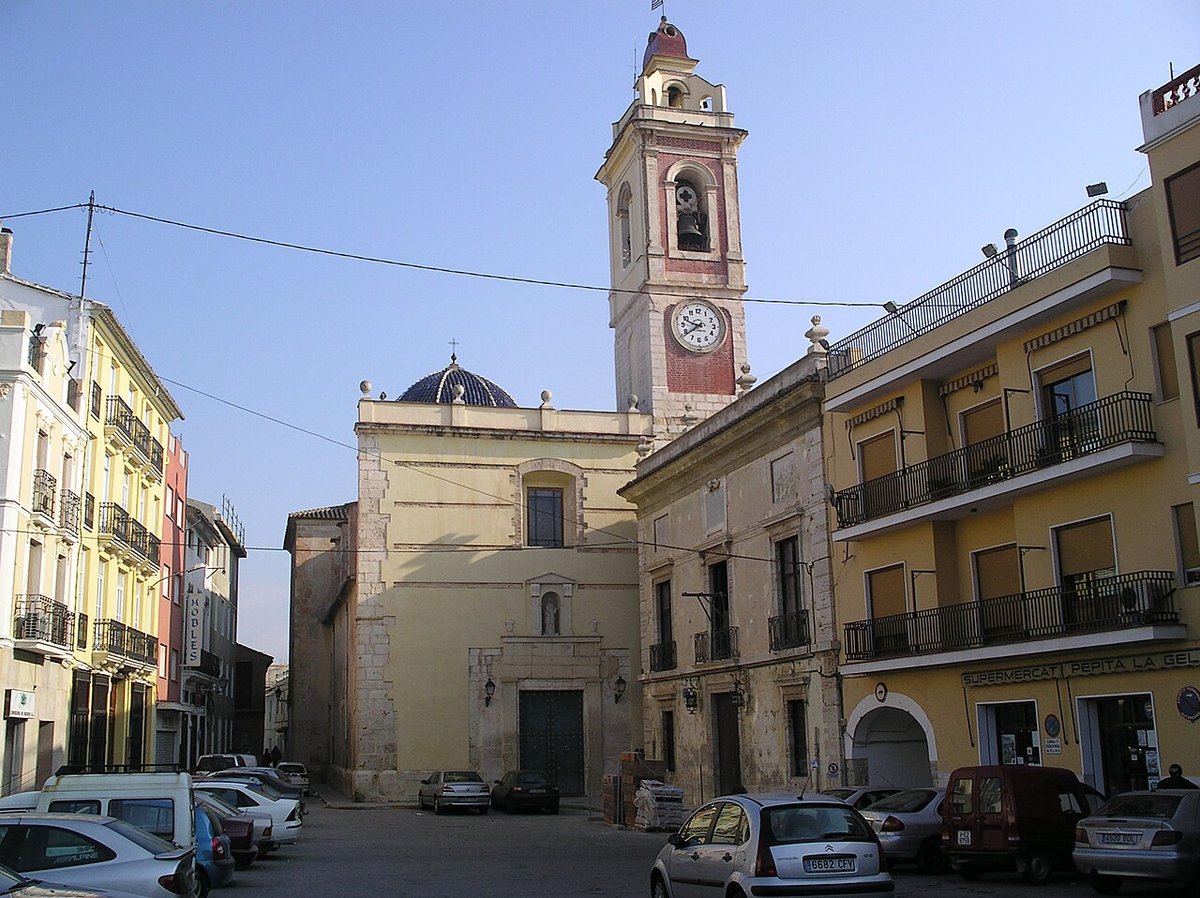
The Iglesia de San Andrés began construction in the eighteenth century, with work continuing over several decades. From the outside it appears sober, in keeping with many Valencian churches of the period. Step inside and the atmosphere shifts.
The interior murals are attributed to Josep Vergara, one of the notable Valencian painters of the eighteenth century. Here he created an extensive set of paintings that cover much of the church’s interior. No specialist knowledge is required to appreciate the effect. The walls are animated with scenes and colour, transforming what might seem restrained from the outside into a far richer space within.
During the summer months, the church also offers something practical: a cool interior that provides relief from the heat. Even a short visit can feel like a welcome pause in the middle of the day.
At the Table: Cooking from the Fields
Food in L'Alcúdia leans heavily on local tradition. Some dish names may sound unfamiliar if you are not from the area, but they make sense once you sit down to eat.
Coca de mollitas is a good example. It consists of a base topped with breadcrumbs mixed with garlic and paprika. On paper it may not sound particularly striking, yet tasting it makes clear why it has endured. It is simple, rooted in ingredients that would have been readily available, and closely tied to home cooking.
Another traditional dish is olla con tagarninas, a stew made with this wild thistle that was traditionally gathered from the fields. It is the kind of meal associated with colder months, appearing when temperatures drop and heartier food is welcome.
Then there is rice. In this part of the Ribera, a common version includes rabbit and snails. This is not the kind of rice dish often seen along seafront promenades. Here, snails are a serious ingredient, not a decorative extra. The flavours reflect the surrounding farmland rather than the coast.
If your visit coincides with local celebrations or communal meals, you may see long tables and large cooking pots set out for everyone. It is perfectly normal to find yourself in conversation with people you did not know ten minutes earlier. Sharing food is part of how the town relates to itself and to visitors.
Along the Séquia Real and the Riu Magre
The landscape around L'Alcúdia is defined by the huerta of the Ribera, irrigated farmland shaped over centuries. It is not dramatic in a postcard sense, yet it is well suited to slow exploration.
One of the easiest routes for walking or cycling follows the Séquia Real del Xúquer. This historic irrigation canal runs between fields and links nearby towns. The terrain is almost entirely flat, so no particular cycling experience is required. The appeal lies in steady movement through cultivated land, with water quietly accompanying the path.
There are also routes along the Riu Magre, as well as agricultural tracks used by local residents for walking or running. In winter some sections can be muddy, depending on the weather. In spring the area turns especially green, and the scent of freshly worked earth carries across the fields. It is a landscape that rewards patience rather than speed.
When to Go
September is usually the liveliest month, thanks to the patron saint festivities dedicated to the Virgen del Oreto. During this period the town fills with activity, and the atmosphere shifts noticeably compared with the rest of the year.
For a calmer visit, May is often a good choice. The weather is generally agreeable, and the surrounding fields are in one of the most attractive phases of the agricultural cycle.
In November, close to the feast of San Andrés, the mood becomes quieter still. There may be fewer people in the streets, but daily life continues as usual: the weekly market, bars that fill up at certain hours, neighbours stopping to chat on street corners. The seasonal changes alter the volume, not the underlying rhythm.
The Point of It All
L'Alcúdia is not a place that leaves you open mouthed within five minutes. There is no castle perched on a rocky outcrop, no monumental square designed for dramatic photographs.
What you find instead is a town that functions much as it always has: agriculture in the surrounding fields, a weekly market, terraces where people know one another by name. For anyone interested in seeing how daily life unfolds in the Ribera Alta, spending a morning among the huerta and ending with a good meal, it makes sense.
Sit for a while at a terrace near the station or the main square and the pace becomes clear. No explanation is required. The conversations, the comings and goings, and the steady backdrop of the fields say enough on their own.