Full Article
about Albalat de la Ribera
A town on the Júcar River, ringed by rice and citrus fields, typical of la Ribera.
Hide article Read full article
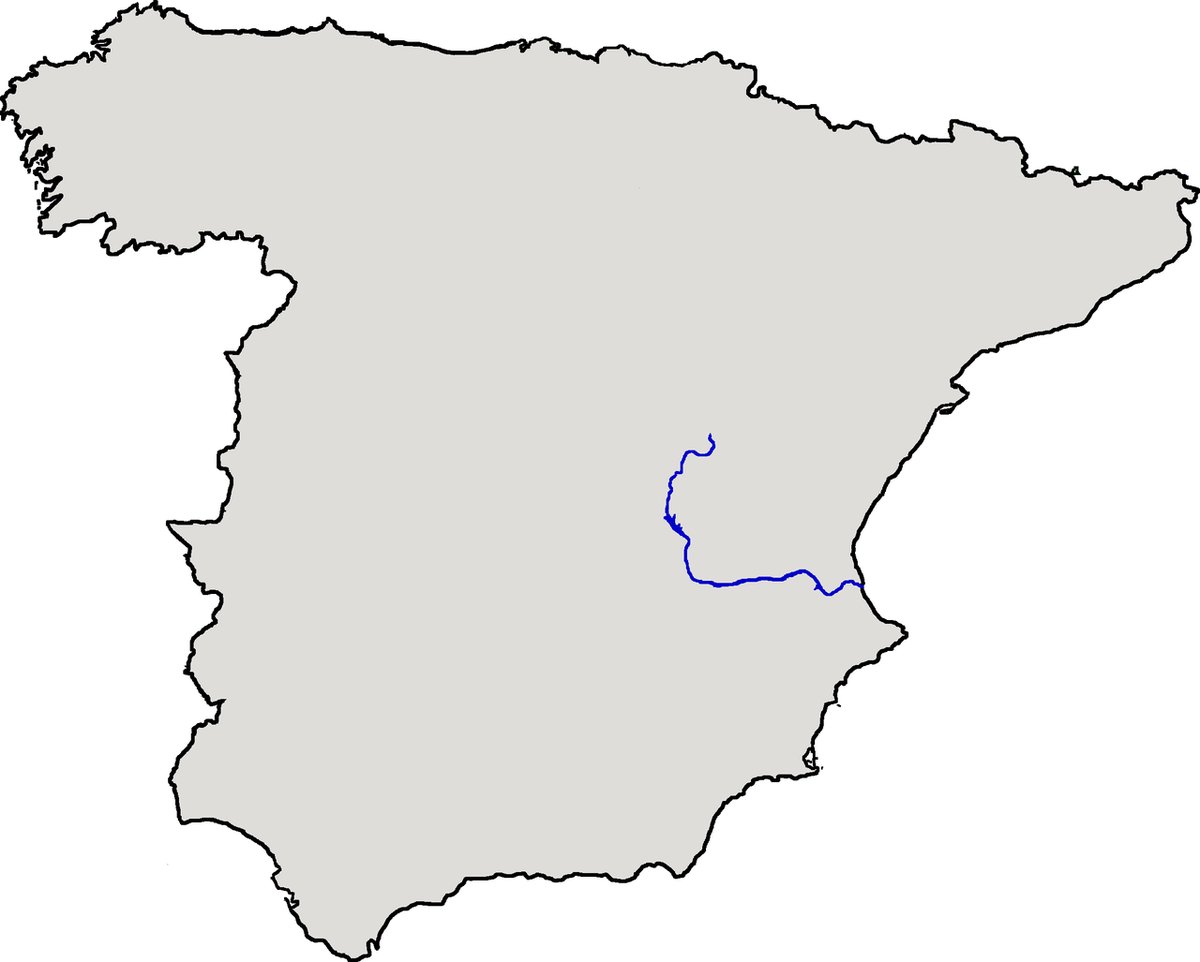
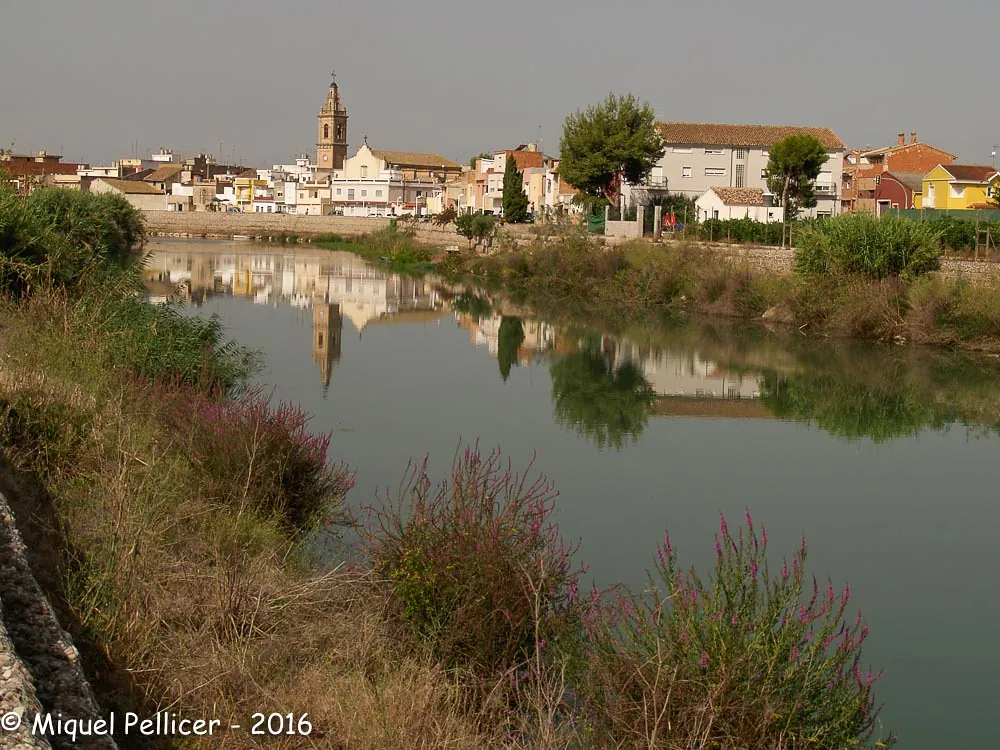
The river Xúquer makes an almost complete turn here, curving around itself in a wide meander. On that bend, Albalat de la Ribera has stood since the Middle Ages. Orange groves reach almost to the edge of the houses, while to the east rice fields stretch across a very flat plain that gradually connects with the landscape around the Albufera lagoon.
The shape of the land explains much about the town. Albalat de la Ribera is an agricultural settlement set on the edge of fertile lowlands, crossed for centuries by routes linking Valencia with the southern part of the former kingdom. Its position, between river and cultivated plain, has always defined both its economy and its role in the territory.
The Road That Remained
The Arabic name, al-balat, means “the road” or “the paved way”. It is usually interpreted as a reference to an important route. Albalat controlled a crossing point between the huerta of Valencia, the irrigated market gardens surrounding the city, and the area of Xàtiva. That function helps explain its origins.
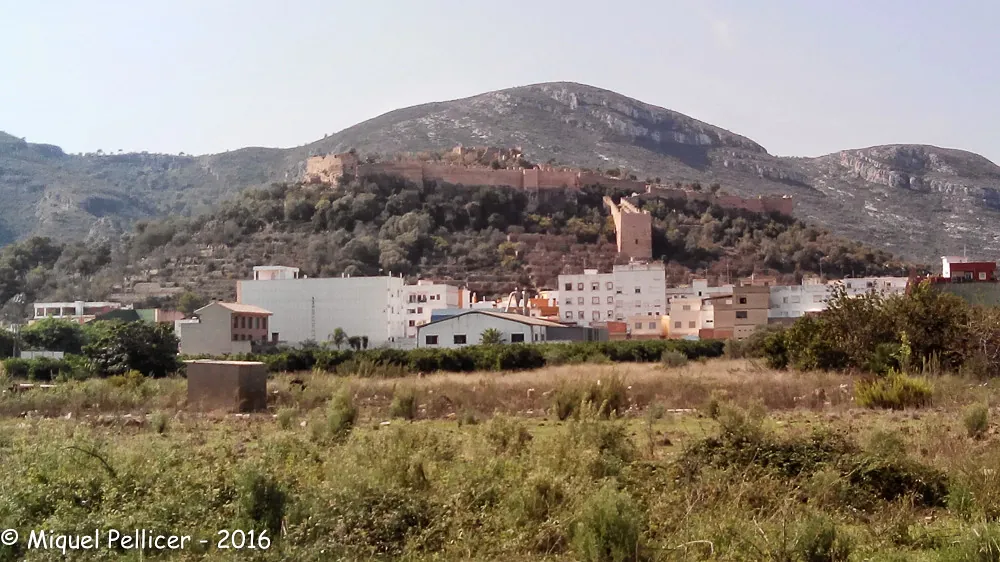
The oldest part of the settlement leans against the small hill known as the Torreta. Archaeological remains of ancient occupation have been documented there, probably Iberian at first and later Roman. From this slight elevation it was possible to oversee the river ford and the entrance to the vega, the fertile riverside plain.
When James I incorporated the area into the new Christian kingdom in the mid-13th century, the former alquería, a rural Islamic settlement, was redistributed according to a strategy that combined repopulation with territorial control. Seigneurial grants from those years included the obligation to settle and defend the place. Medieval documents record exchanges of castles, lands and rights, which indicate that this stretch of the Xúquer continued to hold strategic interest long after the conquest.
Three Buildings That Explain the Town
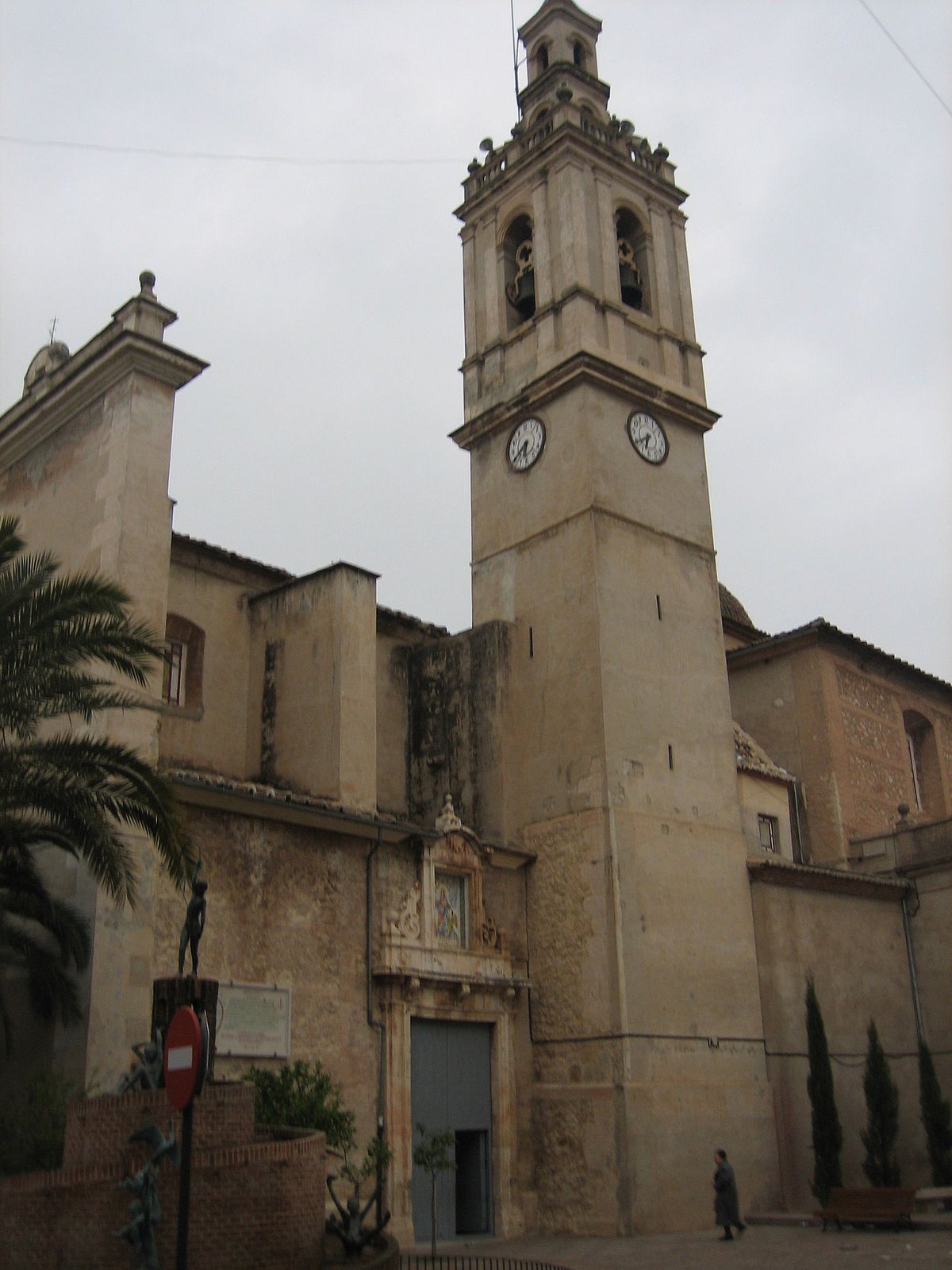
The parish church of San Pedro Apóstol dates from the 18th century and follows a model common in Valencian churches of that period. It has a Latin cross plan and a dome on pendentives over the crossing. The exterior is restrained in appearance. Around part of the building runs a base of Valencian ceramic tiles. This detail had a practical purpose, protecting the walls from damp, while also reflecting moments of agricultural prosperity linked first to rice and later to orange cultivation.
The main altarpiece is later in date and neoclassical in style. More revealing than its decoration is the overall organisation of the building. The sacristy opens directly onto the presbytery, a frequent solution in parishes where the daily life of the clergy was closely tied to the church itself.
A short distance from the centre stands the hermitage of San Roque and San Sebastián. The building is simple in form: three square bays covered with a Valencian vault and a slightly raised presbytery with a barrel vault. Construction is usually placed around 1760, at a time when devotion to San Roque was reinforced in many towns after episodes of epidemics. The hermitage sits at the edge of the urban area, in the transition between the last houses and the fields, marking a clear boundary between settlement and cultivated land.
The Casa del Bou, from the late 18th century, is one of the best preserved traditional houses in the town. It remains inhabited, so it can only be viewed from the street. The façade shows features typical of the home of a relatively prosperous farmer: storage space on the ground floor, the main living quarters above, and an upper gallery open to the courtyard. Parts of the interior structure still recall activities that have now disappeared, such as the breeding of silkworms, once an important supplementary rural activity in many parts of the region.
The Meander That Shapes Everything
A walk through the vega clarifies why the town stands where it does. The Xúquer traces a broad meander here, enclosing low, fertile land. The rice fields begin to flood in late spring and transform the landscape throughout the summer. When the water recedes at the start of autumn, birds once again gather around the ullals, small springs that emerge at the foot of slightly higher ground.
The so-called Ruta dels Ullals is not always clearly signposted. Even so, the path that runs along the river allows access to several of these water points. The ground is damp and puddles form along certain stretches, so sturdy footwear that can cope with mud is advisable.
This is a landscape shaped by agriculture and water management. The rice fields define the horizon for much of the year, while the proximity of the Albufera environment to the east reinforces the sense of being in a low-lying, carefully worked plain. The town itself can be explored quickly, but the surrounding countryside encourages a slower pace.
Practicalities and Local Flavour
Albalat de la Ribera does not have its own railway station. The nearest commuter rail stop is in Algemesí, on the line that connects Valencia with Xàtiva. From there there is usually a road connection to the town.
By car, access is straightforward via the CV‑564, which links Sueca with l'Alcúdia and passes through the municipality. Parking does not generally pose major difficulties outside very specific moments.
In the centre there are traditional bars serving simple set menus and local rice dishes. This is rice-growing country, and the cuisine reflects that. In spring and summer it is worth bringing sun protection. The paths between the rice fields offer little shade, and the reflection of light on the water significantly increases the brightness.
Above all, allow time to walk through the vega. Albalat de la Ribera itself is small and easily covered on foot, yet the landscape that surrounds it, shaped by the curve of the Xúquer and centuries of cultivation, rewards those who take it slowly.