Full Article
about Casas Altas
Small village in El Rincón de Ademuz on the Turia River with traditional architecture
Hide article Read full article
An Enclave at the Western Edge
Casas Altas lies at the westernmost tip of the Comunidad Valenciana, within the Rincón de Ademuz. This comarca is physically separated from the rest of the province and surrounded by territories belonging to Aragón and Castilla‑La Mancha. For centuries, that condition as an enclave shaped daily life here. Communications were difficult, the economy closely tied to the land, and settlements grew in response to a demanding landscape rather than in spite of it.
Today around 118 people live in Casas Altas. The village stands at roughly 680 metres above sea level, spread across a hillside that looks out towards the Turia valley. Its position explains much about its form. The terrain is uneven, the slopes constant, and the built fabric follows the contours of the land.
The historic centre is small and compact. Narrow streets descend between stone and masonry houses that adapt to the incline rather than attempt to level it. It is not a place that takes long to explore. In about an hour it is possible to walk from one end to the other. That brief walk, however, offers a clear sense of how inland villages like this were organised: homes grouped tightly together, short streets, and very little flat ground.
Parish Church and Popular Architecture
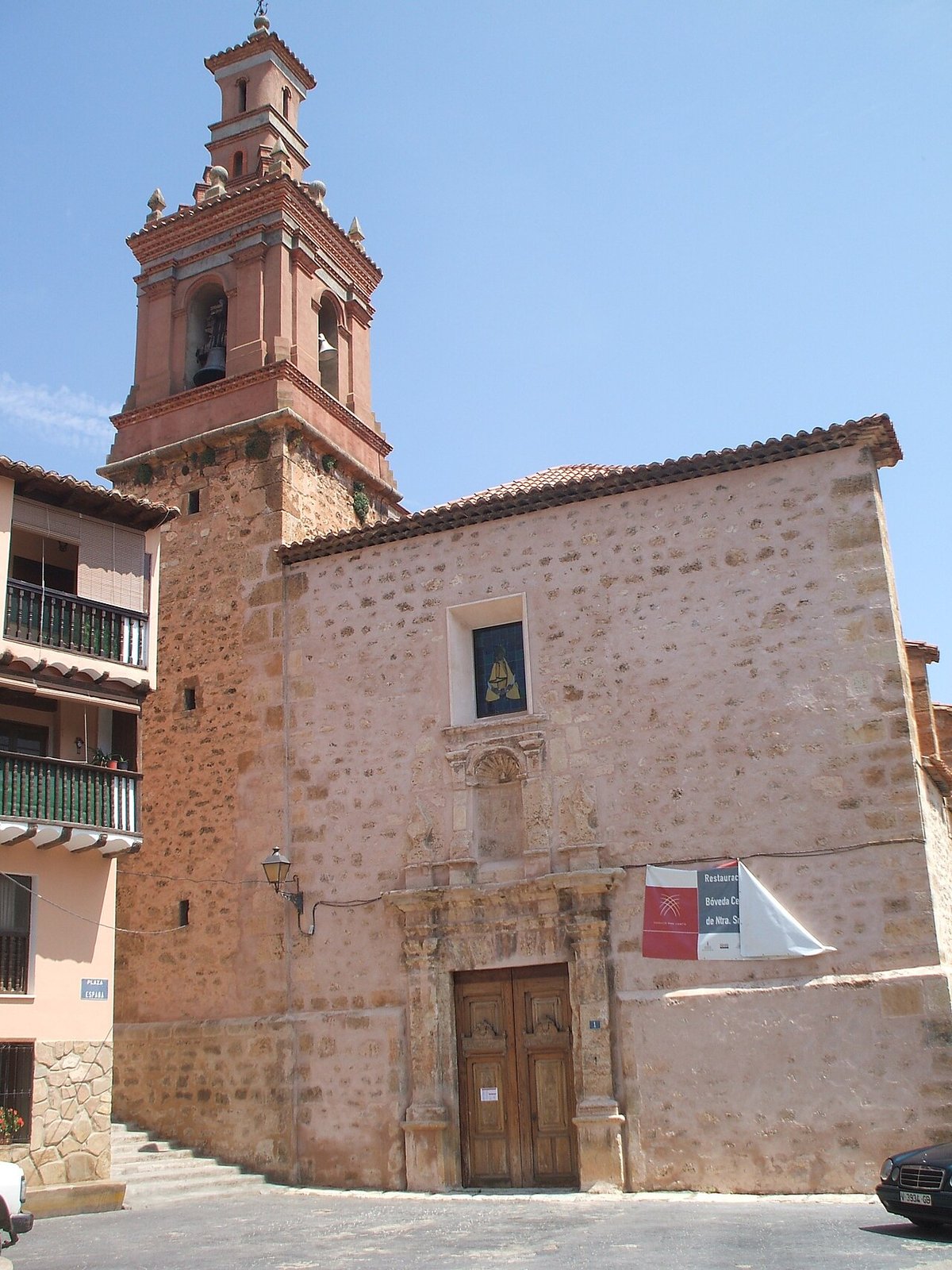
The most visible building in Casas Altas is the parish church of the Natividad de Nuestra Señora. Its origins appear to date back to the medieval period, although its current appearance reflects later alterations. This pattern is common in churches across the area, where structures were gradually adapted to the needs of each period.
Inside, the space brings together additions from different moments in time. The overall impression is modest rather than monumental, yet it helps to understand the central role the church played in community life. In small settlements such as this, the parish was not only a religious space but also a social reference point.
Walking through the streets, elements of traditional architecture remain in good condition. Stone doorways frame entrances worn smooth by use. Balconies with iron railings project slightly over the street. Wooden eaves extend to shield façades from rain and sun. These features are simple and practical, designed to withstand the climate more than to attract attention.
From some of the higher points in the village, the view opens onto the valley and the surrounding sierras. The scale of the landscape feels broad. Pine forests stretch across the slopes, old terraced fields trace lines across the hillsides, and the mountains shift in colour with the seasons.
Paths, Pinewoods and the Turia Valley
Traditional paths lead out from Casas Altas towards vegetable gardens, animal enclosures and cultivated land. Many of these routes are still used for walking or heading into the hills, although they are not always signposted. Anyone planning to venture beyond the immediate surroundings would be wise to check their bearings beforehand or carry a map.
The environment around the village is dominated by pinewoods and scrubland. Wildlife is part of the everyday setting. Wild boar and roe deer are present in the area, along with various birds of prey. Activity is most noticeable early in the morning and at dusk, when the landscape feels more animated.
The local cuisine reflects this rural context. In winter, substantial stews are common, often incorporating mushrooms when the season allows. A traditional dish found throughout the Rincón de Ademuz is gazpacho manchego. Despite the name, this has nothing to do with the chilled tomato soup known elsewhere in Spain. Here it refers to a hearty preparation typical of inland regions, linked to a history of farming and hunting.
After dark, the lack of artificial lighting in the surrounding countryside makes a difference. Just a few minutes away from the centre of the village, the night sky appears particularly clear. The contrast with more densely populated areas is immediate.
Festivities and Seasonal Rhythms
The main patronal festivities are traditionally held around the Natividad de Nuestra Señora in early September. During those days the population increases. Many people who still maintain a house or family ties in Casas Altas return, and the village regains some of the bustle that marked earlier decades.
Religious events form part of the programme, alongside gatherings among neighbours and families. The celebrations serve as a point of reunion as much as devotion.
Summer in general brings a rise in cultural and social activity. This coincides with the arrival of those who spend part of the season in the village. For a small community, these periods alter the rhythm of daily life, filling the streets that are quiet for much of the year.
When to Visit and Practical Notes
Spring and autumn are usually the most pleasant seasons for exploring both the village and its surroundings. Fields alternate between intense greens and ochre tones depending on the time of year, and temperatures are generally more moderate.
In summer, the heat is noticeable during the central hours of the day, especially as the sun falls directly onto the hillside where the village stands. Even so, temperatures drop quickly at night. Winter is cold, and frosts are not unusual.
After periods of rain, some of the dirt paths can become slippery. This is worth bearing in mind for anyone intending to walk outside the village itself.
Casas Altas can be seen in a short visit. It is usually included as part of a wider route through the Rincón de Ademuz, combined with other nearby villages or walks along the Turia valley. Arriving with the car already fuelled from larger towns in the comarca is advisable. Comfortable footwear is also important, as many streets are steep and the paving uneven. In summer, avoiding the middle of the day makes the experience more manageable under the direct sun.
Casas Altas does not rely on grand monuments or large attractions. Its interest lies in its scale, its setting within the Rincón de Ademuz, and the way it reflects centuries of adaptation to a rugged interior landscape. For those exploring this isolated corner of the Comunidad Valenciana, it offers a concise and revealing stop.