Full Article
about Castielfabib
Cliff-top village with castle and fortress church overlooking the Ebrón valley.
Hide article Read full article
A place that doesn’t try to impress
Some villages feel arranged for a photograph. Castielfabib doesn’t. Tourism here is less about ticking off sights and more about walking for a while and realising that life carries on at its own rhythm. There is no stage set, no freshly polished streets for visitors. What you find instead are houses marked by time, steep lanes that make you slow down, and residents going about their day.
It sits in the Rincón de Ademuz, quite isolated even within its own comarca, a small administrative region in inland Valencia. Only a few hundred people live here, and the village clings to the hillside in a way that feels more practical than planned. Anyone arriving in search of something neat and curated may find it jarring. Those interested in how inland villages actually function will find a reason to stop.
Inside the village
The old quarter is the kind that forces a slower pace. Streets are narrow, the gradient is constant, and the stone houses show how they have shifted and adapted over time. Some still have wrought iron balconies or wooden eaves, details that have largely disappeared in bigger towns.
There are no grand squares or a steady run of monuments. Instead, the layout feels compact and slightly tangled, where each corner leads to another incline. Orientation becomes simple after a while. The church sits above, the river below, and everything else falls somewhere in between.
It is not a place that reveals itself all at once. The experience comes from wandering without a fixed route, noticing small details rather than searching for standout landmarks.
The castle and the church
The first thing that stands out is the outline of the castle at the top. Today, only sections of wall and a few structures remain, enough to suggest how the valley below was once watched and controlled. It is not a dramatic ruin in the usual sense. It asks for a bit of imagination to picture what stood here before.
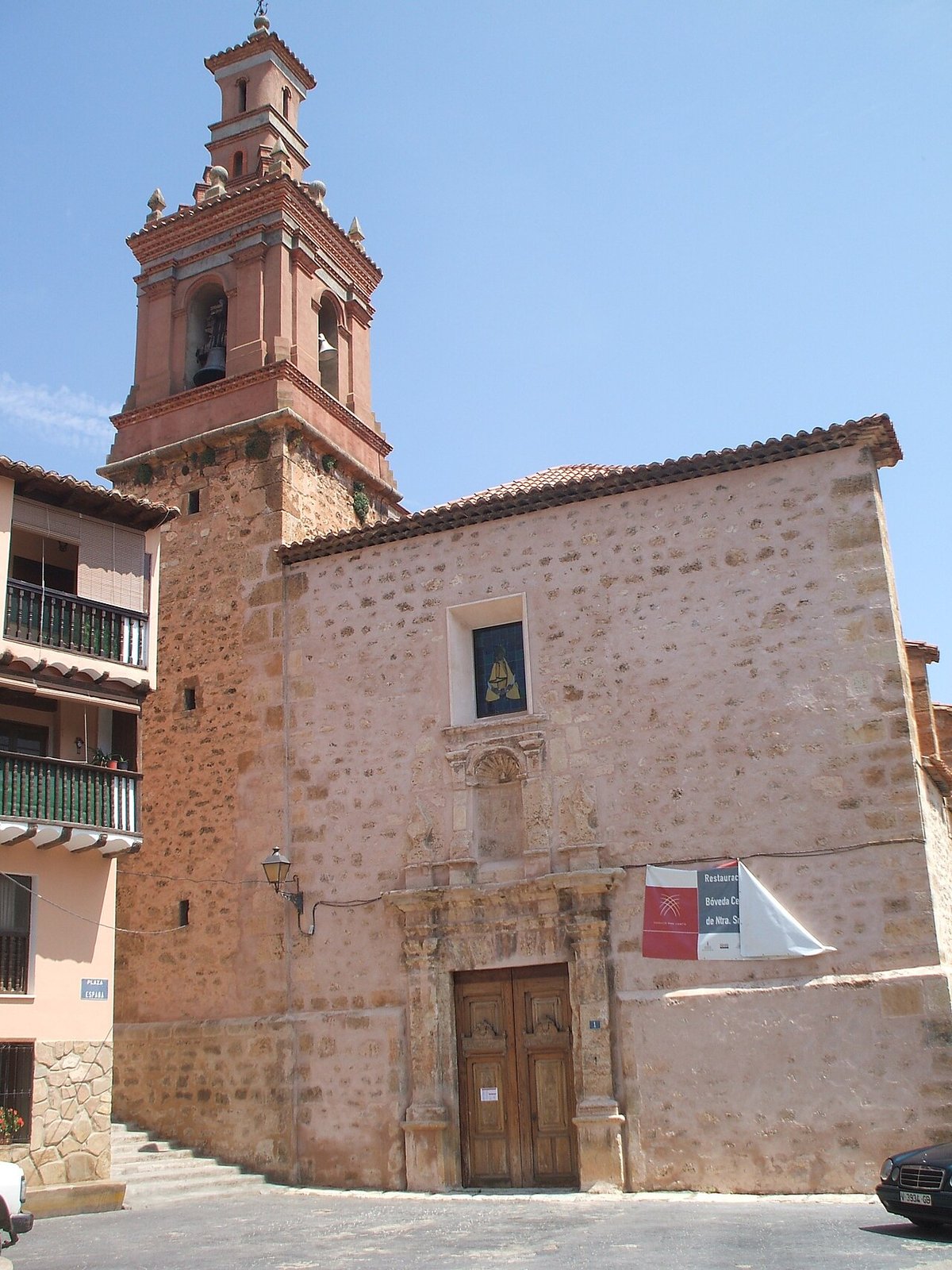
Nearby, the church of San Miguel Arcángel occupies an unusual position within the village. Part of the building dates back several centuries, though it has been altered over time through various reforms. From the atrium, the view opens up across the surrounding landscape. It gives a clear sense of place, with the Turia valley stretching out on one side and hills rising around it.
These two points, the castle above and the church within, help define Castielfabib without overwhelming it. They are reference points rather than headline attractions.
Down towards the Turia
A short walk downhill from the centre leads to rural paths that connect with the Turia river and the nearby hills. The surroundings shift quickly. Dense pine woods appear alongside old terraced fields. Some are still cultivated, others have been left for years.
The landscape feels rugged. Low scrub, exposed rock and scattered holm oaks define much of the terrain. In spring, and after rainfall, there is more green, but the overall impression remains that of a tough interior environment. This is the kind of place where farming has always required effort more than it promised reward.
There are marked trails in the area, generally straightforward routes that vary depending on the season and recent weather. Conditions can change, and in a village like this, asking locally before setting out can save time and unnecessary detours.
Walking here is less about reaching a specific viewpoint and more about understanding the setting. The river, the terraces and the surrounding hills all play a role in shaping daily life.
Nightfall and the sky
One of the more unexpected aspects of Castielfabib appears after dark. With little strong artificial lighting nearby, the sky becomes unusually clear on cloudless nights, especially for anyone used to city conditions.
There is no need to travel far. Stepping just beyond the built-up area is enough. After a few minutes, as the eyes adjust, the stars come into sharper focus. The quiet that surrounds the village adds to the experience, stretching the moment out in a way that feels unforced.
It is a simple thing, but one that leaves an impression.
Festivities and daily life
The rhythm of the village shifts at certain times of year. The celebrations of San Miguel, held towards the end of September, bring together people who maintain ties to Castielfabib even if they no longer live there. Families return for a few days, sharing meals and taking part in short processions through the streets.
A similar change happens in summer. Many who have family homes here come back, and for a few weeks the atmosphere becomes livelier than usual. There is more movement, more conversation, more activity in the streets. Once that period passes, the village settles again into its quieter pace.
These moments do not transform Castielfabib into something else. They simply reveal another layer of its life.
Is it worth the visit?
Castielfabib does not compete with the villages that appear in every guidebook, and that is part of its appeal.
A few hours here are enough to walk its streets, look out over the landscape and get a sense of how this corner of inland Valencia works. There are no embellishments, and very few concessions to tourism. What you see is what is there.
For some, that will feel underwhelming. For others, it is exactly the point.