Full Article
about Torrebaja
Crossroads in El Rincón de Ademuz by the Turia River
Hide article Read full article
Some villages greet you with a large sign and half a dozen views you have already seen online. Torrebaja works the other way round. You drive through the valley and, without ceremony, the village appears among the fields. It feels less like arriving at a tourist destination and more like stepping into the home of a friend you have heard about for years but never visited. There is no introduction. You are simply there.
Torrebaja lies in the Rincón de Ademuz, an inland district of the Comunidad Valenciana separated from the rest of the region by a strip of other provinces. With around four hundred inhabitants, it moves to an agricultural rhythm. At roughly 760 metres above sea level, close to the river Túria and surrounded by terraced fields, the landscape sets the tone more than any single building.
A Village Best Understood on Foot
Torrebaja does not have a picture-postcard old quarter. Older masonry houses stand beside more recent constructions without much fuss. That is often what happens in places where people are still living their daily lives rather than posing for photographs.
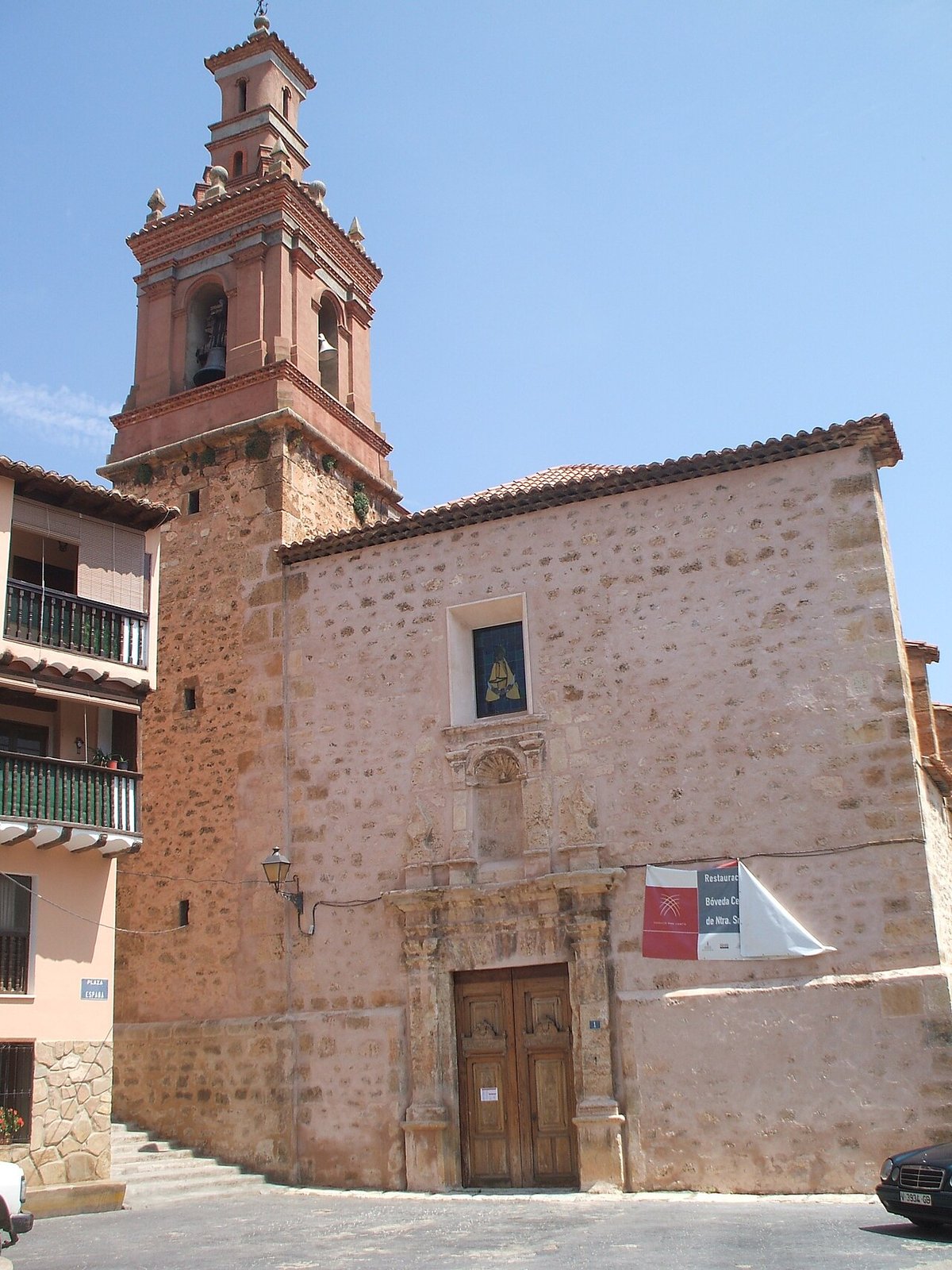
The main square is small and practical. It works a little like a living room when guests arrive, sooner or later everything passes through it. The church of San Joaquín rises in the same space. Its exterior is simple. Inside, it holds modest Baroque elements that may not impress at first glance but have formed part of village life for centuries.
A walk without a fixed plan will soon involve going up or down. The streets adapt to the slope much as furniture is arranged in a small flat. There is no room for perfect straight lines, so everything adjusts as best it can. The result is a layout shaped more by terrain than by design.
The River Túria and the Terraces
From the edge of the village, it quickly becomes clear how this place works. The fields descend towards the river in stone steps. One terrace follows another, like a giant staircase built for cultivation.
The irrigation channels, or acequias, that distribute water have been here for centuries and are still in use. Water runs along narrow channels, and the system sometimes seems to operate with the logic of an old clock. It may not be modern, but it keeps time.
Among the crops, pines and holm oaks, known locally as carrascas, appear on the slopes. Spend a little while looking across the valley and the contrast becomes obvious: the darker green of the wooded hillsides against the lighter tones of worked fields.
The presence of the river Túria shapes both the land and the pace of life. It is not presented as a dramatic feature, but as part of the everyday setting that explains why the terraces are where they are and why the village sits where it does.
Quiet Streets and Telling Details
Torrebaja is not a place for grand monuments. Its appeal lies in small details. Facades marked by time, interior courtyards hidden behind white walls, large wooden doors that have seen several generations pass through them.
Streets such as Calle Mayor or Callejón del Río retain the feel of an agricultural village where everything is arranged around daily needs. It is a bit like stepping into someone’s garage after decades of using the same tools. It may not look conventionally attractive, but everything has its reason.
The church appears again and again during any walk. It is the constant reference point. Baptisms, weddings and farewells have all passed through its doors. Much of the local story has unfolded there, not as a spectacle, but as part of ordinary life.
There is no sense of a staged historic centre. Instead, the village makes sense gradually, through repetition and routine. The square, the slopes, the fields, the church. Each element connects quietly with the others.
Walking in the Rincón de Ademuz
Torrebaja works well as a base for exploring the wider Rincón de Ademuz. The surrounding terrain invites walks without much planning. Paths thread between olive trees, agricultural tracks stretch across the valley floor, and short climbs lead up nearby hills.
Some routes link with neighbouring villages such as Casas Bajas or Puebla de San Miguel. These are not dramatic hikes towards high peaks. They resemble long Sunday walks where the interest lies in the steady presence of the landscape rather than in a single viewpoint.
Gain a little height and the valley opens up as a mosaic of fields and low scrub, with small villages only a few kilometres apart yet largely removed from the noise of cities. The sense of distance is not measured in miles, but in atmosphere.
At certain times of year, agricultural activity becomes especially visible. Cherry trees when harvest season arrives. In autumn, people scanning the forest floor with the concentration of someone searching for lost coins. They are usually looking for níscalos, a type of saffron milk cap, or setas de cardo, oyster mushrooms that grow in the wild.
Birdlife also makes an appearance. Birds of prey can be seen circling above the valley. Hoopoes, with their distinctive crests, perch on wires or at the edges of fields, particularly in spring.
When to Visit Torrebaja
Spring and autumn are often the most pleasant periods. Temperatures are mild, and the countryside shifts between greens and ochres as the seasons change.
Summer is easier to handle here than in many other inland areas because the nights cool down considerably. It feels like opening a window after a hot day in the city and finally noticing a current of fresh air.
In August, Torrebaja celebrates its fiestas dedicated to San Joaquín. Processions take place, families gather, and the streets fill with life. Semana Santa, or Holy Week before Easter, is more subdued in character.
Later in autumn, deeper rural traditions come to the fore. In many houses, the matanza del cerdo takes place, the traditional slaughter and preparation of the pig that has long formed part of the agricultural calendar in Spain. These are long gatherings, centred on substantial food and conversation, with the sense that the rural year continues to set the rhythm.
Torrebaja is not about major attractions. It is the kind of place that becomes clear after stepping out of the car and walking for a while, noticing how the river, the terraces, the houses and the people who live here all year fit together. Like visiting a friend’s village and slowly realising how each piece finds its place.