Full Article
about Villalonga
Gateway to the Circo de la Safor and the Serpis greenway, with spectacular landscapes
Hide article Read full article
A valley of oranges
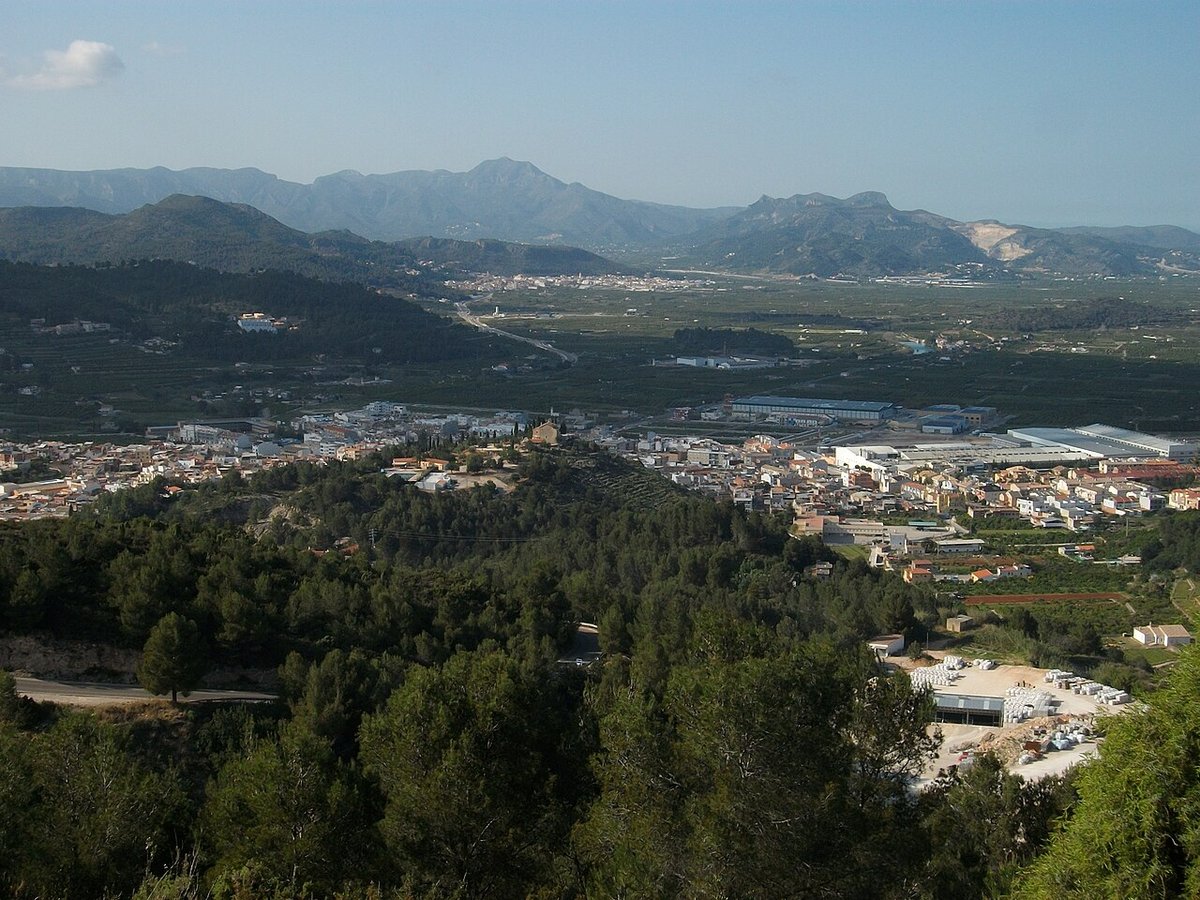
Villalonga is reached via the CV‑685. Before you even enter the village, you can see what defines it: orange groves in every direction. The Serpis valley is thick with irrigated fields, and daily life here has long revolved around that water and those crops.
Parking is rarely a problem. In the centre there is a blue zone with regulated spaces, and a spot usually turns up without too much circling. Saturdays require a bit more patience. The weekly market tends to take over Calle Mayor and traffic becomes sluggish by mid-morning, with vans edging through and locals weaving between stalls.
The setting does much of the talking. The valley opens out around the Serpis river, with farmland spreading across the flat ground and low hills framing the horizon. Villalonga sits quietly within it, practical rather than showy, a place that feels organised around work and routine.
The village that invented its own olive
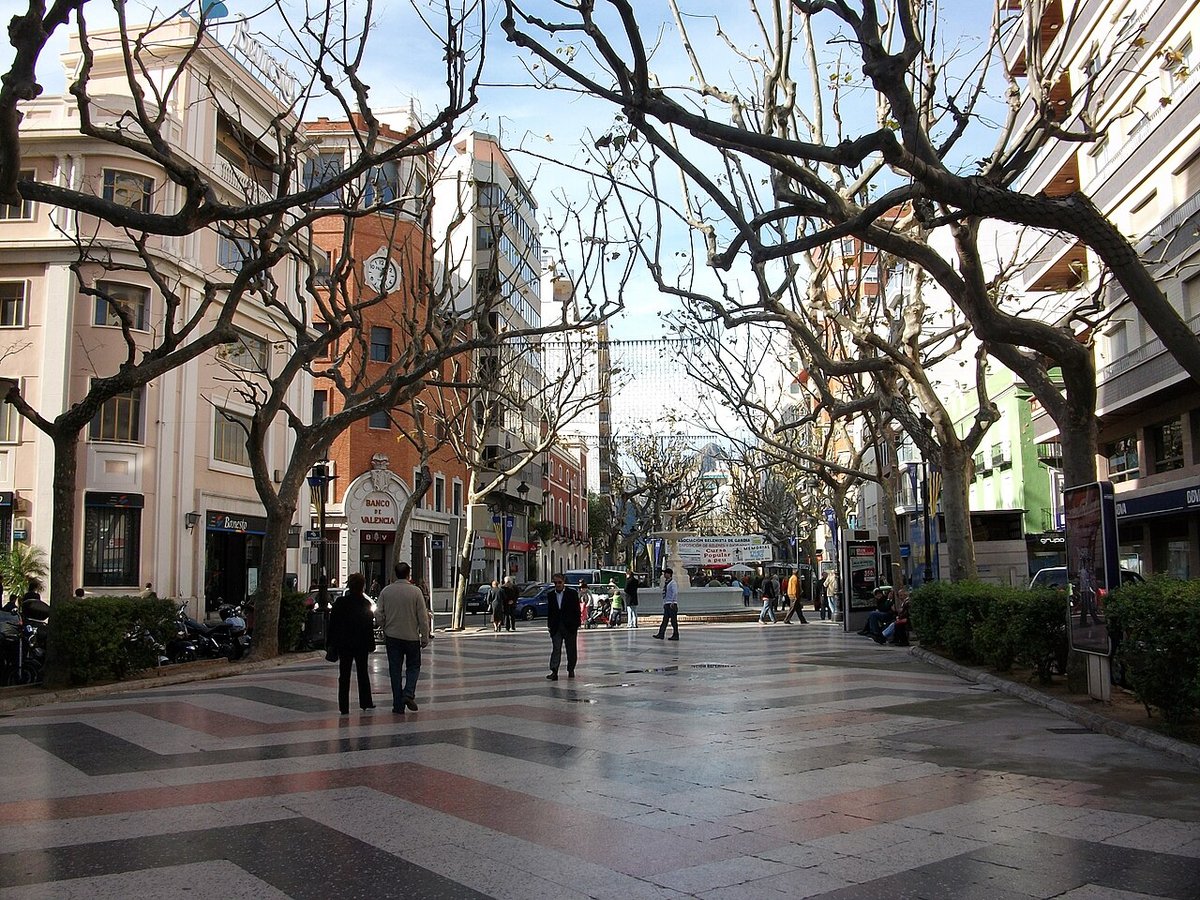
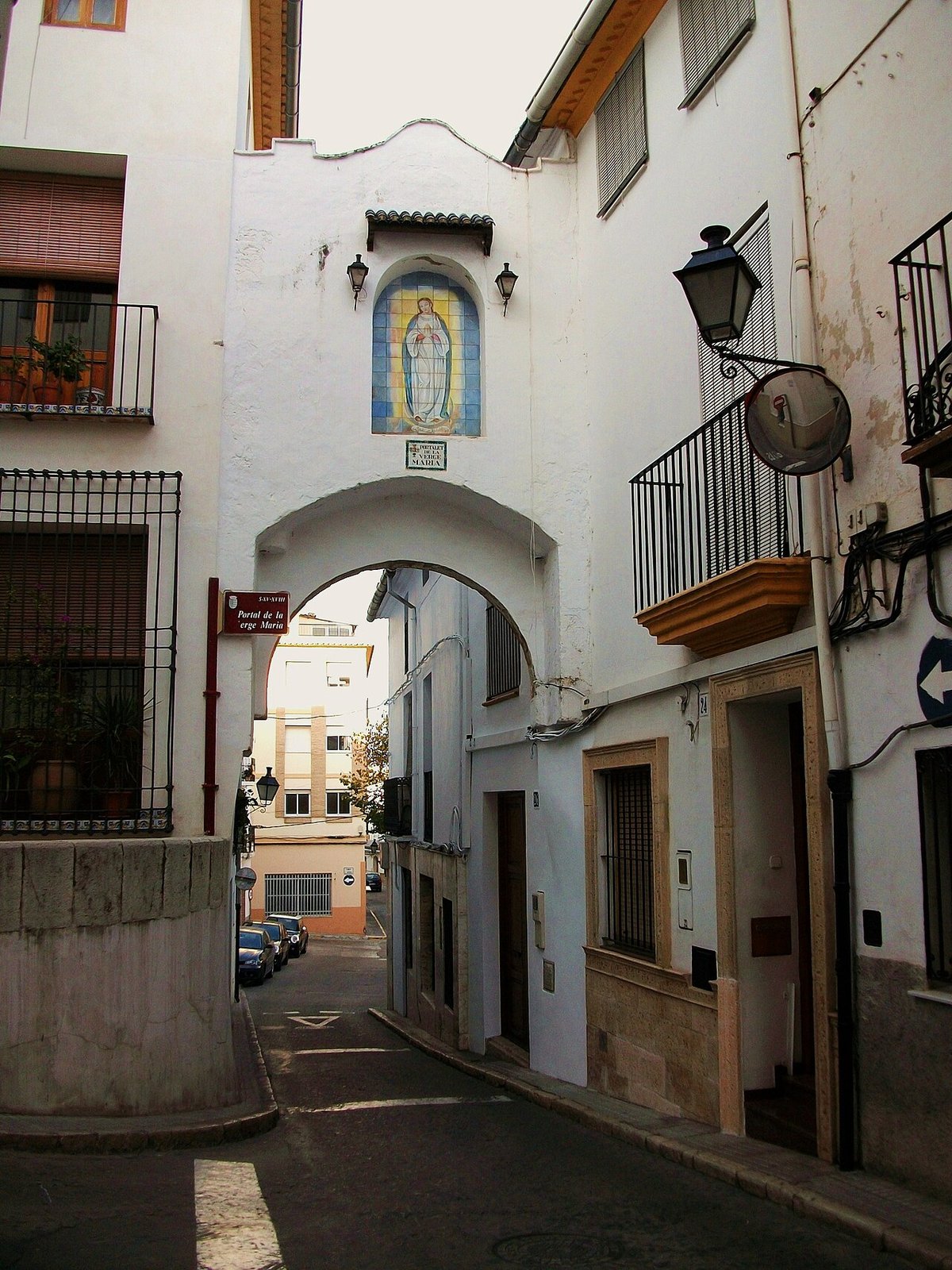
The historic centre is compact. Four streets run more or less parallel to each other, leading towards the square with the church of the Santos Reyes. That is largely it. Low-rise houses line the streets, their light-coloured façades broken by iron balconies that have seen decades of use.
The church dates from the 18th century. Its bell tower can be picked out from various points across the valley, a vertical marker among the fields. Inside, it houses a Cristo de la Salut. Locals speak about it in an unforced way, as if discussing the likelihood of rain. Devotion here is woven into everyday conversation rather than presented as spectacle.
To one side of the centre stands the neo-Gothic chapel of the Mare de Déu de la Font. It was built at the end of the 19th century to protect an image that, according to local tradition, appeared floating in the Serpis at the beginning of the 18th century. The story is passed on simply, part of the village’s shared memory.
Close by is the Font dels Setze Xorros. Sixteen water spouts are lined up along the structure, a reminder of the time before running water reached people’s homes. For many years this was where the village came to fill containers and carry water back through the streets. Even now, it is common to see neighbours filling large bottles here, keeping the habit alive.
Villalonga is sometimes described as the village that invented its own olive, a reference locals understand without fuss. It fits the tone of the place: small-scale, self-contained, with traditions that make sense internally whether or not they travel far beyond the valley.
Up to the Castell, without much of a castle
The standard walk here leads to the Castell dels Moros. It is about 2 kilometres in total, with a short but steady climb. The path begins behind the sports centre and is waymarked as a PR route, so it is straightforward to follow.
At the top, there is not a great deal left. A couple of stretches of wall, an open area of ground, and wide views over the Serpis valley. On clear days you can make out the marjal of La Safor, the coastal wetland, and beyond that the sea. The remains belong to an Andalusi fortification that was already standing when Christian forces arrived in the 13th century. Today it functions more as a viewpoint than as a castle in any conventional sense.
For those who want to continue walking, the same area connects with the Vía Verde del Serpis. This greenway follows the former railway line between Alcoi and Gandia. The section towards Potríes is flat and manageable on foot or by bike. In summer it is wise to set off early. There is little shade and the heat clings to the asphalt once the sun is up.
The combination of short ascent and long, level track makes it easy to shape a morning outdoors. A climb for perspective, then a steady stretch along the old railway line with the river never far away.
Food without fuss
Calle Mayor has several long-established bars where locals gather for a vermouth. The atmosphere is familiar rather than curated, with regulars at the counter and conversations that pick up where they left off the day before.
In winter, if you ask, you may find olla de la Safor. It is a substantial dish made with rice, beans, cardoons, turnip and various pork products. It is filling and direct, the kind of meal that reflects agricultural surroundings and cooler weather.
For something lighter, coca escaldada is the most typical option, eaten as a sweet treat or afternoon snack. The dough is made from flour that has been scalded with oil and salt, rolled thin and served warm. Sometimes it comes with sugar, sometimes with chocolate.
You may also come across coques de dacsa. These are made with maize and filled with simple ingredients such as sardine or vegetables. They are not always available outside private homes, so their appearance can be sporadic.
In winter there are still households that carry out the matanza, the traditional pig slaughter, hanging sausages and cured meats in courtyards and garages to dry. Cabrito from the nearby hills is also cooked on some Sundays, though it is known to be on the expensive side.
Festivals that barely glance at visitors
The main patron saint festivities usually take place in October and last several days. There are processions, tracas, which are strings of firecrackers set off in quick succession, and open-air dances that run late into the night.
In August, the image of the Mare de Déu de la Font is brought down from her hermitage to the village in a night-time procession. It is one of the moments when the streets are at their fullest, with families out together and a noticeable rise in noise and movement.
During these periods the population increases sharply and parking becomes considerably more complicated. Anyone seeking quiet would be better choosing a different date.
A straightforward plan
Villalonga can be seen in a relaxed morning. Park near the centre, head up to the Castell before the heat builds, then come back down and stroll along part of the Vía Verde.
In spring the valley carries the scent of orange blossom as the trees flower. In August, early starts are essential. The sun arrives quickly and with force.
One final detail: some GPS systems confuse this Villalonga with other towns of similar name. It would not be the first time someone has arrived here looking for somewhere else.