Full Article
about Xeraco
Municipality with a dune-backed virgin beach and protected marshland.
Hide article Read full article
At seven in the morning in Xeraco, the air carries the scent of bitter orange and salt. Irrigation gates are often opened early, and water runs along the acequias, the traditional irrigation channels of eastern Spain, brushing the trunks of orange trees that grow almost as far as the sand. From the beach, still empty at that hour, there is sometimes the distant sound of a boat engine heading out to sea. The Mediterranean appears pearl grey, a colour suspended between night and day before the sun fully rises.
Xeraco sits on the Valencian coast in the Comunidad Valenciana, and its character is shaped by that closeness between cultivated land and open water. Here, orchards and shoreline are not separate worlds but parts of the same landscape.
A Town in Two Halves
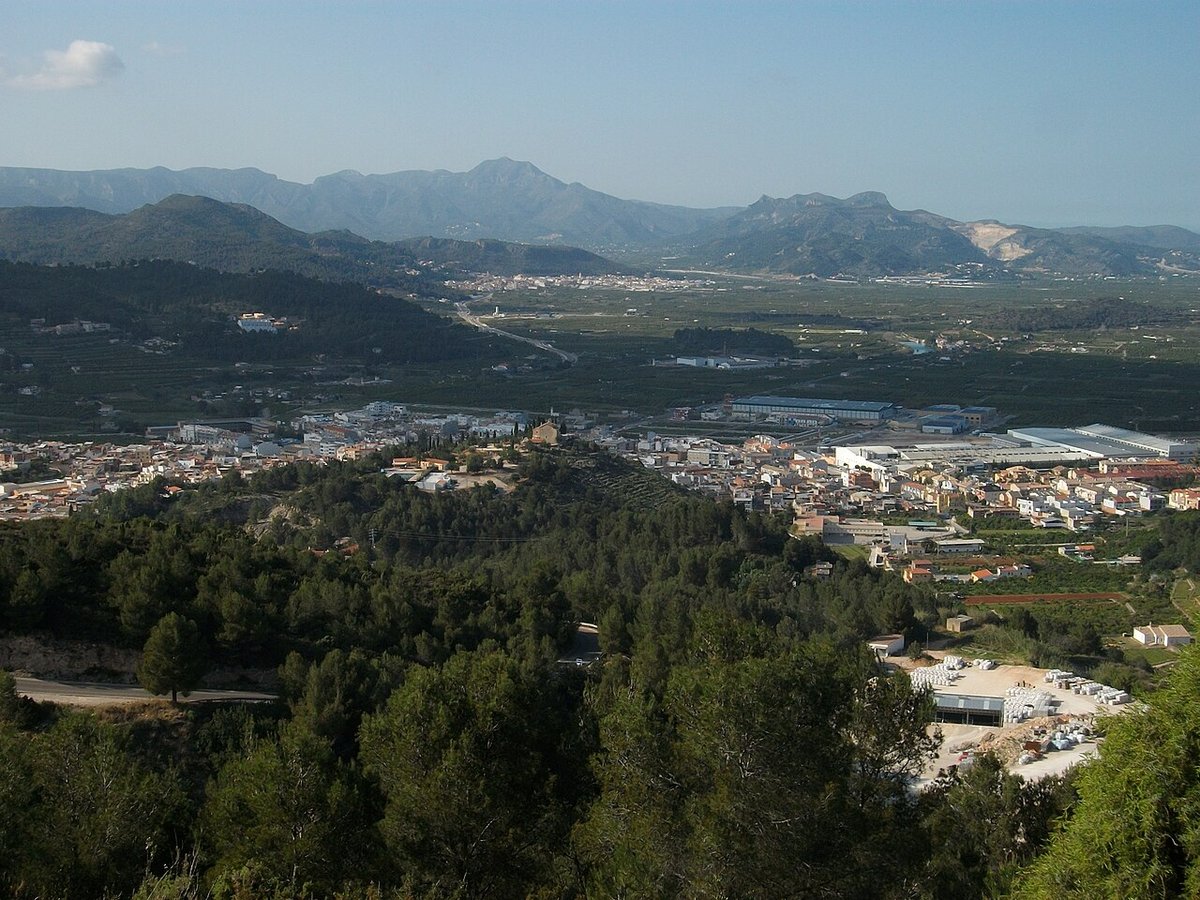
Xeraco is essentially two places existing side by side without entirely overlapping. Inland lies the original village, where daily life remains closely tied to the huerta, the market garden and citrus-growing land that surrounds it. Closer to the sea is the beach district, filled with apartment blocks that are mostly occupied in summer and home to the railway station.
Between these two centres stretch roughly two kilometres of orange groves, forming a green corridor that marks the passage from one to the other. Arriving by car, the CV‑680 runs straight through this agricultural strip and leads towards the coast. Those who come by train step out on the seaward side and then cross the groves to reach the historic centre. The distance is short, yet the shift in atmosphere is noticeable. The noise of suitcases and bicycles gives way to the drier sounds of tractors and shutters being raised for the day.
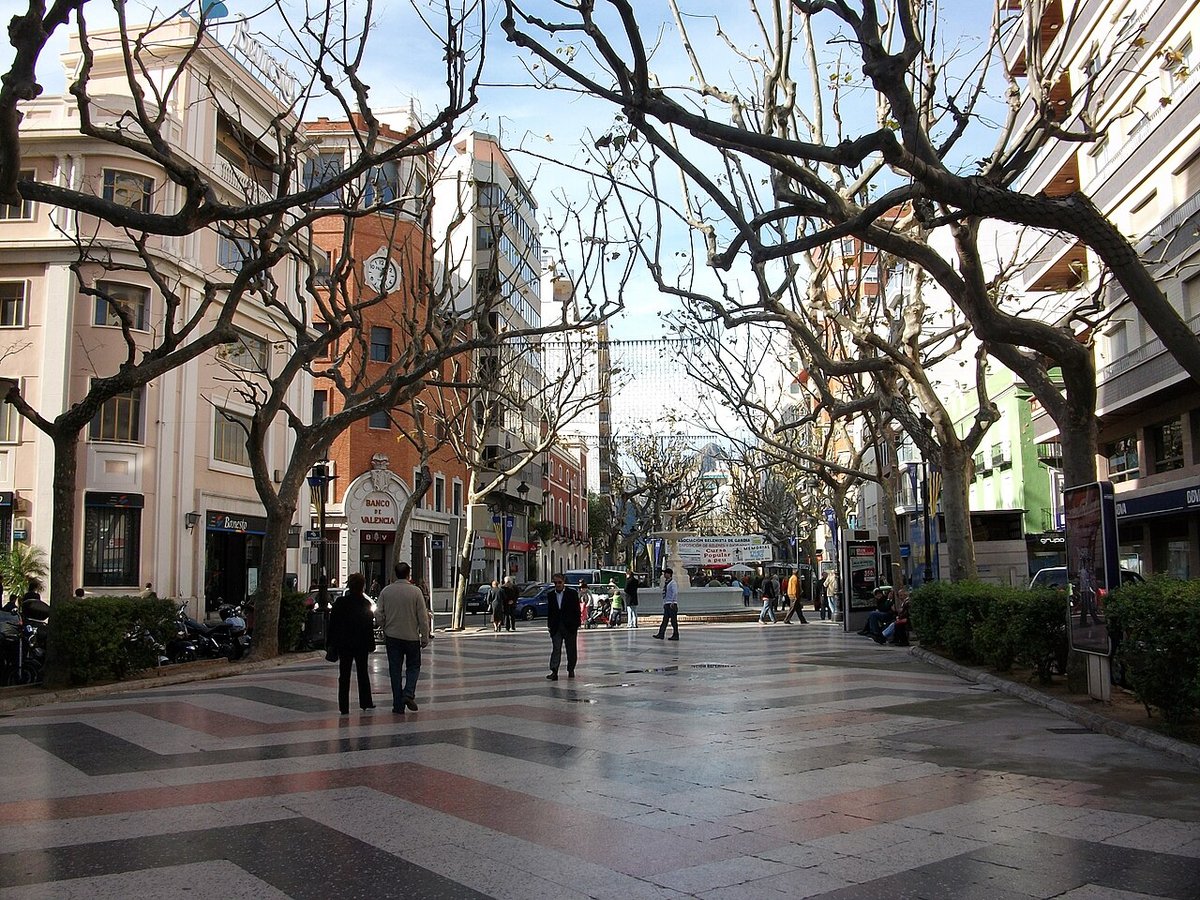
In the inland nucleus, most activity revolves around Plaza de la Constitución. Early in the morning, neighbours stop for coffee before heading out to work in the fields. Conversations tend to be brief, still touched by sleep, and the air smells of toasted bread drifting from nearby kitchens.
Where the Sea Becomes Field
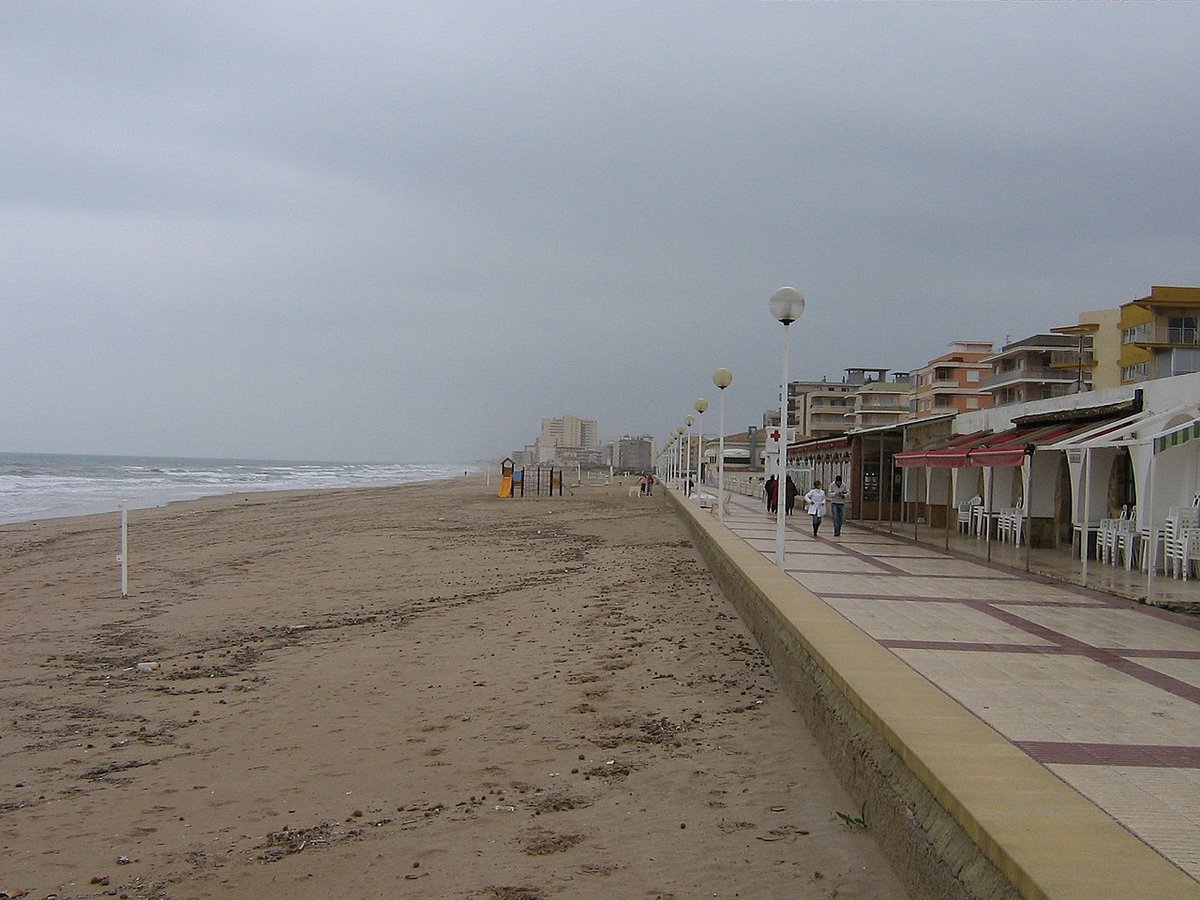
Xeraco’s beach stretches for several kilometres north and south without abrupt interruptions. In one direction it merges with Tavernes; in the other, the riu Vaca, also known as riu Xeraco, forms the boundary with the municipality of Gandia.
It is a wide band of fine sand, open in aspect and relatively free of dense development. Even in summer, there are sections where the only constant sounds are wind and the steady pull of the waves. There are no endless rows of sun loungers and no loud music competing with the surf. Instead, it is common to see anglers standing patiently at the water’s edge, rods fixed in the sand for hours at a time.
During the colder months, the scenery shifts. The beach feels almost like an extension of the surrounding farmland. Agricultural vehicles use compacted sand tracks, and cultivated plots approach very close to the shore. At that time of year, it becomes easier to understand how the huerta, the marjal, which is low-lying marshland typical of this coast, and the sea belong to the same system of water and wind.
The transitions are gradual rather than dramatic. Sand gives way to soil, irrigation channels link inland fields to coastal humidity, and the horizon remains broad and uninterrupted.
The Season of Rice
As evening falls and the air settles, another scent tends to dominate the village: sofrito, the base of many Spanish dishes made from slowly cooked vegetables and oil. In Xeraco, rice is often prepared outdoors, in courtyards, open garages or on terraces large enough to hold a paellero, the wide pan used over a gas ring or open flame.
Arròs al forn, literally oven-baked rice, frequently appears at family tables. It is made with chicken, morcilla, chickpeas, and slices of tomato that brown on the surface. Fideuà, similar in spirit to paella but prepared with short noodles instead of rice, is common on Sundays, particularly when someone has brought back fish or seafood from nearby ports.
If coca de pebre is offered, it is worth accepting. This thin flatbread is topped with roasted red pepper and anchovies. It is eaten cold and cut into pieces, passed around while conversation moves from one subject to another. Harvests are discussed, as are storms and relatives who left to work elsewhere before returning years later. Each household defends its own way of preparing the dough, and debates about the correct method can last well into the evening.
Food here does not stand apart from daily life. It reflects what grows in the fields, what arrives from the sea, and what families have continued to cook for generations.
Choosing Your Moment
Winter in Xeraco can be short and bright. There are days in January when people walk along the beach in short sleeves, although the water remains cold. Traffic is light and the sky seems larger, with long, clear stretches of coastline that feel unhurried.
October is often a good time to see Xeraco at a calmer pace. The sea still holds the warmth of summer, and the fields begin to change colour. Long walks along the sand are possible without encountering many others, followed by a gradual return towards the village as the light fades.
The second half of August presents a different picture. Traffic increases, activity intensifies around the beach area, and silence becomes harder to find. The inland village continues at its own rhythm, but the overall atmosphere shifts noticeably during these weeks.
The River That Slows
Walking south leads eventually to the mouth of the riu Vaca. Here the water slows and darkens before meeting the sea. Reeds and bulrushes grow along the banks, moving with the breeze. Dragonflies are often visible among them, and small fish occasionally break the surface.
Informal paths follow the course of the river. They are not signposted, yet it is enough to keep the water in sight on one side. In certain stretches the track narrows and reeds need to be pushed aside by hand; elsewhere it widens enough for two people to walk together comfortably.
On the return journey, the sun tends to set behind the inland sierras, and the air cools quickly. From the beach, the first lights of the village appear among the orange trees, forming a thin line of yellow points across the plain. It is a natural moment to gather belongings and leave slowly, when the sea has already darkened but still retains a trace of brightness.