Full Article
about Agullent
Town at the foot of the Sierra de Agullent known for its natural spots and springs
Hide article Read full article
In Agullent, the first thing to think about is the car. If you arrive at the weekend, park at the entrance and forget about getting much closer. The village has one main street and the rest are slopes. It is not large, but it hangs on the hillside and everything goes up or down. You can cover it easily on foot.
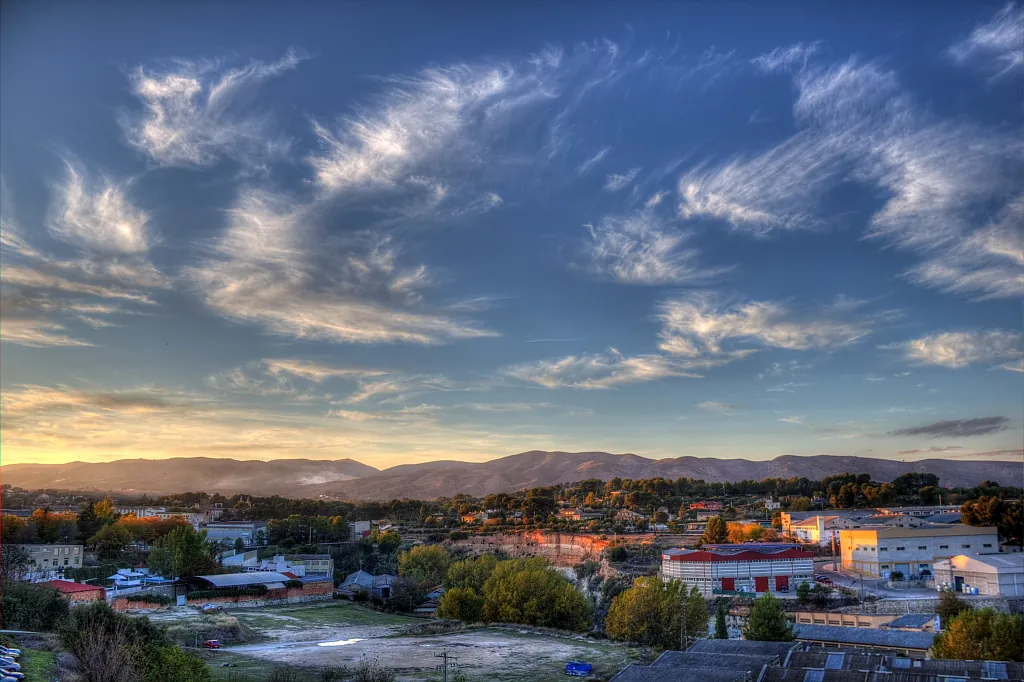
Agullent sits in the Vall d'Albaida, in the interior of the Comunidad Valenciana. It does not try to impress at first glance. Life here moves at its own pace, between steep streets, nearby hills and long meals that stretch into the afternoon.
The hour of the olla
People come here to walk for a while in the sierra or to sit down for a proper meal. There is not much more to it, and that is part of the point.
When it is available, the star dish is olla con pelotas. The pelotas are large meatballs traditionally made at the time of the pig slaughter, served in broth with bones and vegetables. It tends to appear during local festivities or at family gatherings. If you ask in advance at one of the village bars, they sometimes prepare it.
More common is puchero, a hearty stew of chickpeas and onion black pudding, along with whatever else happens to be in the pot that day. It is filling and straightforward, the kind of dish that makes sense in a place where walking often involves a steady climb.
For something quicker in the morning, there is pericana. This simple mixture of shredded salt cod, dried ñora pepper and olive oil is salty and robust. It is not elaborate, but it does the job.
The old mill by the ravine
On the outskirts of the village stands an old flour mill beside the irrigation channel, or acequia. It operated for centuries and stopped grinding grain well into the 20th century. The building is still standing and today serves as rural accommodation.
It lies about a fifteen-minute walk from the centre. The path begins near the sports ground and descends towards the ravine. In summer the sun can be intense, and there is nowhere along the way to buy water, so it is sensible to bring some from the village.
The walk itself is short and straightforward. It gives a sense of how closely the settlement is tied to the surrounding landscape, with water channels and cultivated land shaping daily life for generations.
Moros y Cristianos in narrow streets
The main annual celebration is the festival of Moros y Cristianos, usually held on the first weekend after Easter. These are the days that bring the biggest crowds.
As ever, the car becomes an issue. The village fills up and the limited parking disappears quickly. The most practical option is to leave the car outside and walk down.
The parades pass through narrow streets. There is plenty of music, gunpowder and comparsas, the costumed groups that take part in the procession, squeezed between balconies and façades. The setting makes everything feel closer and louder.
At night the atmosphere carries on for hours, with people out in the streets, drinks in hand and noise lasting late. By Sunday it all settles down again and Agullent returns to its usual rhythm.
For anyone unfamiliar with the tradition, Moros y Cristianos commemorates historical battles between Muslim and Christian forces on the Iberian Peninsula. In towns across the Comunidad Valenciana it has become a fixture of the festive calendar, combining pageantry, marching bands and theatrical flair. In Agullent, the scale may be modest, but the narrow streets give it particular intensity.
La Font Jordana and the path of ice
A short walk from the built-up area lies La Font Jordana. It is signposted, although the final stretch requires a bit of searching. The site combines a spring, an old washing place and a small area with benches. The water usually runs cold, even in summer.
From there, continuing along the same path leads to the so-called Fornet de la Neu. This structure was once used to store compacted snow, which would later be transported down to the cities. Before industrial ice production, such snow pits were an important resource.
Today it remains as a stone-lined well with protective covering above. It is not spectacular, but it clearly shows how snow was collected and preserved for later use. In a region where summer heat can be intense, that practice made practical sense.
The walk between the village, the spring and the Fornet links everyday life with older ways of managing water and cold. None of it is grand, yet it explains how people adapted to their environment with what they had at hand.
An agullentí’s advice
If the plan is simply to see the village itself, an afternoon is enough.
Start at the church of Sant Bertomeu, in the centre. From there, head uphill towards the ermita of the same saint, set a little higher and offering good views over the Vall d'Albaida. Then make your way down towards the old washing place before returning to the town hall square.
There is usually someone sitting there, or coming and going from the bars. Order something, take a seat for a while and look around. Agullent does not try to draw attention to itself. It keeps to its own rhythm, and that is more than enough.