Full Article
about Bocairent
A town carved into the rock, home to the Covetes dels Moros and a medieval quarter—one of the most beautiful.
Ocultar artículo Leer artículo completo
Stone Staircases and Sunday Silence
The bells start at seven. Not a polite Westminster chime, but a full-throated Valencian cascade that ricochets off sheer rock and crashes through open bedroom windows. By half past, the whole town is awake—except on Sunday, when the same bells simply underline the fact that every shop, bar and cash machine has bolted its shutters. Plan accordingly: fill your wallet and stomach before the silence descends.
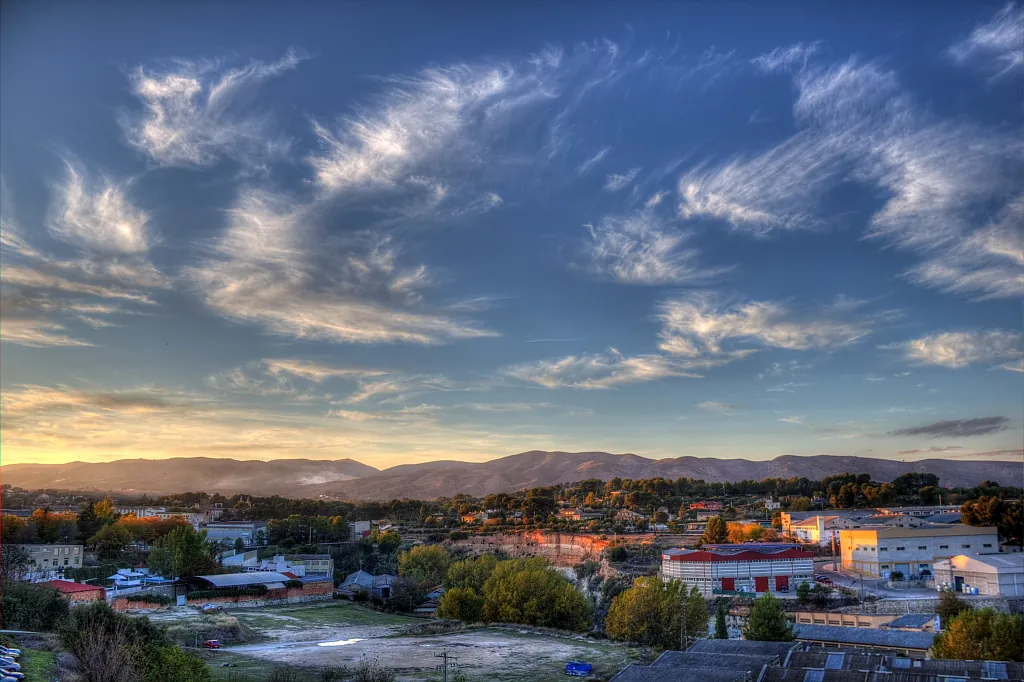
Bocairent sits 660 metres above the Clariano ravine, an hour’s drive inland from Alicante airport. From the approach road the place looks impossible—stone houses bristling along a knife-edge ridge, as though someone squeezed a medieval city onto a dragon’s back. Park in the modern underground garage (free, signed “Aparcament”), then walk. The old town is a no-go zone for wheels; even the bin lorry has to inch in backwards.
Climbing Inside the Beehive
Five minutes uphill, the street surface turns from asphalt to polished cobble. Gravity becomes your companion, sometimes helpful, mostly not. Follow the cemetery wall, duck through a stone gateway and the path drops to the Covetes dels Moros—seventy-odd man-made caves punched into a near-vertical cliff. Despite the name they probably pre-date the Moors; grain stores or hermit cells, nobody is certain. What is sure is that you climb between them on narrow ledges and stone footholds, torch in teeth, while the ravine yawns below. Trainers are fine; vertigo is not.
Back in daylight, the medieval quarter unravels like a ball of wool dropped down steps. Alleyways taper to shoulders’ width, then flare suddenly into pocket-sized plazas where washing flaps above iron balconies. House numbers follow no sequence; expect to be lost within three turns. The relief map is simple: anything that goes up eventually reaches the 16th-century church of La Asunción; anything that drops arrives at the river and the medieval Pont de Sant Blai. Use the bells as a compass—if they’re deafening, you’re near the top.
Mountain Kitchens
Altitude shapes the menu. Winter nights can touch zero, so the local signature is olleta bocairentina, a pork-and-bean stew thick enough to stand a spoon in. Summer brings gazpatxos de montaña—nothing like chilled Andalusian soup, but a game-and-pasta broth fortified with rosemary gathered from the Sierra de Mariola. Between courses, order pericana: salt-cod flaked with garlic and ñora pepper, spread on toast like a smoky British kipper pâté. Portions are farmhand-generous; ask for “un poco” if you’re driving afterwards.
The sierra begins where the streets end. Footpaths strike north past snow-store ruins, circular stone huts built to pack winter ice for city markets. A steady two-hour loop, the Ruta dels Neveros, threads through them and returns via an old mule track scented with thyme and pine resin. Further on, limestone crags offer bolted climbs from British 4a to 7c; take a guidebook—grades are old-school Spanish and protection can be, well, enthusiastic rather than abundant.
When the Town Lets Its Hair Down
February explodes into Moros i Cristians, five days of musket fire and drum bands celebrating the 13th-century Reconquest. Comparsas in silk tunics march through gunpowder smoke, while locals lean from balconies shouting family battle cries. Rooms vanish months ahead; if you dislike crowds, avoid. Easter is quieter but equally atmospheric—hooded processions squeeze up alleyways barely wider than the cross they carry, the stone walls amplifying every slow drumbeat.
August trades gunpowder for brass bands in honour of the Virgen de la Asunción. Temperatures can reach 35 °C, but the altitude knocks the edge off after dusk; terrace tables spread across the plaza and elderly couples dance until the church clock strikes three. Autumn brings the Feria de San Miguel—craft stalls, sheep-cheese tastings and demonstrations of esparto-grass weaving. It’s the moment when residents outnumber visitors again, and hotel prices slide back to earth.
Hard Facts for Soft Soles
Come prepared. Cobbles are lethal when wet; rubber tread beats fashion every time. Mobile signal vanishes in the lower caves—download offline maps. The last ATM stands beside the underground car park; inside the old quarter plastic is useless. If you need a caffeine fix on Sunday, Café de la Plaça keeps irregular hours but usually opens mid-morning when the owner finishes Mass.
Staying over makes sense. The three-star Hotel L’Estació occupies Bocairent’s renovated railway station two minutes from the garage; doubles around €80 with breakfast and a pool that stares straight at the sierra. Inside the old walls, Casa del Navarro offers two rustic apartments carved from a 17th-century townhouse—beams, thick walls, and a terrace where swifts scythe the sky at twilight.
Parting Shots
Bocairent delivers what many Spanish hill towns promise but few still achieve: a functioning community rather than a film set. You will sweat, you will swear at the gradients, and you may curse the bells. Yet the reward is the scrape of leather on stone that hasn’t changed for centuries, the smell of pine drifting down from Mariola, and a bowl of stew that tastes of cold winters survived. Turn up with sturdy shoes, a sense of direction you don’t mind losing, and enough cash for a second drink—because the first will taste of gunpowder if the fiesta’s in town, and you’ll probably need another.