Full Article
about Carrícola
Pioneer village in ecology and art, with outdoor sculpture trails on the Benicadell.
Hide article Read full article
A small village at the foot of the Benicadell
In March, the slopes around Carrícola turn white with almond blossom. Dry stone walls trace the hillsides, and between them the trees catch the light, their flowers flashing against the darker earth. The scent drifts in short bursts, a mix of honey and damp soil. As afternoon light filters through the branches, it leaves golden patches across the terraced fields that step down the incline.
Tourism in Carrícola often begins just like this: a short walk beyond the village centre, watching how the agricultural landscape still sets the pace of daily life.
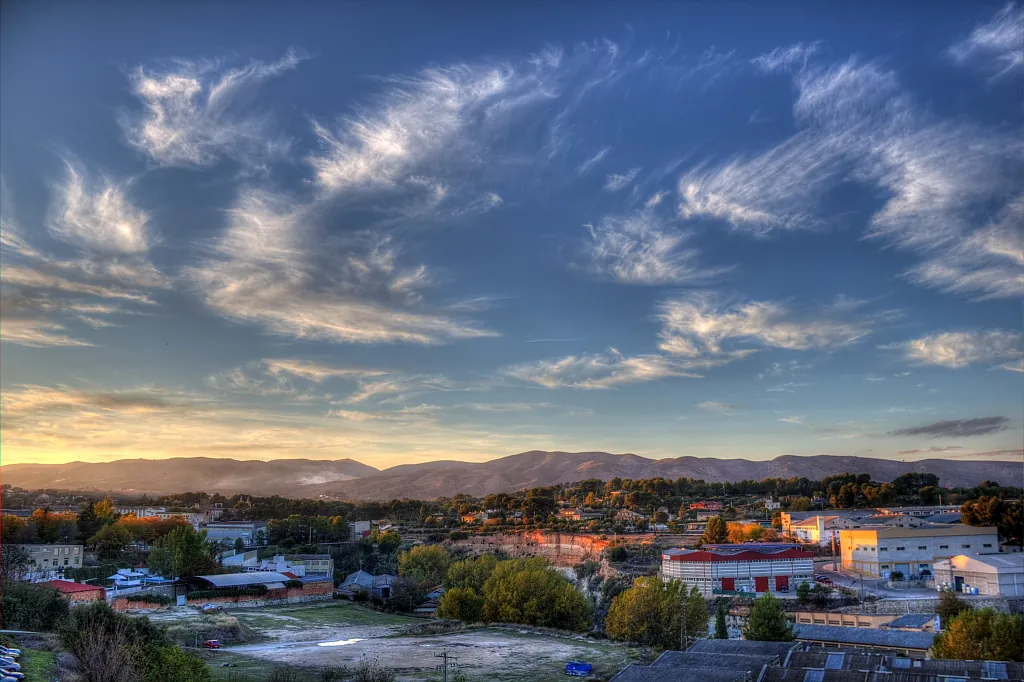
Carrícola lies in the Vall d'Albaida, at the foot of the Serra del Benicadell, around 400 metres above sea level. Fewer than a hundred people live here year round. The scale is immediately clear. There are only a handful of streets, long stretches of quiet between houses and a sense that this is first and foremost a place to live rather than somewhere designed for visitors.
Life around the church square
The village gathers around the church of Sant Joan Baptista, a restrained building in pale stone that looks over a small square. From here, narrow streets branch out, some with cobbled sections. Old doorways appear along the way, flowerpots rest on windowsills and wooden doors show the wear of many summers in the sun.
By mid-afternoon the light falls sideways between the façades, sharpening textures: uneven stone, ageing plaster, the dark lines of wrought iron grilles. Cars rarely pass through. More often there is the sound of footsteps, a conversation drifting from an open window or a door opening and closing.
In summer it makes sense to leave the car at the entrance to the village and continue on foot. Inside, everything tightens quickly and the streets narrow within a few metres.
Carrícola does not require much time to explore. In a couple of hours it is possible to walk through the centre and head out along the nearby paths. Many visitors combine it with other villages in the Vall d'Albaida or with a route in the Benicadell, which rises in the background like a wall of pale rock cut against the sky.
Terraces, dry stone and the working landscape
Step beyond the last houses and the terraces begin. These agricultural platforms, supported by dry stone walls, shape horizontal lines across the mountain. Some of the walls are very old. Together they form a patterned landscape of almond trees, olive groves and small vegetable plots that keeps the terrain open and cultivated.
At the end of winter the almond trees whiten the slopes for a few brief weeks. Afterwards comes the low green of grasses and the scent of aromatic plants that grow between the stones: thyme, rosemary and, if you look closely, the occasional rue plant.
This agricultural mosaic can be explored along short paths that start in the village itself. They are not long-distance routes. Instead they link springs, abandoned terraces and small patches of shade beside shallow ravines. The terrain invites an unhurried pace, with frequent pauses to look back towards the rooftops or up towards the mountain.
Carrícola’s setting at the foot of the Serra del Benicadell is constant. The mountain shapes the horizon and influences the routes that fan out from the village. It is both backdrop and destination.
Paths towards the Serra del Benicadell
Several trails leave Carrícola and climb gradually towards the Benicadell. At first they cross cultivated land and pass along dry stone margins. Higher up, pines begin to appear, along with Mediterranean scrub.
Some stretches form part of a nature art route that has been installed over the years in the surrounding area. The pieces appear among the trees or beside the path. Made from simple materials, they are designed to blend into the landscape rather than dominate it. Walking here becomes a quiet search, noticing how art and terrain intersect without clear boundaries.
Early in the day there is often movement in the sky. Kestrels hover above the terraces. Swallows arrive with the warmer weather. Smaller birds slip between the olive branches. Binoculars are not essential to begin paying attention; much of it happens close enough to follow with the naked eye.
The higher sections bring more vegetation and a wider sense of space, yet the village never feels far away. Looking back, the compact cluster of houses stands out against the ordered lines of the terraces.
Summer gatherings and small-scale traditions
The rhythm in Carrícola remains measured even during celebrations. The main festivities are usually concentrated in summer, when many residents who live elsewhere during the year return. The square fills more than usual. Houses that have been closed for months reopen.
Alongside these gatherings, smaller religious celebrations linked to the parish continue through the year. They follow traditions passed from one generation to the next. They do not have the scale of festivals in the larger towns of the Vall d'Albaida. Here, everything happens on a reduced scale, in keeping with the size of the community.
The effect is not one of spectacle but of continuity. Daily life and celebration overlap rather than competing for space.
When the landscape feels most alive
From late winter into spring the surroundings are at their most vivid. First come the almond blossoms. Then the fields turn green and temperatures soften, making it comfortable to explore the paths that lead out from the village.
Summer brings intense afternoon heat. At that time of year, it is better to head out early in the morning or towards sunset, when the shadows lengthen again across the terraces and the light eases.
Carrícola is small and straightforward to navigate. Its appeal lies less in a checklist of sights and more in the relationship between the village and its setting: the church square and the narrow streets, the dry stone walls and cultivated plots, the gradual ascent towards the Serra del Benicadell. A short walk is enough to understand how closely daily life here remains tied to the land that surrounds it.