Full Article
about El Palomar
Quiet town with poplars and natural recreation areas
Ocultar artículo Leer artículo completo
Six hundred souls and one working street
The church bell strikes midday. A farmer in mud-splattered boots coaxes his tractor up Carrer Major, forcing a delivery van to reverse 50 metres to the nearest widening. Nobody honks. The driver simply leans out, asks after the almond harvest, and lights a cigarette while the ancient Massey Ferguson rattles past. This is El Palomar: no souvenir stalls, no multilingual menus, just a grid of whitewashed houses wedged between almond terraces 80 kilometres south-west of Valencia.
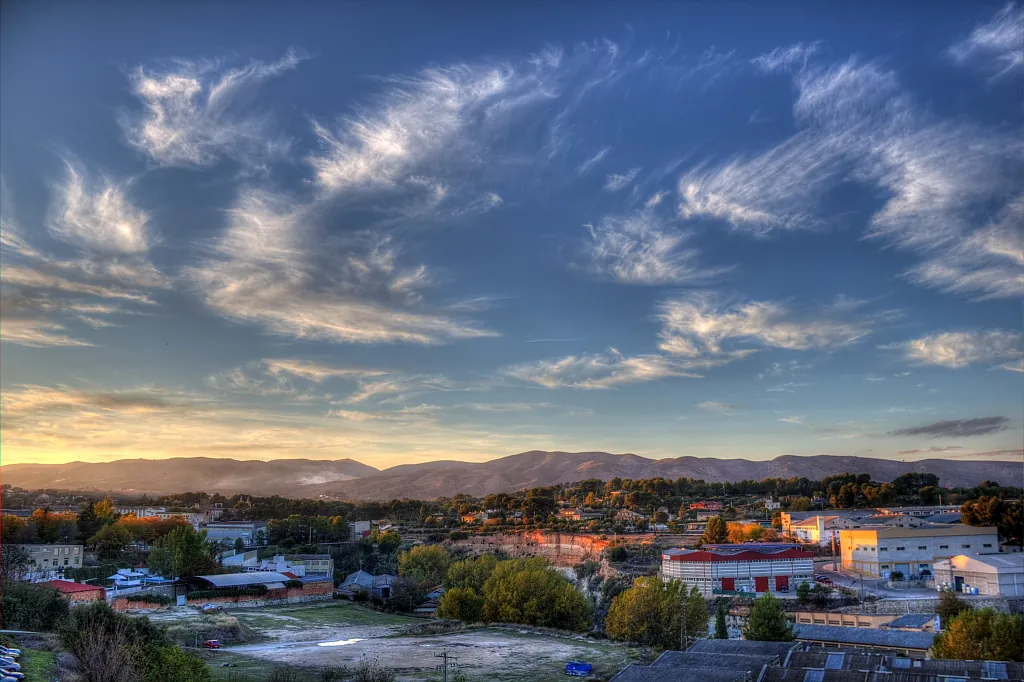
At 350 metres above sea-level the air is clearer than on the coast, but you are still only 40 minutes from the nearest beach at Gandia if the July heat becomes oppressive. The village sits in a fold of the Vall d'Albaida, a basin ringed by modest sierras whose pine-dark crests turn violet at dusk. Olive and citrus groves lap against the outermost houses; beyond them the irrigated green gives way to dusty secano where almonds cling to stone-walled banks. It is the sort of landscape that looks semi-deserted in August and absurdly fertile in late February when the almond blossom arrives like a brief, pinkish snowstorm.
What passes for sights
San Miguel Arcángel, the parish church, is the only building taller than three storeys. Its square tower leans slightly, the result of an 18th-century rebuild on medieval footings. Inside, the altarpiece is pure Baroque bombast—gilded pinecones and startled cherubs—though the side chapels retain the quieter ochres of the Renaissance. The door is rarely locked; if it is, the keys live with the baker two doors down, identifiable by the flour on his forearms.
Round the corner, Calle Nueva hides two casas señoriales whose stone coats of arms commemorate landowners who grew wealthy shipping raisins to Victorian Britain. Their balconies sag but the ironwork still shows wheat sheaves and bunches of grapes, the 19th-century equivalent of a LinkedIn profile. You can cover the historic core in twenty minutes, yet the details reward slower inspection: a 1920s ceramic street sign, a doorway narrowed during the Civil War to stop carts being requisitioned, a communal wash-house whose water trickles straight from an irrigation ditch.
Walk ten minutes east along the CV-681 and the tarmac dissolves into a camino of packed earth and fist-sized stones. Follow it for half an hour and you reach the Font de la Figuera, a spring where shepherds once overnighted. The trough still holds water; dragonflies stitch the surface. Beyond, a rough loop climbs 200 metres to the ridge of La Solana. The ascent is steep, the path occasionally erased by winter torrents, but the view repays the effort: a patchwork of green and khaki fields stitched together by dry-stone walls, with the hazy bulks of the Mariola and Benicadell ranges beyond.
Lunch without a menu
There is no restaurant in El Palomar itself. Mid-morning coffee materialises at Bar Central, a single-room establishment whose opening hours obey lunar logic. If the metal shutter is up, order a café amb llet and a fartón—an elongated doughnut designed for dunking. By 11:30 the regulars have departed for the fields and the owner starts mopping the floor, a reliable signal that service is over for the day.
Serious eating requires wheels. Five kilometres north, the industrial estate outside Ontinyent hides Restaurante L’Alter, whose English-speaking chef learned his trade in Birmingham. Expect properly pink lamb and a wine list that ventures beyond the usual Rioja. Closer, in the hamlet of Bocairent, Bar Casa Rafa stuffs home-made longaniza into crusty baguettes; the sausage tastes like Lincolnshire with extra paprika and costs €4.50. If you insist on dining within village limits, the mini-supermarket on Plaça Major stocks tinned mussels, local chorizo and cold beer—enough for an impromptu picnic on the church steps.
Where to lay your head
Accommodation is limited to two rural houses, both converted farmyards on the western edge. Els Horts del Palomar sleeps six, has a four-metre pool and accepts single-night stays outside August. The British owner leaves a laminated folder explaining how the induction hob works and which bars open early for the cycling fraternity. Expect spotless rooms, IKEA beds and a terrace that catches the last sun as the church bell tolls nine. Price: around €90 per night for the whole house mid-week, rising to €160 at Easter. Book through Spain-Holiday or email directly—Airbnb hasn’t discovered the village yet.
Timing and transport
Spring, specifically the fortnight after Valentine’s Day, remains the clever season. Almond blossom turns every slope pastel, daytime temperatures nudge 18°C and the scent of orange-flower drifts across the valley. Accommodation is still empty and the only crowds are Spanish photographers chasing the perfect blossom shot. Autumn works too, once the September fiestas end and the grape harvest begins; mornings smell of crushed Moscatel and the light softens to honey.
Public transport is fiction. Fly to Valencia or Alicante, collect a hire car and allow 80 minutes via the A-7 and CV-60. Sat-nav will try to drop you in someone’s driveway; ignore it and aim for the signposted car park above the church—an expanse of dusty concrete large enough for coaches that never arrive. Mobile signal flickers between Vodafone and EE; download offline maps before you leave the motorway. In winter the CV-681 can ice over at night; carry chains if you plan a January visit.
The honest verdict
El Palomar will never feature on a Valencia city-break itinerary. It offers neither Michelin stars nor selfie-backdrops. What it does provide is a calibrated antidote to the coastal strip: a place where the baker remembers how you take your coffee after two visits, where the night sky still looks starry, and where the loudest noise is the irrigation water clacking through the sluice at dawn. Come if you need reminding that Spain still functions at tractor speed. Bring walking boots and a sense of temporal elasticity. Leave the phrasebook—here, courtesy matters more than conjugation, and the village has been greeting strangers since long before Google Translate.