Full Article
about Terrateig
Small farming town with rural charm in Vall d'Albaida
Ocultar artículo Leer artículo completo
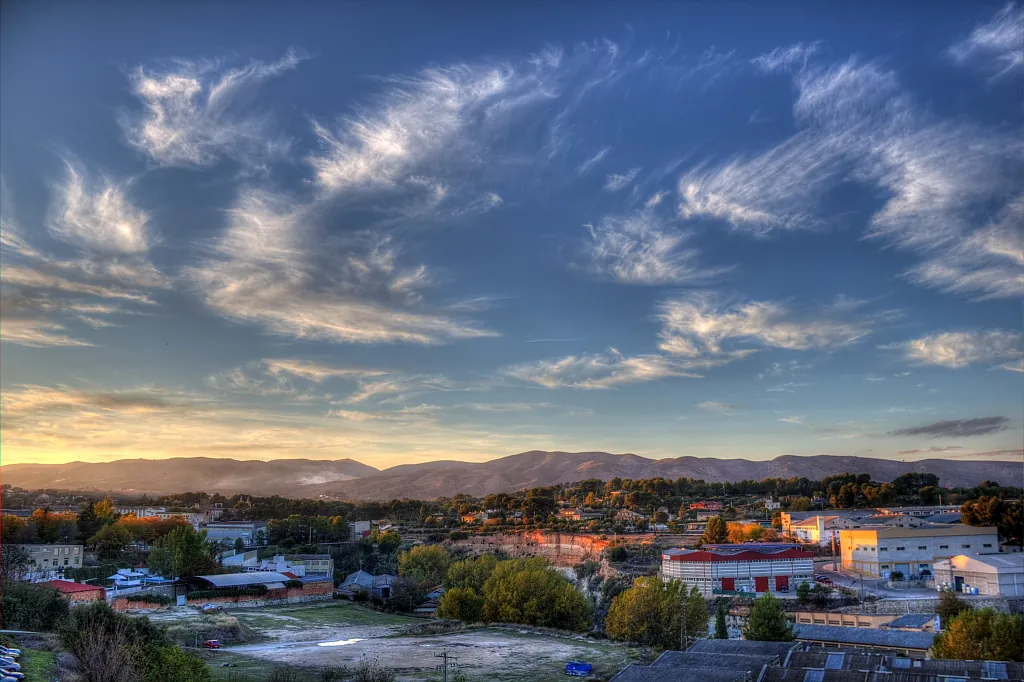
The church bells strike eleven, and Terrateig's main street falls silent except for the scrape of a metal chair against concrete. An elderly man adjusts his position beneath the plane tree in Plaça de l'Església, settling in for another hour of watching absolutely nothing happen. This is village life at 250 metres above sea level, where the Vall d'Albaida's dry hills meet irrigated orange groves, and nobody's in a particular hurry to be anywhere else.
With 290 permanent residents, Terrateig functions more as a living museum of rural Valencian life than as any sort of destination. The parish church of Sant Miquel Arcàngel dominates the modest skyline—its stone bell tower more functional than ornate, marking time for farmers rather than tourists. Whitewashed houses crowd narrow lanes that twist uphill, their stone thresholds worn smooth by centuries of agricultural boots. Many have been restored with surprising restraint, maintaining original masonry work rather than succumbing to the coastal trend of rendering everything uniform beige.
The Rhythm of Dry Stone and Citrus
Terrateig's relationship with its landscape reveals itself slowly. Dry stone walls terrace the surrounding hills, creating a patchwork of almond orchards that explode into white blossoms during February and March. The effect lacks the drama of mass tourism posters, but carries its own quiet reward: entire hillsides humming with bees, the air thick with blossom scent drifting down to mingle with woodsmoke from village chimneys. Orange groves occupy the flatter land closer to the village centre, their geometric irrigation channels cutting precise lines through red earth.
The agricultural calendar still dictates village activity. Morning markets bring local farmers selling seasonal produce from the backs of battered Land Rover Defenders—artichokes in winter, tomatoes heavy with irregular shapes that would never pass supermarket standards, almonds dried on rooftops and sold in rough brown paper bags. Prices hover around €2-3 per kilo, cash only, with transactions conducted in rapid Valencian that bears little resemblance to textbook Spanish.
Walking Through Forgotten Connections
What Terrateig offers, primarily, is access to the old Spain that package holidays rarely touch. Traditional footpaths connect neighbouring villages through landscapes that maps often forget to mark. The Camí Vell d'Ontinyent runs east towards La Vall de Gallinera, following ancient mule tracks past abandoned charcoal platforms and threshing circles carved directly into bedrock. These aren't maintained National Trust paths with way-markers every hundred metres—navigation requires basic Spanish to ask directions from field workers, who'll gesture vaguely towards distant electricity pylons and mutter about following the dry riverbed.
Hiking here demands self-sufficiency. The GR-7 long-distance route passes within 8 kilometres, but local connections involve negotiating private farmland where dogs bark from farmhouse courtyards and farmers eye strangers with the suspicion reserved for anyone wearing footwear unsuitable for agricultural labour. Summer walking starts before 7 am or waits until after 5 pm—midday temperatures regularly exceed 35°C, and shade exists only where olive trees have been allowed to reach maturity.
Food Without Fanfare
Village gastronomy reflects agricultural reality rather than culinary ambition. The Bar Central opens at 6 am for farmers needing coffee and brandy before heading to fields, serving basic tapas that haven't changed since the 1970s. Morcilla arrives crumbled over chickpeas rather than presented as foam or gel. The €8 menú del día runs to three courses: soup thick enough to stand a spoon in, followed by pork shoulder slow-cooked until it surrenders to fork pressure, finishing with crema catalana whose caramelised sugar cracks satisfactorily under spoon pressure.
Local specialities appear seasonally without announcement. Rollets d'anís—aniseed-flavoured pastries twisted into knot shapes—emerge during fiestas, sold from kitchen doorways by women who've been using the same family recipes since childhood. They're best consumed immediately, when the exterior retains slight crispness giving way to dense, fragrant interior that pairs unexpectedly well with strong coffee. Attempts to request recipes meet polite deflection—some knowledge remains resolutely local.
When the Village Celebrates
Terrateig's social calendar revolves around agricultural and religious observances with equal weight. Fiesta week in late September coincides with the final almond harvest, transforming the village into a temporary community of 800 as extended families return for Sant Miquel celebrations. Temporary bars appear in garages normally shuttered against summer heat, serving beer at €1.20 while grandmothers preside over massive paella pans capable of feeding entire extended families.
Processions during Holy Week maintain intimate scale—twenty locals carrying modest floats through streets barely wide enough for single-file passage. The atmosphere feels more like family reunion than religious observance, with participants recognising every face in crowd and conversation flowing easily between ritual and agricultural discussion. Visitors welcome but not specifically catered for—participation requires respect rather than tourism infrastructure.
Practical Realities
Access from the UK involves flying into Valencia or Alicante, then hiring a car—public transport exists but requires patience and fluent Spanish. From Valencia airport, take the AP-7 south towards Alicante, exiting at Ontinyent and following the CV-81 through increasingly narrow roads that climb past abandoned textile mills. Journey time runs 75 minutes in good traffic, longer during Spanish holiday periods when coastal routes clog with returning residents.
Accommodation within Terrateig itself remains effectively non-existent—one rural house occasionally rents rooms, but planning requires booking months ahead during almond blossom season. Better options lie in neighbouring villages: Ontinyent offers functional hotels from €45 nightly, while rural casas scattered through Vall d'Albaida provide self-catering bases for €80-120 per night. These work better anyway—Terrateig serves as pleasant stop rather than destination, connecting multiple villages into coherent exploration of interior Valencia.
The village makes most sense visited during spring or autumn shoulder seasons. February brings blossom but also unpredictable weather—sunny mornings can collapse into afternoon thunderstorms that turn dirt tracks to mud. Summer's fierce heat empties streets between noon and 5 pm, when even the bar closes for siesta. Winter offers clear skies and walking weather, but short days mean early starts if attempting longer routes.
Honest Assessment
Terrateig rewards visitors seeking rural Spain without romantic delusions. The village offers no Instagram moments, no artisan workshops guaranteed daily, no restaurants with tasting menus. What exists instead feels more valuable: continuity, agricultural rhythms unchanged despite decades of Spanish economic transformation, community cohesion visible in daily interactions between neighbours who've known each other across generations.
Come here to walk ancient paths between villages whose names never appear in guidebooks. Come to eat food whose recipes predate fusion cuisine by centuries. Come to understand that Spain extends far beyond coastal resorts and city breaks, into valleys where church bells still regulate daily life and farmers gather at dawn to discuss rainfall statistics with the intensity others reserve for football results.
Don't come expecting entertainment or organised activities. Don't come without basic Spanish—the village receives few foreign visitors, and English remains largely theoretical. Don't come for almond blossoms without checking bloom forecasts, which can shift by weeks depending on winter temperatures.
Terrateig works best as revelation rather than destination: proof that authentic village life persists, quietly, while tourism transforms Spain's better-known corners into performance art. The village continues regardless of visitors, which might be precisely why it's worth the detour.