Full Article
about Ayora
County capital with an impressive castle, known for its honey.
Hide article Read full article
A Valley Shaped by Borders
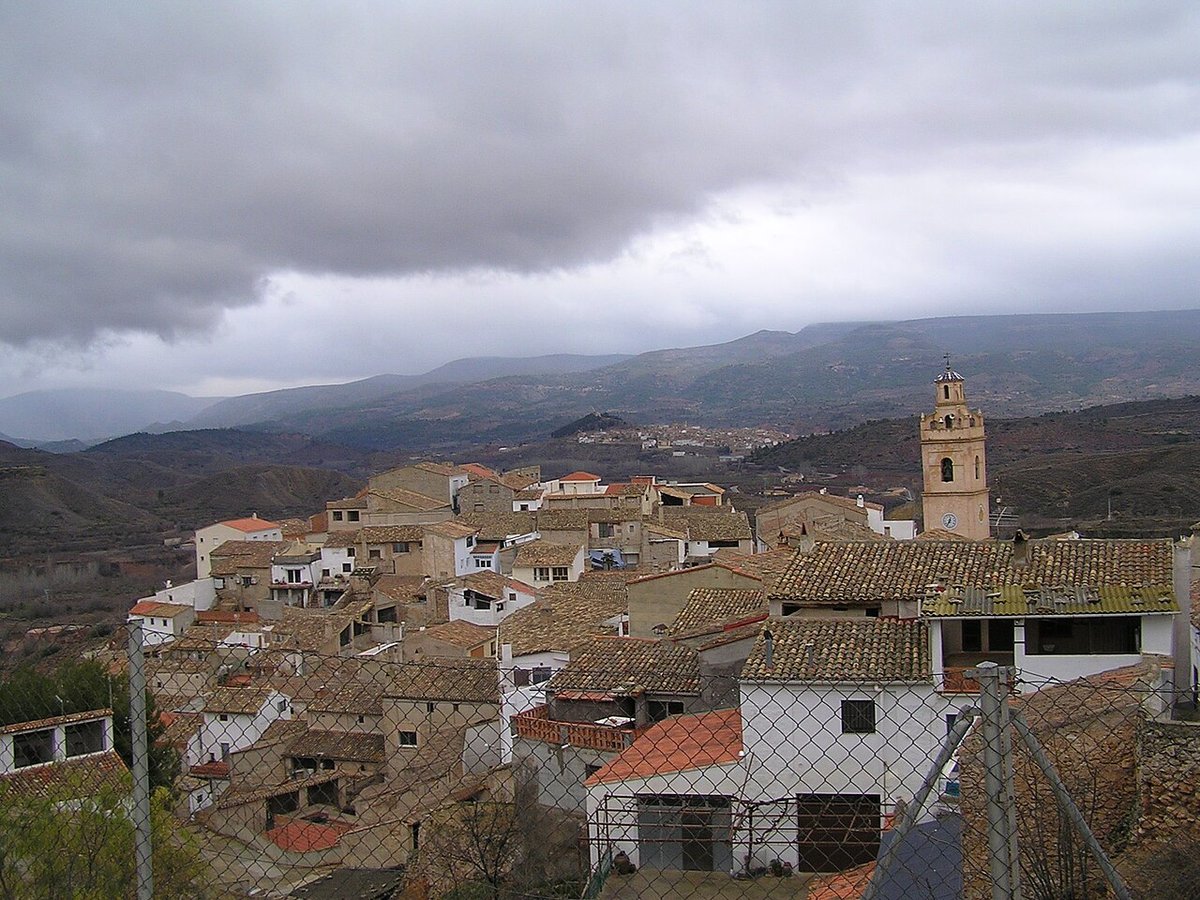
Any look at tourism in Ayora starts with geography. The town sits at the western edge of the Comunidad Valenciana, in the Cofrentes‑Ayora Valley, a broad depression ringed by mountain ranges that for centuries marked shifting frontiers. This is a landscape that has long functioned as a meeting point between territories. In the Middle Ages especially, borders moved often, and daily life depended as much on local agreements as on decisions taken far away.
The castle crowns a hill of gypsum rock above the old town. From the top, the view opens onto gentle folds of pine forest and olive groves. The setting explains much about Ayora’s past. Control of height meant control of the valley floor, and the valley itself formed a natural corridor between inland Spain and the Mediterranean coast.
Ayora lies just over an hour by car from the city of Valencia. The usual approach is via the A‑3 before continuing along regional roads into the valley. The sense of arrival comes gradually, as the mountains close in and the town appears beneath its hilltop fortress.
When Bees Appeared on Rock
A few kilometres from the town centre, in the rock shelters of Tortosilla and El Sordo, prehistoric paintings survive with an unusual subject: beehives and bees. Unlike the better known Levantine rock art scenes focused on hunting, these images depict a relationship with honey thousands of years ago. The detail often draws the attention of those who work with hives today.
These shelters form part of the Rock Art of the Mediterranean Basin on the Iberian Peninsula, a UNESCO World Heritage listing that covers numerous sites across eastern Spain. Access involves travelling along a track and walking a short stretch on foot. The panels are protected by metal grilles to prevent deterioration.
The interest here lies less in the scale of the figures and more in the idea of continuity. Beekeeping still carries weight in the local economy and in the identity of the valley. The presence of bees on stone links present‑day activity with a very distant past, suggesting that honey has long shaped the way people have understood and used this landscape.
The Iberian Settlement of Castellar de Meca
In the nearby mountains stands Castellar de Meca, one of the best known Iberian archaeological sites in inland Valencia, although administratively it lies on the provincial boundary. The settlement occupies an elevated plateau commanding the natural corridor between the Meseta and the coast.
Among its most frequently cited features is the so‑called Camino Hondo, a road cut into the rock and marked by deep cart ruts. Archaeologists interpret it as part of the access route to the settlement and as a system for controlling cart traffic. The very act of carving a route into stone suggests a community concerned with managing movement and trade.
The site was occupied over long periods, from stages prior to Iberian culture through to Roman times. Remains of defensive walls, cisterns and traces of dwellings are still visible. The surrounding landscape helps explain its strategic role. From the plateau, several kilometres of valley can be observed, reinforcing the impression of a settlement designed to oversee passage through this interior corridor.
From Andalusi Farmstead to Frontier Town
Before the Christian conquest, Ayora formed part of a network of alquerías linked to the Andalusi agricultural system. Some sources mention the place name Anadar Liaura, associated with water and the valley’s watercourses, though the etymology is not always clearly documented. What is certain is that irrigation and control of resources shaped the organisation of settlement.
After incorporation into Christian rule in the 13th century, the castle gained prominence as a control point on a frontier that remained unstable between the Iberian crowns. For decades, the territory changed political allegiance before finally becoming integrated into the Kingdom of Valencia at the beginning of the 14th century.
The present castle preserves stretches of wall and partially rebuilt towers. Part of the structure fell into ruin during the War of the Spanish Succession in the early 18th century, when many fortifications in the area were rendered unusable to prevent further military use. Today it functions primarily as a viewpoint over the valley, a place to understand how geography dictated both defence and daily life.
Two Churches, Two Phases of Growth
Ayora’s urban evolution can also be traced through its churches. The Iglesia de la Asunción dates from the 16th century, a period of expansion in the Early Modern era. Built with stone from the surrounding mountains and abundant local gypsum, it follows a model of a broad nave with ribbed vaulting. The choice of materials ties the building closely to the valley itself.
Santa María la Mayor points to an earlier and more complex phase. Local tradition places an earlier mosque on this site, over which the Christian church was built, a common process in towns reorganised after conquest. The building has undergone numerous alterations and combines elements from different periods. Often mentioned are a Mudejar‑tradition wooden ceiling and a Gothic altarpiece whose authorship remains uncertain.
Together, these two churches reflect layers of change: from Islamic rural networks to Christian frontier settlement, and later to a more consolidated town integrated into the Kingdom of Valencia.
Honey as Living Heritage
Ayora’s connection with honey is far from symbolic. Beekeeping forms part of the livelihood of many families in the valley and surrounding mountains, where rosemary, thyme and other aromatic plants shape the character of each harvest. The vegetation of the sierras feeds directly into the flavour of local production.
Each autumn the municipality organises a fair dedicated to honey, bringing together producers from the comarca and neighbouring areas. It operates as more than a visitor showcase. It is also a meeting point for the sector, where discussions turn to flowering cycles, hive health issues and how the season is unfolding. For anyone visiting at that time of year, the fair offers a clear sense of how deeply this trade is woven into the territory.
From prehistoric rock shelters to Iberian roads cut in stone, from frontier castle to parish churches, Ayora’s story is closely tied to its setting. The valley has always shaped the town’s fortunes. Today, the same landscape that once defined borders continues to define identity, with honey acting as a thread between past and present.