Full Article
about Campillo de Llerena
A village set between the Campiña and Serena regions, noted for its hunting grounds and nearby reservoir.
Hide article Read full article
A small town at an easy pace
Tourism in Campillo de Llerena moves quickly. This is a place to park near the centre and explore on foot without much planning. Most of the town is gathered around Calle Real and the Plaza Mayor, so distances are short and the layout is straightforward.
It helps to set expectations early. There is no large historic quarter and only a handful of notable buildings. Campillo de Llerena is small and calm, the sort of place that still runs on its own everyday rhythm rather than on visitors’ timetables.
Parking is usually simple in the streets close to the centre. In summer it is wiser to arrive early or later in the afternoon, as the heat builds around midday and shade is limited.
Around Calle Real and the Plaza Mayor
Calle Real cuts across much of the town and leads directly to the Plaza Mayor. This is the natural focal point, where daily life and the few key landmarks meet. Here stands the Iglesia de Santa María Magdalena, the most recognisable building in Campillo de Llerena.
The church dates back to the 16th century, although it has undergone later alterations. Inside, the decoration is modest. There are gilded altarpieces and a baptismal font, with little else competing for attention. It is not an ornate interior, but it reflects the scale and character of the town itself.
The brick bell tower is visible from several streets and shapes the skyline in a subtle way. It acts as a point of reference as you move through the centre, appearing and disappearing between rooftops.
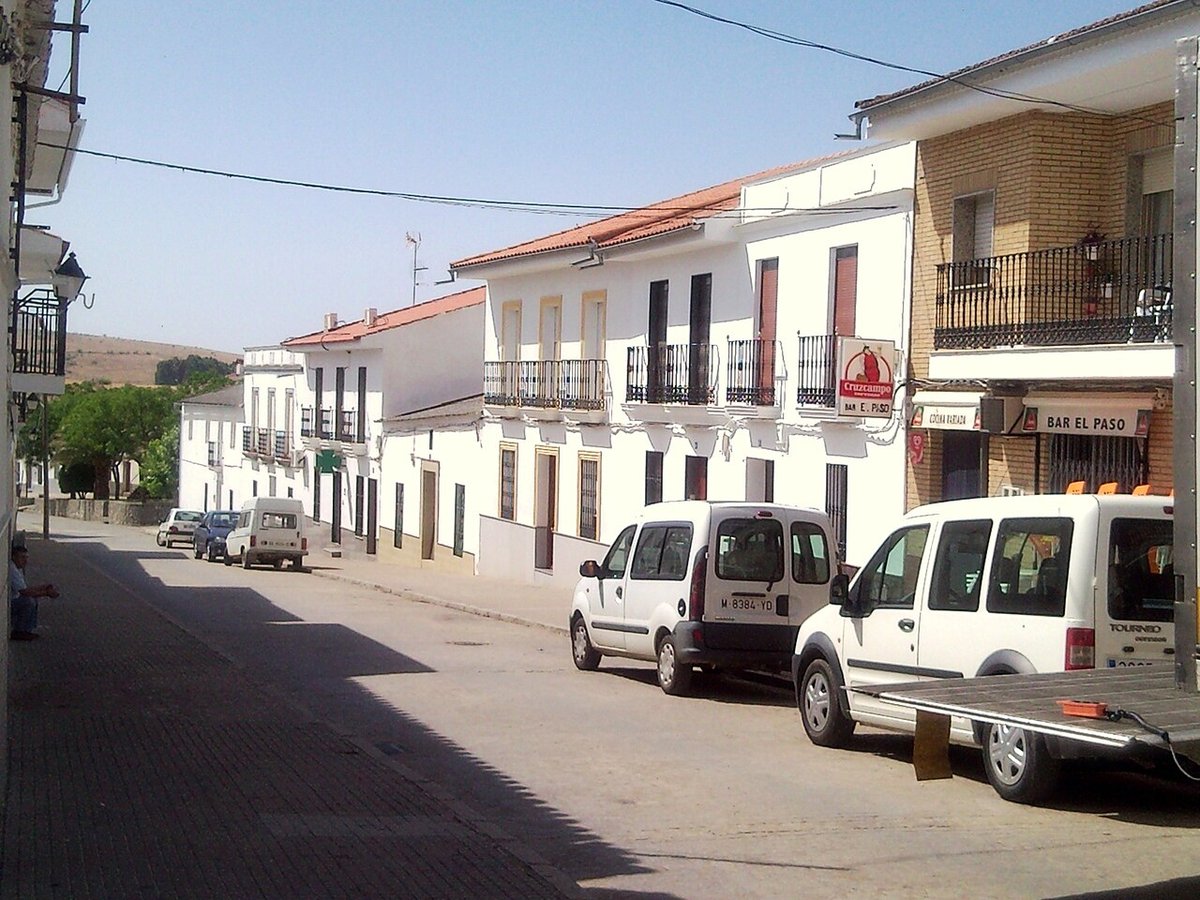
The houses along Calle Real follow a pattern common across this part of Extremadura. Whitewashed walls, two storeys and, in some cases, stone doorways. Some façades display coats of arms or older architectural details. Many are attributed to the 18th century, although their condition varies.
Step away from the main street and the atmosphere shifts slightly. There are courtyards, outbuildings and larger houses that hint at the town’s agricultural past. Campillo de Llerena is not a preserved monument. It is a place that continues to function much as it always has, with its history woven into daily life rather than set apart from it.
The quieter side streets
A few short streets still preserve older façades with minimal alteration. Callejón del Carmen and Calle Santa Ana are clear examples. White walls, small windows and very little traffic define these spaces.
They take only minutes to walk, yet they help make sense of the town’s layout. The historic core here is simple and compact, without the layers or complexity found in larger towns. That simplicity is part of the experience, offering a clearer view of how the settlement developed and how it is used today.
There is no sense of spectacle in these streets. Instead, they provide a quieter, more domestic perspective that complements the openness of the Plaza Mayor.
Fields and paths beyond the houses
Just beyond the last houses, dirt tracks begin almost immediately. These paths run between agricultural plots and form part of the working landscape rather than a designed network of walking routes.
Cereal crops dominate the surrounding fields, with some olive groves and scattered vegetable plots closer to small streams or old water sources. The terrain is open and practical, shaped by farming needs over time.
There are no signposted trails, so walking here is informal. Comfortable footwear is advisable, and the sun should not be underestimated, particularly outside the cooler seasons. Spring and autumn offer the most pleasant conditions for being outdoors.
In these open areas, it is not unusual to see birds, especially near streams or temporary pools of water that appear after rainfall. These moments add a quiet layer of interest to what might otherwise seem like a simple rural setting.
Local life and seasonal events
The calendar of Campillo de Llerena follows the familiar rhythm of many towns in the region. Patron saint celebrations usually take place in summer, with processions and activities held in the streets.
At other points in the year, there may be fairs or small events linked to agriculture and harvests. These are modest occasions, aimed primarily at residents rather than visitors. They offer a glimpse into local traditions without being staged or adapted for tourism.
The atmosphere during these times remains consistent with the town itself. Nothing feels oversized or designed to impress. Instead, events reflect the community and its routines.
When to go and how to get there
Spring and autumn are the most comfortable seasons for walking through the town and exploring the surrounding paths. Temperatures are more manageable, making it easier to move between the centre and the countryside.
Summer visits are still possible, but timing matters. Early morning or late afternoon is best, as the heat becomes intense in the middle of the day and there is little shade. In winter, temperatures drop noticeably once the sun goes down.
Campillo de Llerena is located in the Campiña Sur area of Extremadura. The usual approach is by road from Llerena, followed by regional routes that connect the surrounding towns. The journey is not complicated, although distances in this part of the region can take longer than they appear on a map.
A simple way to experience it
A brief visit is enough to understand Campillo de Llerena. About an hour in the centre allows time to walk along Calle Real, reach the Plaza Mayor and see the Iglesia de Santa María Magdalena.
After that, heading out along the surrounding paths adds context. The relationship between the town and its farmland becomes clearer when seen from the outside looking back in.
There is little need to plan beyond that. Campillo de Llerena is best approached without a tight schedule. It is a place that reveals itself quickly, yet makes more sense when viewed as part of the wider landscape that sustains it.