Full Article
about El Gordo
Known as the village of the storks for its large colony; set on an island in the Valdecañas reservoir.
Hide article Read full article
A village shaped by its surroundings
El Gordo sits on the agricultural plain of Campo Arañuelo, in the north-east of Cáceres. For centuries, life here has been organised around cereal farming and the dehesa—the managed landscape of holm oaks used for grazing. The population now stands at around 360. Distances are short and the pace is that of a working village.
The place makes most sense when you see it in relation to its land. Open fields extend in every direction, crossed by farm tracks. The river Tajo is a presence felt more than seen, influencing the old routes and patterns of cultivation from a distance. This isn't a settlement of landmarks, but of continuity between the fields and the built-up centre.
The houses reflect that rural economy. You see thick walls of local stone, adobe, and lime, with interior courtyards and simple, unadorned façades. There's no architectural display, but a consistency that becomes apparent when walking the streets: these are buildings made for utility, from materials found nearby.
The church of San Pedro
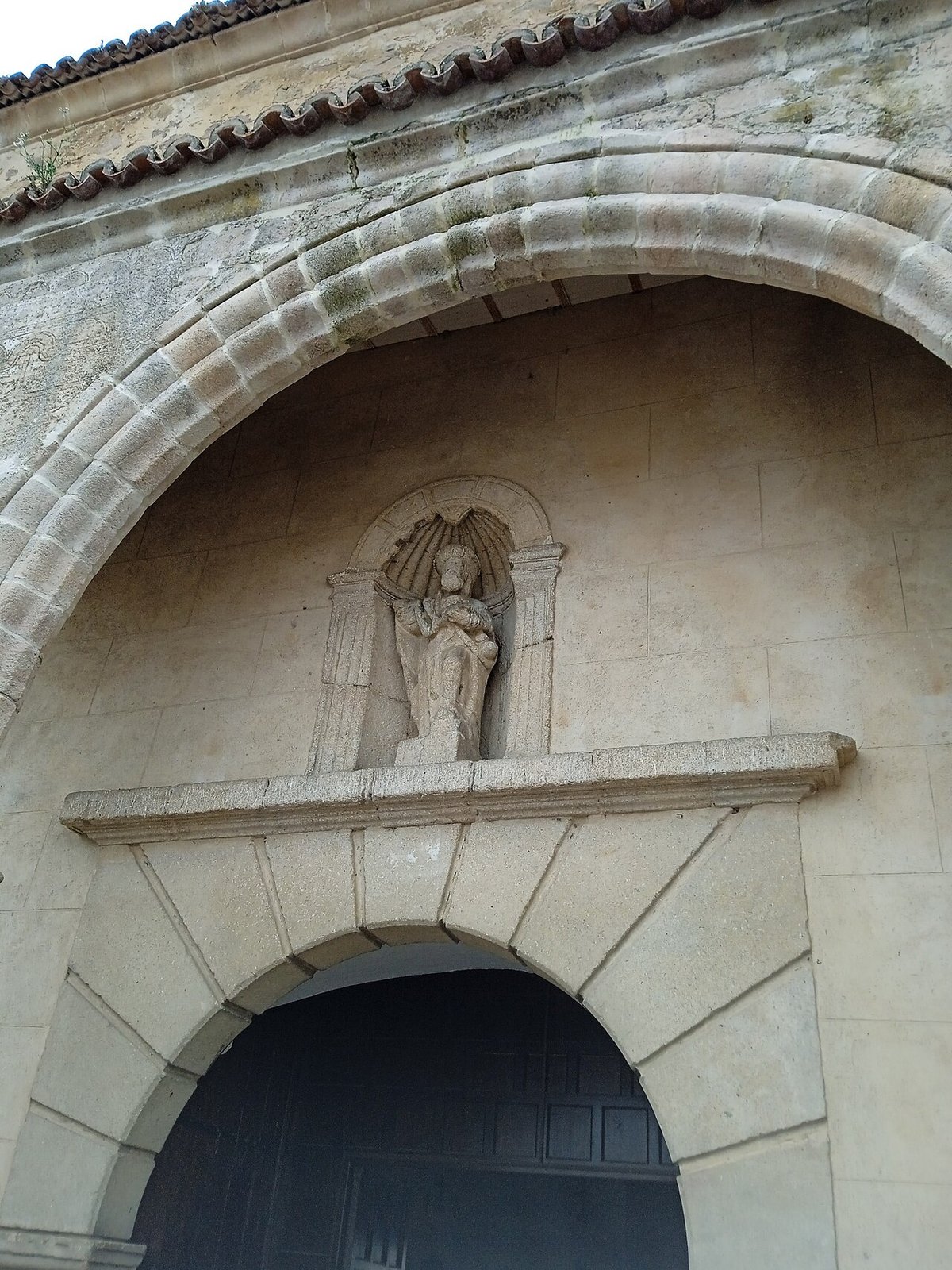
The parish church of San Pedro occupies the centre of the village. Its structure dates from the 16th century, with modifications made likely in the 18th. It is not large, nor is it ornate, which is typical for a community of this size.
Inside, the decoration is restrained. The altarpieces are of simple design and the space feels modest. What matters here is less the interior detail and more the church's role in organising the village. As in many settlements across Extremadura, it acts as an anchor: the plaza opens before it, and the main streets radiate outward, shaping daily movement.
Its central position makes it a natural reference point. From here, you can observe the rhythm of the village—how people move and how the built space unfolds.
Streets and everyday architecture
From the church, several short streets branch off. Traditional building forms remain visible. Many houses retain their enclosed courtyards and outbuildings, structures once directly linked to farm work or livestock.
Some façades still have south-facing wooden galleries. These were not built for decoration; they were used to capture winter sun and to dry produce from the fields. Details like this show how domestic architecture was adapted to climate and labour.
Walking these streets reveals a practical architecture shaped by necessity. The materials, the orientation of spaces, the way buildings connect—all speak of a life tied closely to the land. Even where modern updates have been made, that underlying logic is still recognisable.
The landscape of Campo Arañuelo
Beyond the last houses, the landscape opens almost immediately. Fields of cereal dominate, alternating with dehesas of holm oak. The horizon is low and wide, a defining feature of this part of Cáceres.
The Tajo lies at some distance, but its influence is historical and ecological. It has shaped traditional routes and cropping patterns. Locals often note the movement of birds along its corridor, particularly with the shift of seasons.
This relationship between land and water isn't always obvious at first glance, but it underpins what you see. The openness, the agricultural cycles, even the dirt paths cutting through fields are part of a system that extends far beyond the village limits.
Walking the surrounding tracks
The agricultural tracks that circle El Gordo offer a clear sense of the area's scale. These are not signposted hiking routes; they are working paths used to reach plots of land.
Walking them provides a different perspective. From outside, the low profile of the village becomes clear, with only the church tower rising slightly above the rooftops. The simplicity of the skyline mirrors the restraint seen in the streets.
Be aware that shade is scarce on most stretches, and the heat in summer is intense. These are paths made for work, not leisure, and that character is evident.
They do, however, allow for a slower way of seeing. The distance between houses and fields, the quiet, and the sheer continuity of the landscape become more apparent when you move at walking pace.
Before setting out
You can walk through the centre of El Gordo in under an hour. Another hour lets you follow one of the outer tracks to see the village within its landscape.
Spring and autumn are the mildest seasons. Summer heat dictates the local daily routine, while winter can be cold and notably quiet.
The village is usually reached from Navalmoral de la Mata via local roads crossing the plain. It's wise to check for services beforehand; in a settlement this size, not everything stays open year-round.
The plan here is straightforward: a walk through the streets, time spent observing the relationship between buildings and fields, and a chance to see how a small Extremaduran village is organised by its surroundings.