Full Article
about Benquerencia de la Serena
A hilltop castle crowns the village, commanding sweeping views of the plain; noted for its rock art and vernacular architecture.
Hide article Read full article
Arriving in Benquerencia de la Serena
Tourism in Benquerencia de la Serena is straightforward. You arrive via regional roads and enter the village directly, with no build-up or grand approach. Parking is usually easy to find near the centre without much circling.
In summer, timing matters. It is better to arrive early in the day, as the heat becomes intense from midday onwards and the streets empty out noticeably. The pace slows even further, and there is little movement beyond daily routines.
Benquerencia de la Serena has a population of just over 700 people. It is a quiet place in the La Serena region of Extremadura, where life continues more out of habit than in response to visitors. This is not a destination shaped around tourism, and that defines the experience from the start.
The Castle and the High Ground
The most visible feature is the castle. Set on higher ground, it can be seen from almost anywhere in the village and naturally draws attention.
What remains today are the ruins of a medieval fortress. The structure is still recognisable, though much of it has been lost over time. Visiting does not take long. The path up is simple, and once there, it is mostly a matter of walking around and taking in the surroundings.
From this elevated point, the landscape becomes the main focus. La Serena stretches out in all directions: open land, agricultural fields and dehesa, a type of pasture dotted with holm oaks typical of western Spain. On clear days, the horizon seems distant and uninterrupted, with very little to break the line of sight.
This view explains the area better than any description. It is wide, exposed terrain, shaped by farming and seasonal change rather than dense settlement.
The Church and Village Centre
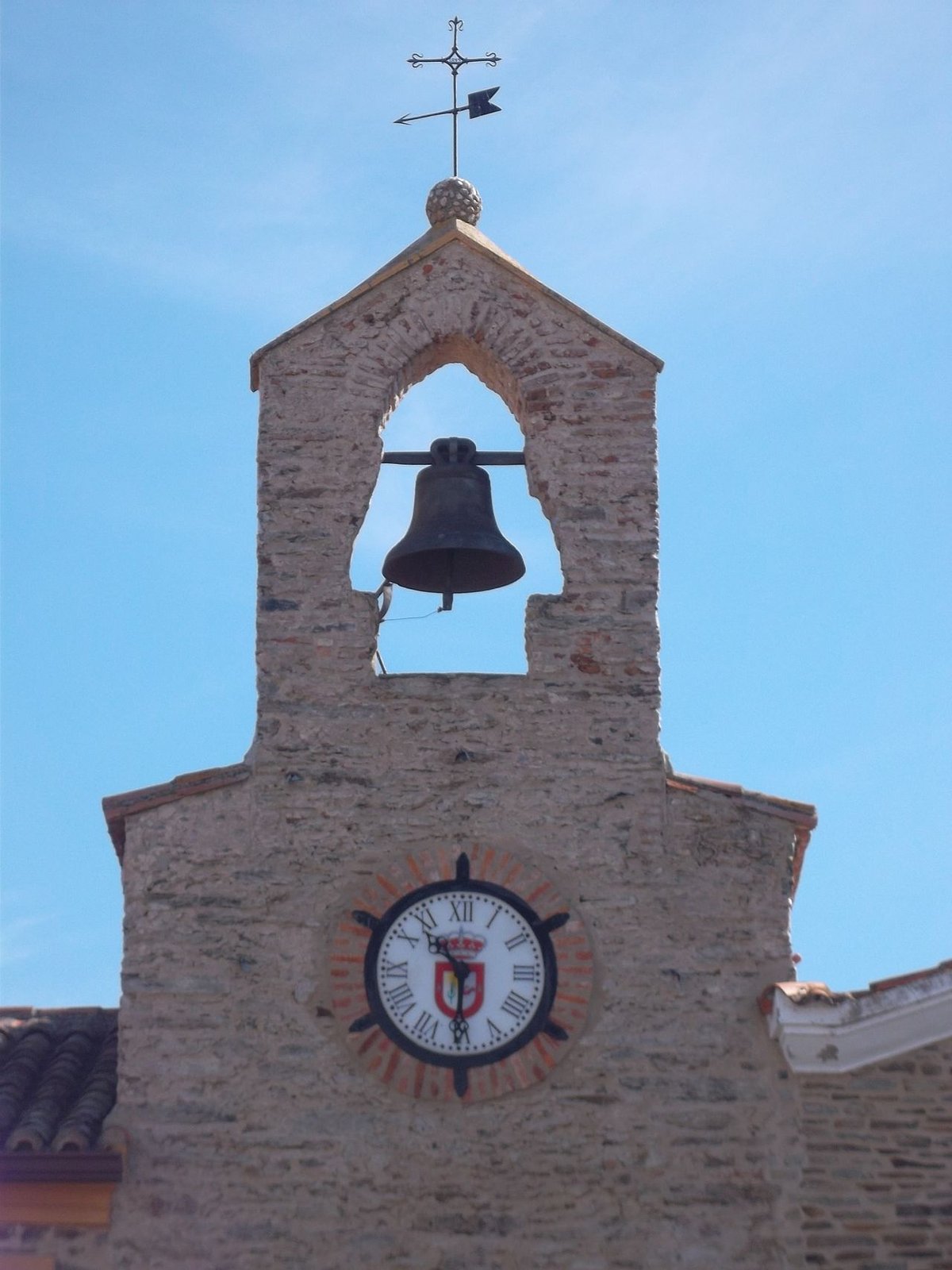
The parish church stands in the main square. It dates from the 16th century and has a simple tower that does not dominate the skyline in the way the castle does.
Inside, there are no particularly striking features. The building shows signs of alterations made over time, and the overall impression is functional rather than ornate.
The centre of Benquerencia de la Serena can be covered quickly on foot. Streets are lined with whitewashed houses, with sections of stone walls appearing here and there. During the week, it is notably quiet. There is little background noise, and daily life unfolds at a steady, unhurried pace.
Nothing feels staged or arranged for visitors. The village remains primarily a place to live rather than a place to visit.
The Landscape Around: Open Countryside
Benquerencia de la Serena has always depended on the countryside around it. The surrounding land is used for farming, and it is common to see plots with sheep and goats, alongside cereal crops.
The appearance of the landscape changes significantly with the seasons. In winter, the fields are green, while during harvest periods they turn yellow or brown. These shifts define the visual character of La Serena more than any single landmark.
For those who enjoy walking, rural tracks begin directly from the village. Some walkers follow sections of the GR‑10, a long-distance footpath that crosses the region. However, the route is not always clearly marked on the ground. It is advisable to carry a map or GPS, or to ask a local resident before setting out.
In open areas away from the built-up centre, steppe birds are commonly seen. Early morning offers the best chance to spot them, especially if you move a little further out into the countryside where there is less disturbance.
Local Life and Festivities
Festivities in Benquerencia de la Serena follow the rural calendar. Events are typically linked to the church or nearby hermitages, small religious buildings found in the countryside, and there may also be a romería, a traditional pilgrimage or procession held in the surrounding area.
These are not celebrations designed to attract visitors. Participation comes mainly from residents of the village and people from nearby towns. The atmosphere reflects local traditions rather than organised tourism, with a focus on continuity rather than spectacle.
Food in Benquerencia de la Serena
Food here follows the logic of the region. Meals are based on local products, especially those linked to traditional livestock farming.
Common elements include:
- Products from the matanza, the traditional slaughter and preservation of pork
- Cured meats and sausages
- Sheep’s or goat’s cheese
Dishes tend to be simple and familiar, with no emphasis on long menus or modern cuisine. What is served reflects what has been eaten in villages across La Serena for generations. The approach is practical and rooted in availability rather than presentation.
A Practical Way to Visit
Benquerencia de la Serena is not a place for a full day of sightseeing, and it does not try to be. There are no major monuments beyond the castle, and the village itself can be seen in a relatively short time.
A brief stop works best. Spend an hour walking through the centre, visit the castle, and take in the view. After that, it makes sense to continue exploring the wider La Serena region.
This part of Extremadura is better understood by moving through it, driving between different نقاط and stopping along the way, rather than staying in a single village. Benquerencia fits naturally into that kind of route: a quiet pause that reflects the wider landscape.