Full Article
about Helechosa de los Montes
In the heart of the Siberia Biosphere Reserve; known for its big-game hunting grounds and the Cijara reservoir.
Hide article Read full article
A village set apart
Helechosa de los Montes sits far from almost everything. It belongs to the comarca of La Siberia, between the Guadiana and the Estena rivers. The approach is along the EX‑118. Before any houses appear, there is a water treatment plant and a few hunting signs, a reminder of the landscape that surrounds the village.
Its recent history mirrors that of many places in the area. There were more people here decades ago; now there are fewer. That sense of distance and change is part of what defines Helechosa today.
Getting in and getting around
Parking is straightforward. The centre is small, with no regulated zones or anything similar, and a side street will usually do.
If you arrive during a summer festival, it is better to leave the car before the bridge and continue on foot. At other times of the year, you can get close to the main square without difficulty.
One practical note stands out: the nearest petrol station is quite far away. It is worth arriving with enough fuel rather than relying on finding somewhere nearby.
A short walk through the centre
The heart of the village is dominated by the church of Nuestra Señora de Altagracia. Its brick bell tower stands out, and inside there is a Baroque altarpiece. Local accounts say it survived the war because it was covered with lime, a detail that still circulates in conversation.
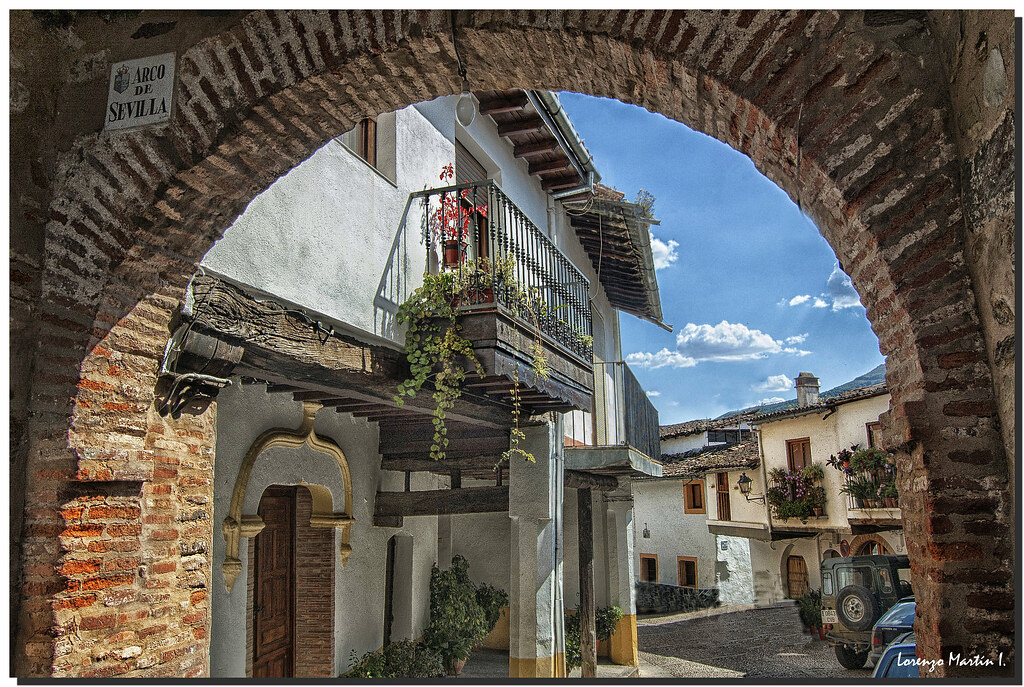
The square brings together several elements typical of small towns in Extremadura. There is a fountain, a rollo de justicia, a historic stone column linked to past legal authority, and stone benches. The façades around it are striking for their decoration. Many feature sgraffito patterns that imitate brickwork, with reddish lines drawn over white plaster. Up close, the effect is simple but distinctive.
The centre does not take long to explore. In about twenty minutes, a full circuit of the streets is done. The pace is slow, the scale modest.
Food traditions remain tied to local life rather than formal dining. In homes, especially during gatherings or celebrations, dishes such as caldereta, a rich meat stew, and migas, fried breadcrumbs with savoury additions, are still prepared. It is also common to come across people selling produce like mountain honey or sheep’s cheese. This reflects the dehesa landscape around the village, where grazing and small-scale production shape everyday life.
Paths, water and open land
Beyond the houses, the surroundings offer simple walks rather than marked routes. From the cemetery, a path leads towards the Estena river. It begins with a gentle climb and then descends to the water. The distance is not long and it can be managed easily with some water to hand.
Near this route there are remains of an old aqueduct, along with ruins whose origin is uncertain. Some locals say they belonged to a castro, an ancient settlement, while others think they were no more than a livestock enclosure. The lack of agreement adds a layer of curiosity without turning the place into a formal site.
Another option is to follow the service road of the Cíjara dam. The surface is asphalt and it is used by guards and fishermen. The landscape opens up here, with wide views over the reservoir and surrounding land. It is possible to spot vultures overhead, and on quiet days, deer near the shore. Certain areas close to the dam are restricted, and the signs should be respected.
Before reaching the reservoir, the Estena forms a series of pools. In summer, people come here to bathe. The water is cold and the bottom is muddy, which shapes how the place is used and experienced.
Local celebrations through the year
The festive calendar follows patterns common in this part of Extremadura. In winter, San Blas is marked with a bonfire and the sharing of food in the square. It is a simple gathering, centred on warmth and community.
Spring brings a romería, a pilgrimage to a nearby hermitage. Many people make the journey by tractor or trailer, turning the event into a social outing as much as a religious one.
During Corpus Christi, figures known as diablucos appear. They wear simple masks and run through the streets handing out lupins. The moment is brief, after which the procession continues.
August changes the rhythm of the village. More people return, often those who live elsewhere for most of the year. Communal meals and open-air dances become part of daily life for a while, and the population swells before settling back again.
A place that keeps its pace
Helechosa de los Montes does not offer large monuments or a historic centre packed with sights. The appeal lies elsewhere. A visit works best when approached without hurry.
A short walk around the square, some time by the Estena, and a look out over the reservoir from higher ground is enough to get a sense of the place. Autumn and winter bring a different atmosphere, when the dehesa smells of damp holm oak and there is less movement overall.
Anyone looking for somewhere widely photographed may prefer to continue along the road. Helechosa follows its own rhythm. It is a small village that continues much as it is, shaped by its setting and by those who remain.