Full Article
about Herrera del Duque
Historic capital of Siberia Extremeña; it has a Templar castle.
Hide article Read full article
A Town Shaped by Its Position
Herrera del Duque makes more sense on a map than on its welcome sign. It sits in La Siberia extremeña, in the north-east of Badajoz, already close to Castilla-La Mancha. For centuries this was a crossing point between the Meseta and the Guadiana valley, and that frontier condition still explains much of its layout today: a castle dominating the hill, a solid-looking church, and a cluster of houses spreading out around the main square.
The landscape around it feels open and transitional. Dehesa stretches outwards, dotted with trees and low hills, and the sense of distance between places is part of daily life. It is a setting where movement has always mattered, whether for traders, shepherds or travellers passing between regions.
Fortified Views and Local Devotion
The castle overlooking the town dates back to the Almohad period, probably the 12th century, although what stands today reflects later rebuilding. After the Christian conquest it passed into the hands of the Sotomayor family, who reconstructed it in the early 15th century when they were granted lordship of the area. Its polygonal layout and high walls follow a straightforward idea: control the surrounding land. From the top, the view stretches across a wide expanse of dehesa and low sierras that now belong to several provinces.
Below, the church of San Juan Bautista follows a similar defensive logic. Its cylindrical buttresses give it an almost military appearance. Inside, things are more restrained than expected. Much of its heritage was lost in 1936, and what remains is largely the result of later replacements. One piece has endured and is still well known locally: a silver processional monstrance that appears during celebrations dedicated to the Virgen de la Consolación.
Devotion to this figure is tied to a local story. According to tradition, the image was found in a cork oak in the 15th century, on the site where the hermitage now stands. Each September, residents walk the route up to that spot, turning the path into a shared act of memory as much as a religious one.
Water and the Changing Landscape
To the north of the municipality, the dehesa gives way to the García Sola reservoir. This large stretch of water on the Guadiana transformed both the landscape and the local economy in the 20th century.
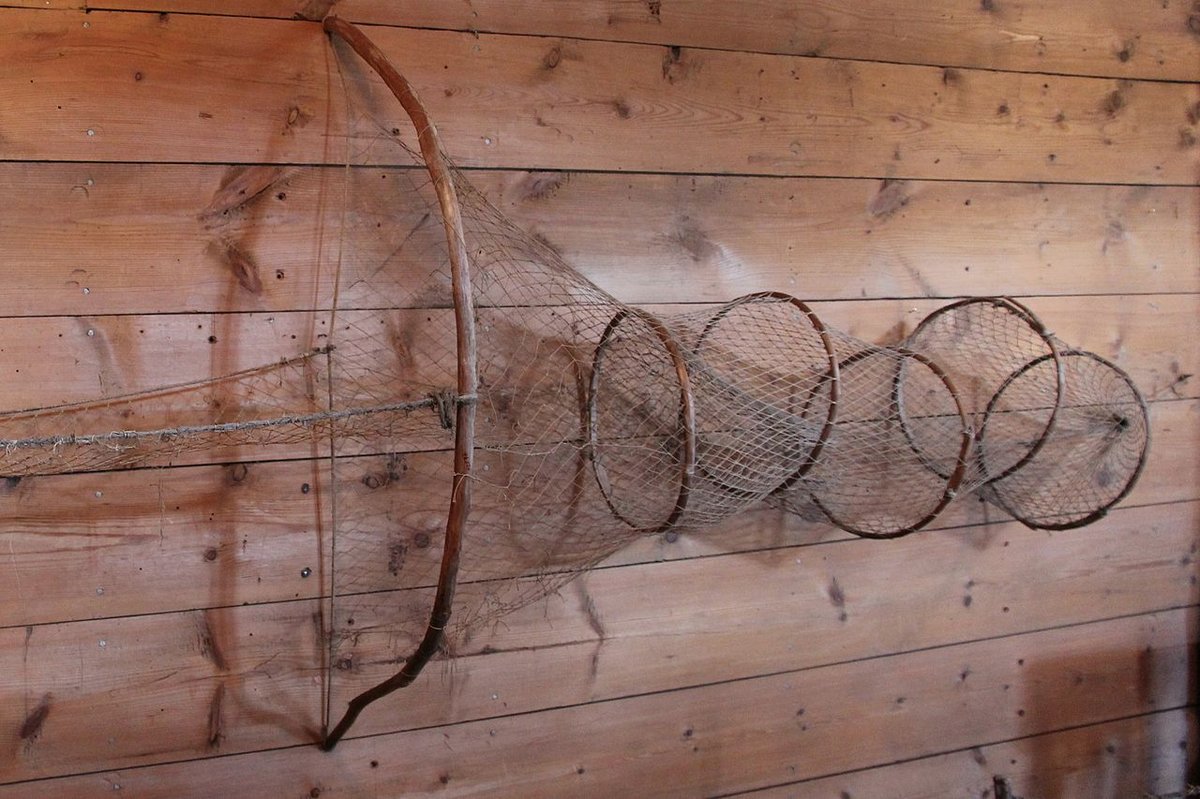
Beside it lies the small settlement of Peloche. Its steep streets and low houses reflect its modest scale, and its development is closely linked to the reservoir and fishing. Conversations here still turn to escarapuche, a simple stew made with fish from the reservoir, usually boga or barbo, along with paprika, garlic and bay leaf. It is a winter dish, the kind that calls for bread and a spoon.
Colder months also bring caldereta de cordero, a lamb stew common across this part of Extremadura. Recipes often include young garlic and pimentón de la Vera, a paprika that has long been part of the region’s cooking.
Water is not only present in the landscape. Within the municipality there is also a mineral water bottling plant that provides employment for part of the population. It comes up often in local conversation: a source of steady work, but also a reminder that the area’s main resource travels far beyond its boundaries.
Paths That Meet at the Square
Plaza Mayor is at the centre of daily life. It is not especially large, but it brings together the town hall, a dark stone fountain often seen in photographs, and several buildings from different periods.
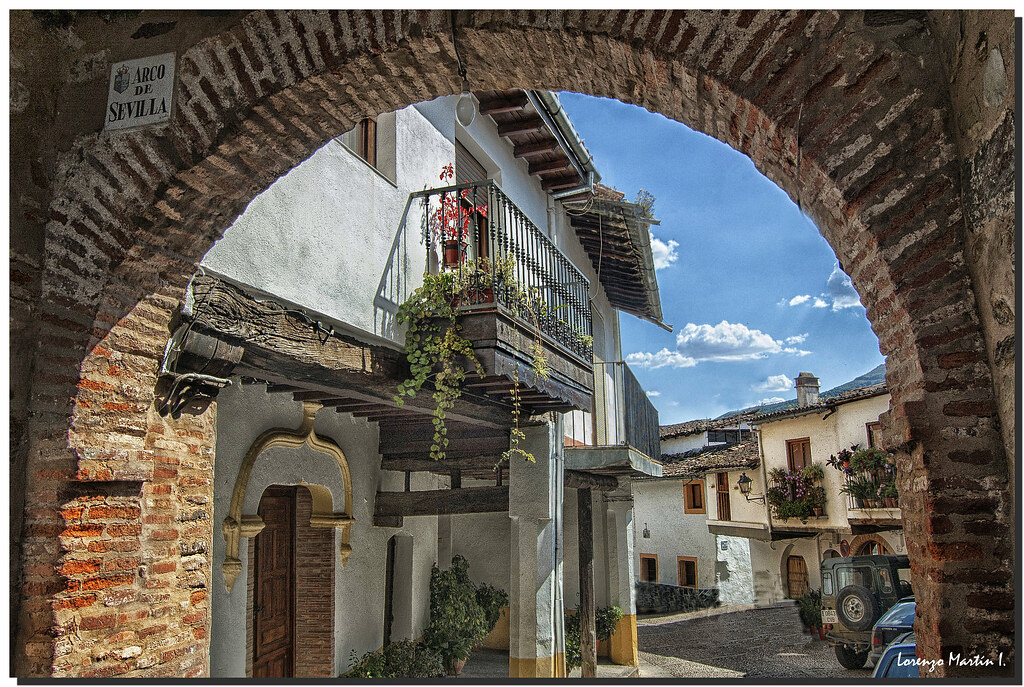
From here, a few straightforward routes help make sense of the place. One climbs towards the castle, passing old houses with coats of arms that recall the families who once held influence here. Another heads down towards the reservoir, ending near rocky outcrops where griffon vultures can often be seen riding the air currents.
The path leading to the hermitage of the Consolación is perhaps the most familiar to locals. Today it is partly paved, but for a long time it was a mule track used by carriers crossing the sierra on their way to La Mancha. The route still carries that sense of movement between regions.
The Rhythm of the Year
The festive calendar in Herrera del Duque follows a pattern common to many inland towns, where celebrations depend heavily on the involvement of residents.
Carnival arrives in February, with groups and costumes often prepared at home. In May, crosses decorated with flowers appear, the result of days of preparation by women in the town. Easter is more restrained, with smaller processions, floats carried by locals, and the steady sound of drums echoing through the narrower streets of the centre.
The main festivities take place at the beginning of August. This is when many people who live elsewhere return, and the pace of the town shifts for a few days. Activities gather in the square, music fills the evenings, and encierros, traditional bull-running events, draw people from nearby towns.
Getting There and Moving Around
Herrera del Duque is relatively isolated from Extremadura’s largest cities, yet well placed when viewed on a map of central Spain. It sits within reasonable distance of Cáceres, Córdoba, Toledo and Ciudad Real. Most visitors arrive by car, and parking in the centre is usually straightforward.
The essential route through the town is best done on foot. The climb up to the castle is short and offers an immediate sense of the territory: dehesa, gentle hills and, in the distance, the shimmer of the reservoir. The church of San Juan Bautista is generally open in the mornings, though in a small town routines can vary.