Full Article
about Sancti-Spíritus
A small village in Siberia with genuine rural character; noted for its church and natural setting.
Hide article Read full article
A village shaped by distance
At the far interior edge of La Siberia extremeña lies Sancti Spiritus, a very small municipality that today has around 141 residents. It sits well away from major roads, and that distance explains much of its character. Change has been slow here, and the surrounding landscape still sets the rhythm of daily life.
La Siberia is a large, sparsely populated region in the north-east of the province of Badajoz. For centuries it functioned as livestock territory. Estates and dehesas structured both land use and settlement. Sancti Spiritus emerged within that rural system and is still understood through it today.
The name of the village points to a religious origin, something common across this part of Extremadura. Even so, the first impression on arrival is not history but scale. The built area is compact. Short streets, low houses and whitewashed façades define the whole.
The church and the centre
The parish church stands at the centre of the village. It is not a monumental building, and it does not aim to be. Its role is more practical, acting as a meeting point for local life. Nearby, the square gathers activity when the weather allows.
The church reflects different periods of alteration. This is typical in small places where construction depended on available resources. Older sections sit alongside more recent repairs, creating a layered appearance rather than a single, unified design.
This central space gives a sense of how the village works. Daily routines tend to converge here, even in a place where everything remains within a short distance.
Streets, houses and everyday architecture
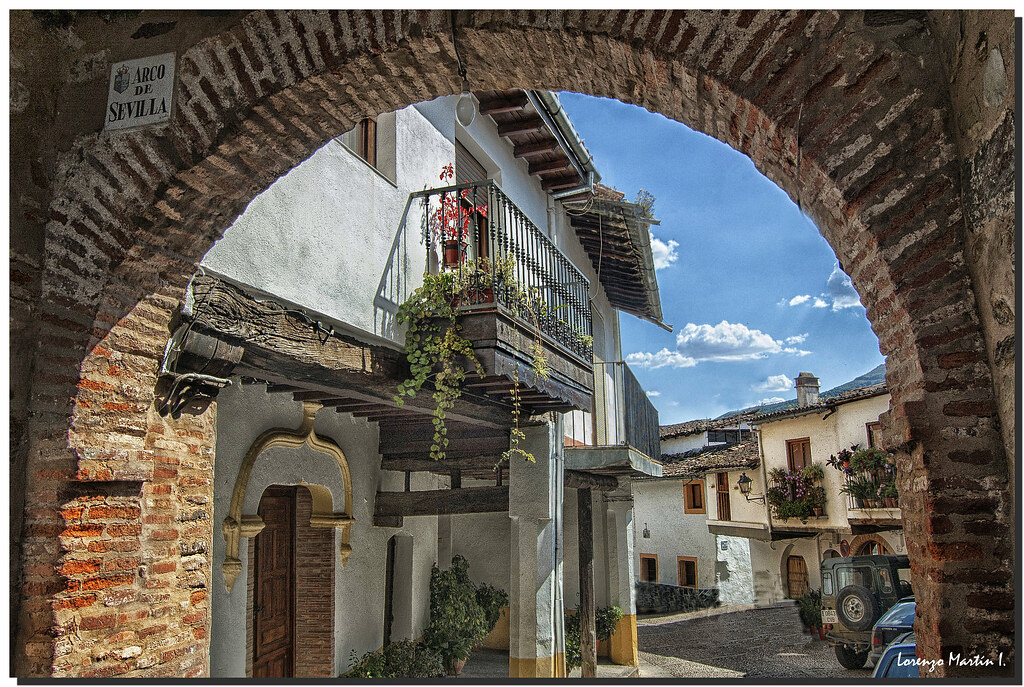
Sancti Spiritus can be explored quickly, but it rewards a slower pace. The houses retain clear features of rural Extremaduran architecture. Stone walls and lime coating are common, along with roofs covered in curved tiles.
Iron grilles and wooden doors still appear on many façades. Behind them, there are often patios with small vegetable plots or modest animal enclosures. These spaces explain the layout of the homes. They were built for practical use rather than display, shaped by work as much as by living needs.
The overall impression is consistent. Materials and forms repeat across the village, giving it a unified feel without any sense of planning for appearance. Everything reflects function first.
Walking through the streets also shows how closely indoor and outdoor life are connected. The transition from house to patio, and from patio to open land, happens with little separation.
The dehesa all around
The landscape surrounding Sancti Spiritus is the dehesa, a distinctive system of open woodland. Holm oaks and cork oaks define the terrain in every direction. Between the trees stretch grazing areas where livestock still moves.
Rural tracks link estates and small ponds. Many follow routes that were once used for moving animals. Some of these paths can be travelled on foot or by car without difficulty, although they retain their original character.
A slower walk through this environment reveals one of its most noticeable features: birdlife. Large species are easy to spot. Storks and birds of prey appear regularly, alongside smaller flocks that move across the open spaces. La Siberia is often mentioned in bird studies because of this diversity.
The dehesa is not just scenery. It continues to function as a working landscape, and that ongoing use shapes both its appearance and its rhythm.
Traditions that continue
Local celebrations in Sancti Spiritus remain simple in tone. Summer usually brings together residents and people who return to the village for a few days. Religious processions and events are still part of the yearly calendar.
In winter, the memory of the pig slaughter persists. For generations it was a household necessity, providing food for the year ahead. Today it survives more as a social and family gathering, keeping its place in collective memory even as its original purpose has changed.
These traditions reflect continuity rather than spectacle. They are tied to everyday life and to long-standing practices rather than to large-scale events.
Getting there and moving around
The most common approach from Badajoz follows the N‑430 towards Castuera. From there, the route continues along secondary roads in the direction of Puebla de Alcocer and Sancti Spiritus. The final stretch passes through open dehesa.
Once in the village, walking is the easiest way to get around. Everything lies within a short distance, and the landscape begins as soon as the last houses are left behind. Those who want to explore the surrounding tracks should carry a map or use offline navigation, as signage in the countryside is not always present.
Sancti Spiritus does not rely on attractions or landmarks to define it. Its identity comes from scale, continuity and the close relationship between settlement and land. The pace is set by the dehesa, and that pace remains largely unchanged.