Full Article
about Siruela
Winter capital of the Mesta; a town with a livestock-raising past set amid dehesa in La Siberia.
Hide article Read full article
First steps in Siruela
If you’re coming for tourism in Siruela, start with the practical side. Leave the car at the entrance to the village and continue on foot. The centre is small, and it is rarely worth trying to park inside. You can cover it in a short time. Around midday things slow down noticeably and several shops close, which is typical in places of this size.
Siruela sits in La Siberia, a comarca in Extremadura. It is a calm municipality, not a place defined by major monuments or a perfectly preserved historic quarter. The appeal lies more in its rural setting and the landscape that surrounds it than in a dense list of sights.
Around the village centre
The main point of reference is the church of Nuestra Señora de la Asunción. It stands in a visible part of the town and its tower can be seen from different spots as you walk around. The structure dates from the late Gothic period, although the interior is quite plain. It functions primarily as an everyday place of worship rather than a carefully curated historic site.
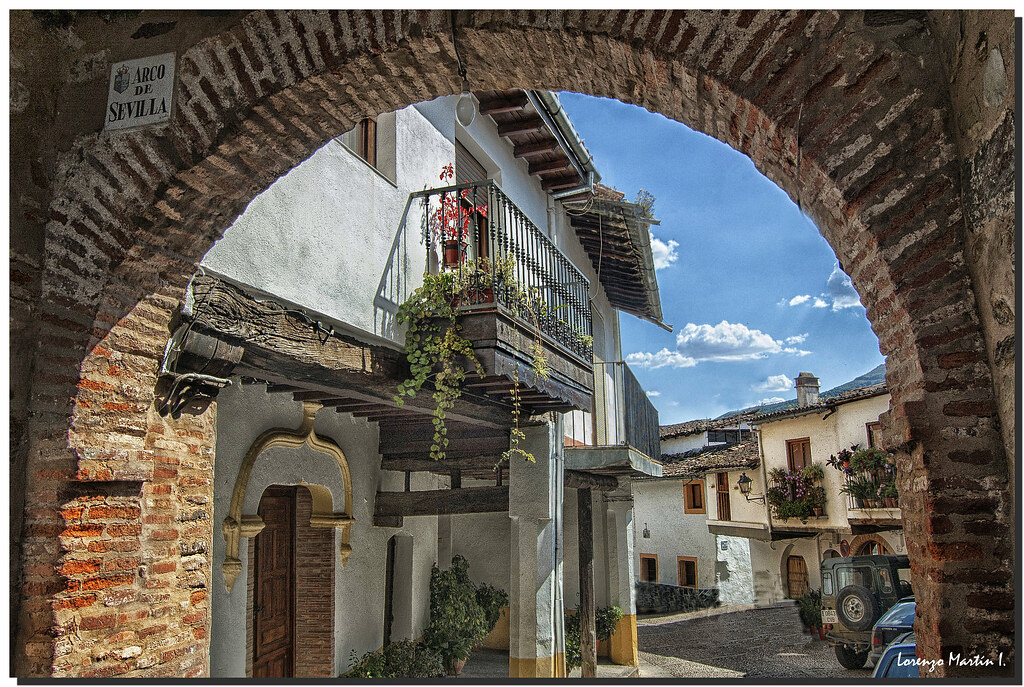
Nearby, there are a few older houses with granite doorways and worn coats of arms. They do not form a continuous historic street. Instead, they appear here and there, mixed in with newer homes. The effect is uneven but interesting if you enjoy small architectural details. A short wander through the streets close to the main square is enough to pick up on these traces of the past without needing a fixed route.
The hermitage and views over the dehesa
A few minutes’ walk from the centre brings you to the hermitage of Cristo de la Misericordia. The route involves a gentle uphill stretch, nothing demanding. In front of the building there is an open space where romerías, traditional local pilgrimages and festivities, are usually held.
From here, the surrounding landscape becomes clear. The dehesa extends in every direction. This is a characteristic type of countryside in western Spain, with scattered holm oaks, open ground and dirt tracks leading out into the fields. It is not a dramatic viewpoint, but it helps you understand the setting and scale of the area.
Paths and countryside around Siruela
The most consistent feature of Siruela is its environment. Agricultural tracks leave the village and spread out across the dehesa. These can be followed on foot or by bike without much difficulty.
Signposting is not always present. If you plan to go further out, it is sensible to have a map on your phone or ask locally about the main routes beforehand. After several days of rain, some sections become muddy and harder to navigate.
At certain times of day, especially early morning or towards dusk, wildlife becomes more visible. Deer and wild boar are sometimes seen in open areas, and birds of prey often circle above the holm oaks. This is not a designated natural park, but the countryside still feels active and inhabited.
Food and local traditions
The food in Siruela follows the patterns of this part of Extremadura. Pork products are central, alongside lamb stews and cured meats prepared during traditional matanzas, the seasonal slaughter carried out in colder months. The dishes are straightforward and filling.
In autumn, when the first rains arrive, some people head out to look for wild mushrooms in the surrounding countryside. If you are not familiar with the different varieties, it is best to go with someone who is.
The main festivities are linked to the patron saint, the Virgen de la Asunción, usually celebrated in August. There is also typically a romería at the hermitage of Cristo. During these days, the village becomes noticeably livelier than usual, with more activity centred around the streets and gathering spaces.
Before you go
It helps to arrive with the right expectations. Siruela is not a monumental town. It works better as a quiet stop or as a base for exploring La Siberia. If walking through the dehesa and observing everyday rural life appeals, it delivers that without crowds. If you are looking for a dense historic centre or a long list of landmarks, you may find that you have seen most of it within an hour.