Full Article
about Garganta la Olla
One of the prettiest villages in La Vera; a historic ensemble with legends of the Serrana.
Hide article Read full article
A village shaped by terrain
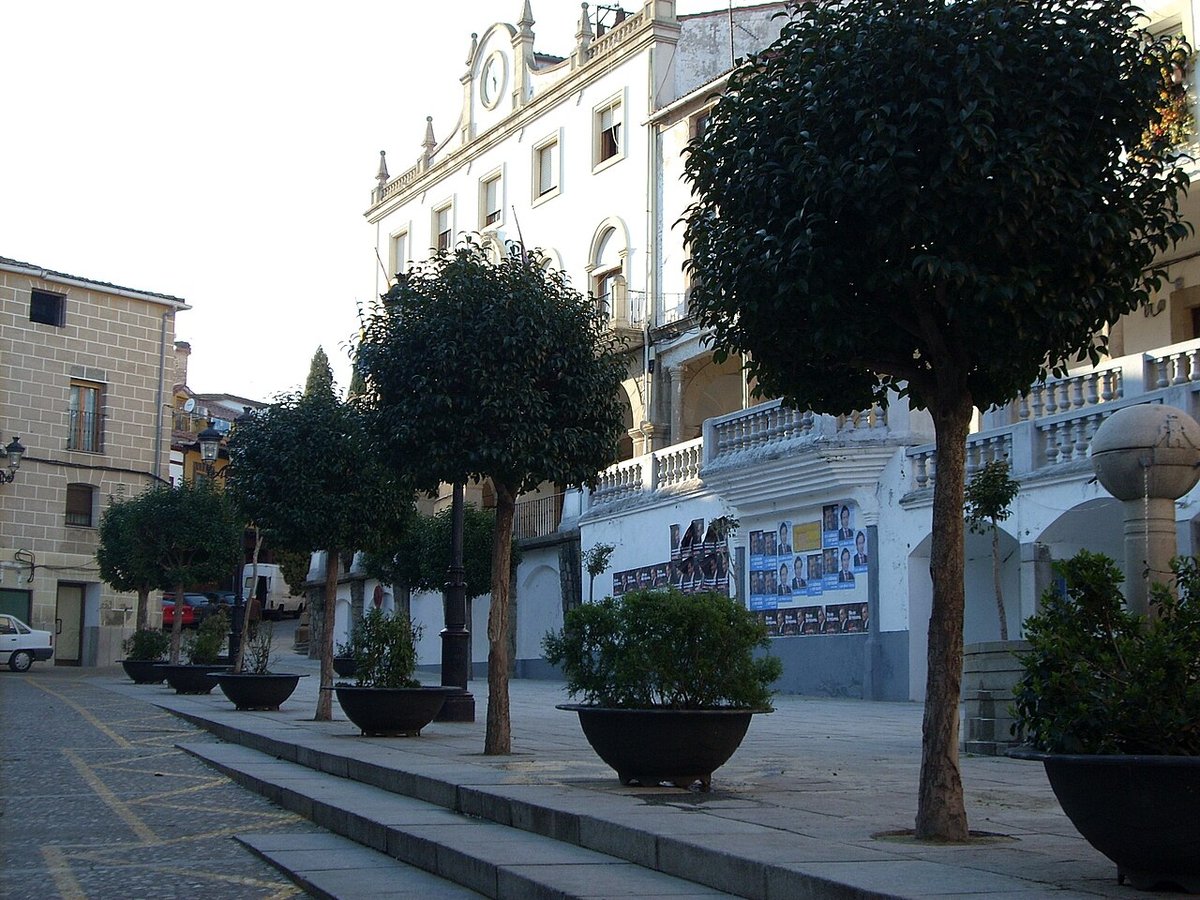
In La Vera, in the north of Cáceres, the landscape sets the rules. Garganta la Olla grew beside the Garganta Mayor, on uneven ground that required careful, patient building. Today, tourism in Garganta la Olla still revolves around that same terrain and a town layout that has barely shifted from its original logic.
The village has around nine hundred inhabitants and sits at roughly 590 metres above sea level. Its streets are narrow and often steep. Many houses combine stone, adobe and timber framing. This is not decorative. It reflects traditional building methods in the mountains, designed to insulate against both cold winters and hot summers.
The historic centre was declared a Conjunto Histórico-Artístico in the 1990s, a Spanish designation recognising its cultural and architectural value. The reason becomes clear when walking through the old quarter. Wooden balconies and overhanging galleries follow the irregular lines of the streets. Public fountains appear along the way, including the Fuente del Chorrito and the Fuente de los Tres Caños. For centuries, water shaped daily life here.
Buildings that tell the story
One of the best-known structures is the Casa de la Inquisición. The building is usually dated to the 15th century, although it has undergone later alterations. Its façade clearly shows the traditional timber-framed construction. Upper floors project outwards, adapting to the slope of the street below.
At the centre of the village stands the church of San Lorenzo Mártir. The current structure reflects different construction phases. Late Gothic elements can be identified alongside later modifications. Its masonry tower dominates the square. Inside, religious pieces from the 16th and 17th centuries are preserved, though the main interest lies in the building itself and how it fits into the surrounding urban layout.
Nearby, several houses display notably developed wooden galleries. Some rest on low arcades at street level, others extend outwards to create additional space above. Buildings such as the Casa del Postigo help explain this domestic architecture typical of La Vera, where adapting to the terrain often meant building outwards rather than upwards.
Water and the surrounding landscape
The Garganta Mayor flows just outside the village. Along several stretches, it forms natural pools. During the summer months, these are used as bathing spots, mainly by people from the surrounding area. The water remains cold, even at the height of the heat.
The landscape around Garganta la Olla includes areas of oak and chestnut trees. Footpaths lead from the village following watercourses or climbing towards the higher ground of the sierra. One of the known routes is the Ruta de las Gargantas, which links different sections of the valley. Conditions can change depending on recent weather, so it is sensible to check the state of the paths if there has been rain or if the water level is high.
This close relationship between settlement and water is constant. The same streams that shape the land also influence how people move through it, where paths develop and where people gather, especially in warmer months.
Festivals rooted in local life
The main celebrations in Garganta la Olla are the fiestas of San Lorenzo, held in August. These combine religious events with more informal gatherings, and much of the activity centres on the streets of the historic core.
Carnival also has a strong presence. Local groups, known as comparsas, move through the old quarter wearing homemade costumes and playing music. The atmosphere is lively but grounded in local participation rather than large-scale spectacle.
Easter, or Semana Santa, is marked by more restrained processions closely tied to the parish. These events follow a quieter tone, in keeping with traditions seen across many Spanish villages.
In December, the nearby town of Jarandilla de la Vera hosts the festival of Los Escobazos. People from Garganta la Olla and other surrounding villages attend each year. Fire plays a central role, with lit brooms forming part of a long-standing tradition in the region. It is one of the more distinctive winter celebrations in La Vera.
Visiting Garganta la Olla
Garganta la Olla lies along the EX-203 road, within the comarca of La Vera. The drive from Cáceres usually takes about an hour, depending on the route.
The historic centre is best explored on foot. Distances are short, though the slopes and narrow streets require a steady pace. In summer, early starts are advisable for walking or heading towards the water, before the heat builds. Autumn brings a different rhythm, with chestnut trees becoming more prominent in the landscape and the atmosphere noticeably quieter.
The village does not separate its architecture, water and daily life into distinct experiences. They are closely tied together, shaped by the same terrain that first determined where and how Garganta la Olla would be built.