Full Article
about Talaveruela de la Vera
Small Vera town with charm and views of the Sierra de Gredos
Hide article Read full article
Between the Tiétar Valley and the First Slopes of Gredos
Talaveruela de la Vera lies at the western edge of the La Vera region, in the province of Cáceres, where the Tiétar valley begins to rise towards the lower slopes of the Gredos mountains. With just over 300 residents and sitting at around 560 metres above sea level, it is a small settlement shaped as much by its surroundings as by its history.
The setting is defined by a close relationship between cultivated land and the natural environment. Orchards spread around the village, chestnut groves occupy nearby slopes, and small streams descend from the sierra. This balance between water, woodland and agriculture has long determined how people live and work here. The landscape is not decorative in a superficial sense. It reflects a practical system that has developed over generations.
Water at the Centre of the Village
The Talaveruela river runs directly through the village and has played a central role in both its layout and its economy. For centuries, it supplied small family plots and powered mills that have now disappeared or been significantly altered. Even today, that connection to water is still visible in everyday features of the town.
Bridges cross the river at key points, while old washing places recall a time when domestic life was closely tied to the flow of water. Cultivated plots lie close to the riverbanks, reinforcing the sense that the settlement grew in response to this natural resource rather than apart from it.
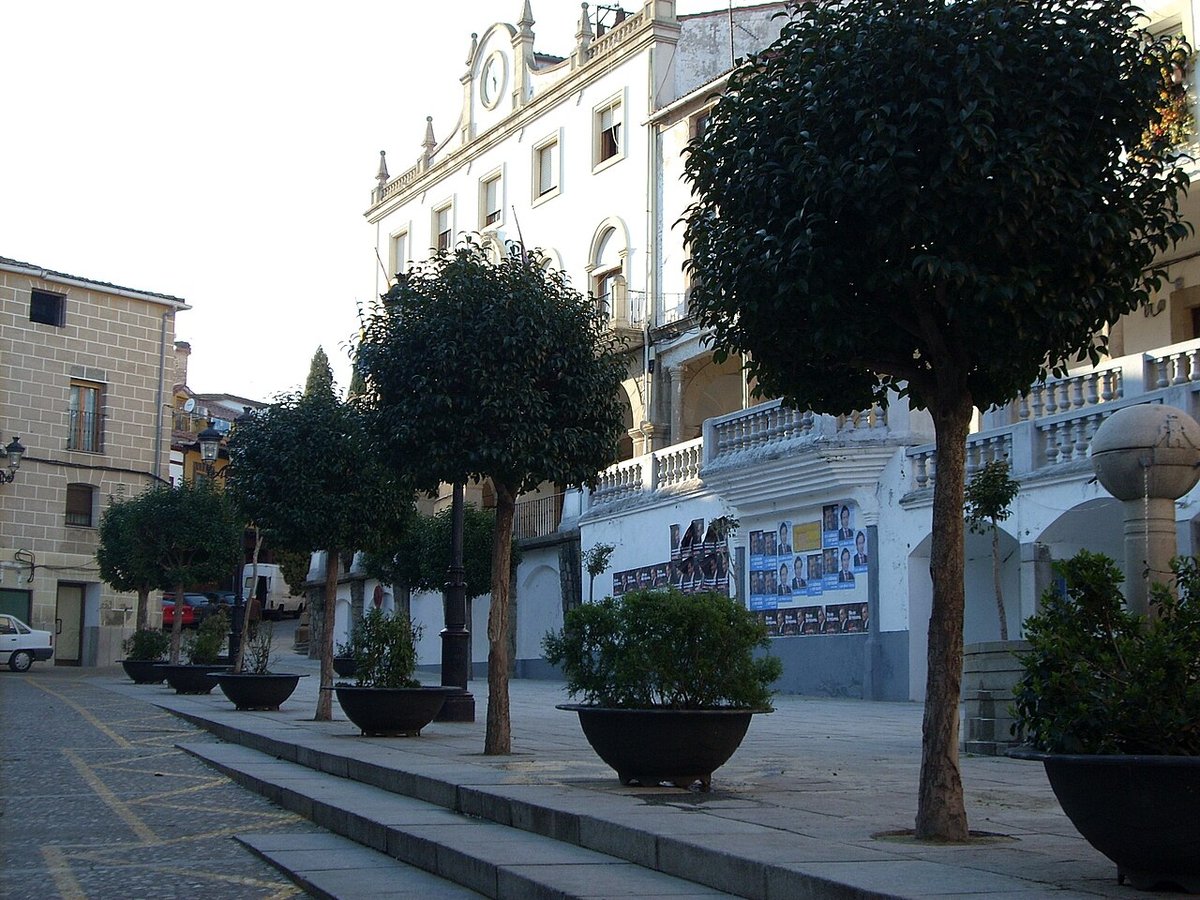
The urban layout is compact. Streets are narrow and paved with stone, following the natural slope of the land rather than imposing a rigid grid. Walking through the village, the terrain is always present underfoot.
Buildings follow the traditional architectural style of La Vera. Stone masonry walls form the base, often combined with timber frameworks. Some houses include projecting upper galleries, designed to provide shade during the summer and shelter from winter rain. Although Talaveruela does not present itself as a monumental ensemble in the formal sense, there is a noticeable consistency in its older buildings. That coherence gives the village a clear identity without relying on standout landmarks.
San Andrés and Local Life
At the centre of the village stands the parish church of San Andrés. Its current structure dates back to the 16th century, although it has undergone later modifications, a common pattern in many churches across La Vera. The building is restrained in style, in keeping with the scale of the settlement.
Its importance lies less in artistic features and more in its role within the community. For generations, the church has been a focal point for gatherings, ceremonies and shared traditions. It continues to shape the rhythm of local life, marking key moments in the year through religious and social events.
This kind of continuity is typical of smaller rural communities in the region, where public space and shared customs remain closely linked.
Paths Through Chestnut Groves and Up to the Sierra
The landscape around Talaveruela changes noticeably with the seasons. Close to the village, chestnut groves and cultivated plots dominate the terrain. As elevation increases, the vegetation shifts, with oak trees appearing and the environment opening out into less densely cultivated land.
La Vera’s relatively humid climate supports vegetation that is less common in other parts of Extremadura. This gives the area a distinct character within the wider region, especially in contrast to more arid zones.
From the village itself, traditional paths lead outwards in several directions. Some climb towards the mountains, while others connect Talaveruela with neighbouring settlements. These routes have been used for centuries, linking homes with orchards, woodland areas, and nearby villages.
Certain stretches coincide with signposted routes such as the GR‑180, also known as the Ruta de La Vera. This long-distance trail connects many towns in the region by following historic communication paths. Even where routes are now marked for visitors, their origins remain practical rather than recreational.
The paths are generally straightforward and do not present major technical challenges. Their value lies in how they reveal the relationship between settlement and landscape, rather than in any sense of difficulty.
The Rhythm of the Year
Seasonal and religious events continue to play an important role in Talaveruela’s social life. The patronal festivities in honour of San Andrés bring together much of the village’s activity, combining religious observances with gatherings in public spaces.
Autumn introduces another key moment in the local calendar. The chestnut harvest has long been tied to the area’s traditional economy, and it is common for informal gatherings and shared meals to take place around this time. Roasting chestnuts becomes a social activity as much as an agricultural one.
These customs are not fixed or staged in the same way every year. They depend on local initiative and participation, which means they can vary in scale and form. What remains consistent is their connection to the agricultural cycle and to the community itself.
Walking the Village and Noticing the Details
Talaveruela de la Vera can be explored easily on foot. The compact layout allows visitors to cross the entire urban area in a short time, moving naturally from the centre towards the paths that lead into orchards and chestnut groves.
Attention to small architectural details adds another layer to the experience. Timber frameworks on older façades, the way houses adjust to the slope, and the use of local materials all reflect building traditions found across La Vera. These features are not isolated highlights but part of a broader pattern that defines the village.
In that sense, Talaveruela does not rely on a single attraction. Its character comes from how its elements fit together: water running through the centre, cultivated land at its edges, and a built environment adapted to both.