Full Article
about Villanueva de la Vera
Historic quarter with traditional architecture and the famous Diablo waterfall
Hide article Read full article
A village shaped by running water
Water runs through the streets of Villanueva de la Vera like an exposed system of veins. It comes down from the Sierra de Gredos, splits into channels, crosses the old quarter and reappears in fountains and washing places. That constant sound is not background noise but part of everyday life. A short walk is enough to see how the settlement grew around this network.
The current village took shape in the 15th century. Several nearby hamlets, including Casillas, La Mesa, Curuela and Salobrar, gradually came together in a more sheltered location, away from the conflicts affecting the area at the time. Over the following centuries, the community managed to free itself from dependence on the lordship of Valverde by paying a significant sum. This kind of process was common in Castile during the 16th and 17th centuries and marked the beginning of greater local autonomy.
Channels that organise daily life
The regueras, the water channels that cross the village, were never decorative. They are traditional conduits that carry water from the mountain gorges of Gredos towards orchards, mills and animal enclosures. Municipal records mention several mills operating since the Early Modern period, all powered by this same system.
The mechanics are simple. Stone channels guide the flow, and small gates allow water to be diverted where it is needed. For generations, irrigation was organised through a system of turns shared among families. In some cases, that custom still survives informally.
The old quarter adapted to this constant presence of water. Many houses retain timber framing, long balconies and covered walkways that shelter entrances. Inside entrance halls, small channels often guide the water onwards so it does not spill into stables or cellars. In summer, the smell of drying peppers drifts from balconies and rooftops. This is part of the traditional process behind pimentón de La Vera, the smoked paprika for which the region is known.
The parish church and traces of local governance
At the centre of the village stands the church of the Purísima Concepción. The current building dates from between the 16th and 17th centuries, although later alterations changed parts of the interior.
It is a single-nave structure with solid masonry walls and a tower that rises above the surrounding houses. Its importance lies less in scale than in what it has preserved. For centuries, the parish safeguarded documents linked to the life of the concejo, the local council, offering a record of how the community organised itself.
An old inscription on one of the walls refers to the regueras and the penalties imposed on anyone who damaged them. It may seem like a small detail, yet it captures how seriously water management was taken. These channels were essential to the village’s survival and order.
Peropalo: a living carnival ritual
Villanueva de la Vera is closely associated with the Peropalo, a celebration held around carnival time. It combines festive elements with a ritual that many researchers consider to be very old.
At the centre is a figure, a doll fixed to a long pole and placed in the main square. Over several days, it becomes the focus of mockery, symbolic blows and a form of popular trial. The sequence ends with the figure being burned in public.
Music plays an important role. Traditional instruments such as the dulzaina, a type of shawm, and the tamboril, a small drum, accompany the events. The participation of local residents is wide and active, giving the celebration a strongly communal character.
Although the Peropalo has received official tourist recognition within Extremadura, it remains rooted in local practice rather than staged for visitors. Its meaning is tied to shared memory and collective involvement.
Gorges and paths on the slopes of Gredos
Above the village, several gorges descend from the mountains, forming pools and small waterfalls along the way. One of the best known in the area is the Garganta de Gualtamino. It can be reached by following paths that lead from the village towards the sierra.
The route alternates between cobbled sections and earth tracks that pass through groves of chestnut and oak. In certain spots, the water narrows between rocks and creates natural pools. These are commonly used for bathing during the hottest periods. Even at the height of summer, the water remains cold, which is typical of the southern slopes of Gredos.
A long-distance footpath also passes through Villanueva de la Vera. It crosses the wider La Vera region and links several municipalities. These are not short strolls but longer routes, better suited to half-day walks or for moving between villages on foot.
Walking through the village
Villanueva de la Vera lies at the western edge of the comarca, at the foot of the mountains. Access is via local roads that pass through areas of chestnut trees and cultivated land. In autumn, when chestnuts fall, it is common to see residents drying them near their homes or along the roadside.
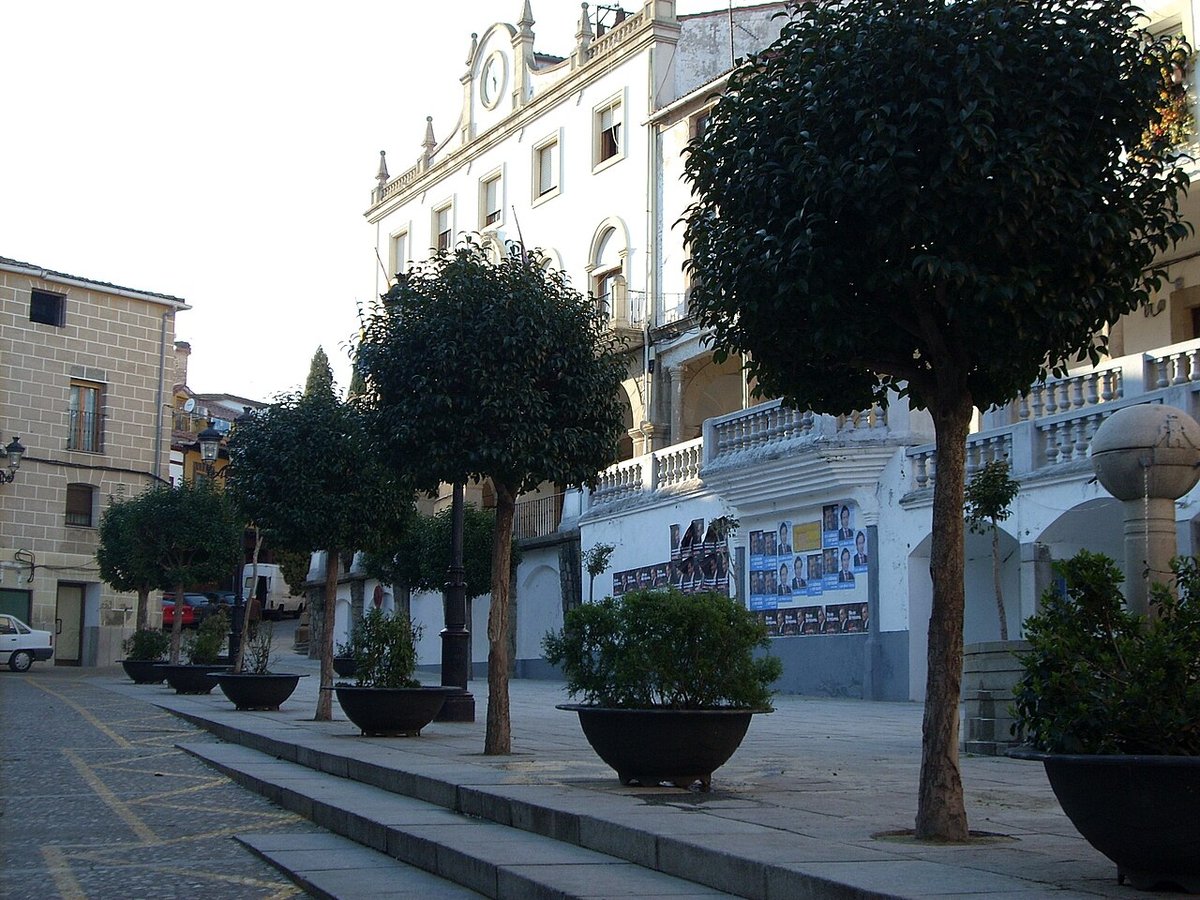
The old quarter is easily explored on foot. Narrow streets, houses rising two or three storeys, and water crossing from one side to another set the pace. Details stand out on closer look: timber frameworks, long south-facing balconies and small bridges that cross the regueras.
It is not a large place. A couple of hours is enough to walk through it at an unhurried pace, following the sound of water as it threads through the streets and defines the rhythm of the village.