Full Article
about Perales del Puerto
Gateway to the Sierra de Gata; a crossroads surrounded by nature
Hide article Read full article
An afternoon rhythm
By mid-afternoon, when the sun drops behind the low hills of the Sierra de Gata, the stone façades of Perales del Puerto take on a warm, almost reddish tone. Somewhere a wooden door shuts with a dry thud, or a car crosses the square at an unhurried pace. Otherwise, it is quiet in the way only a small village can be.
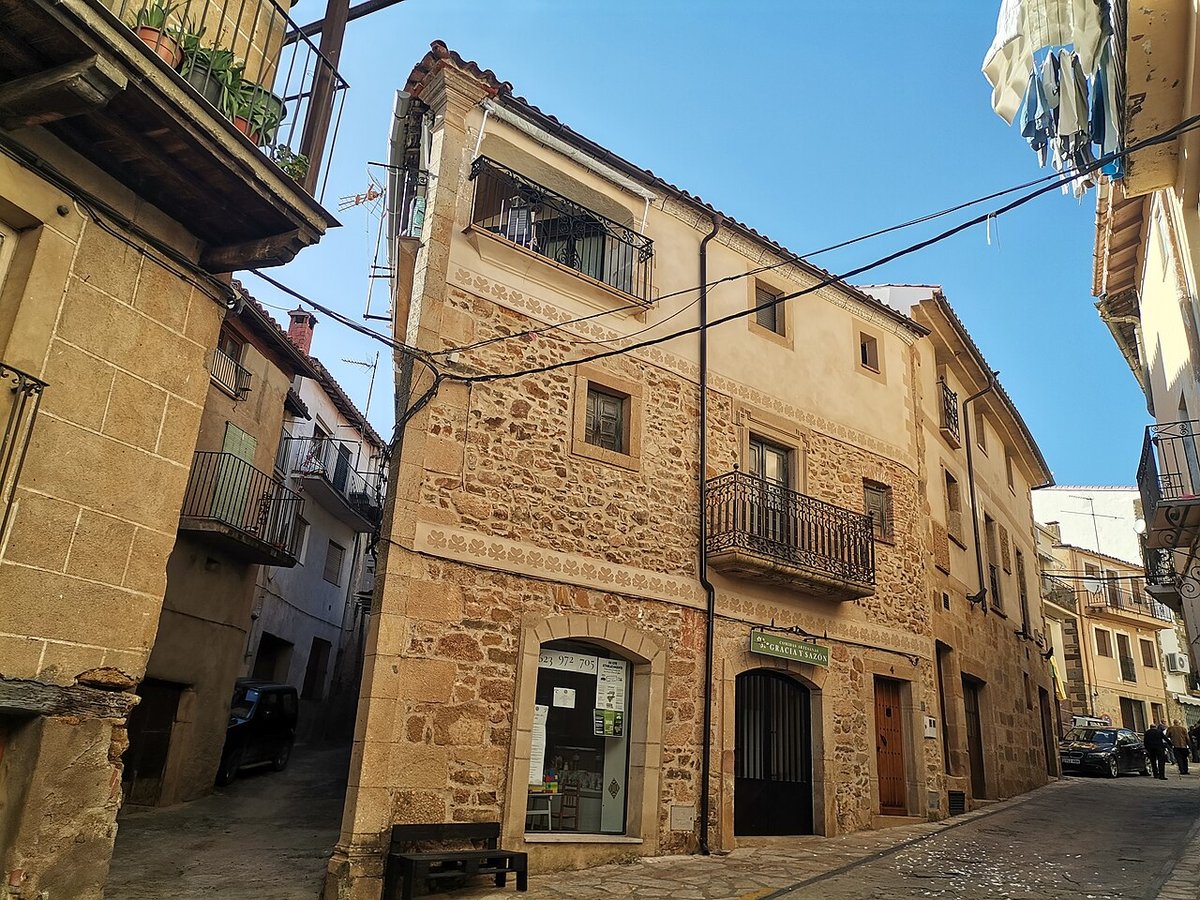
Tourism here follows that same gentle scale. Perales del Puerto is not about large monuments or long itineraries. With just under a thousand residents, it is a place to move through slowly, paying attention to small details: an iron balcony filled with plant pots, a courtyard carrying the faint smell of firewood, a stretch of street where the stones have been smoothed by years of footsteps.
Nothing insists on being seen. The experience comes from noticing what is already there.
The church at the centre
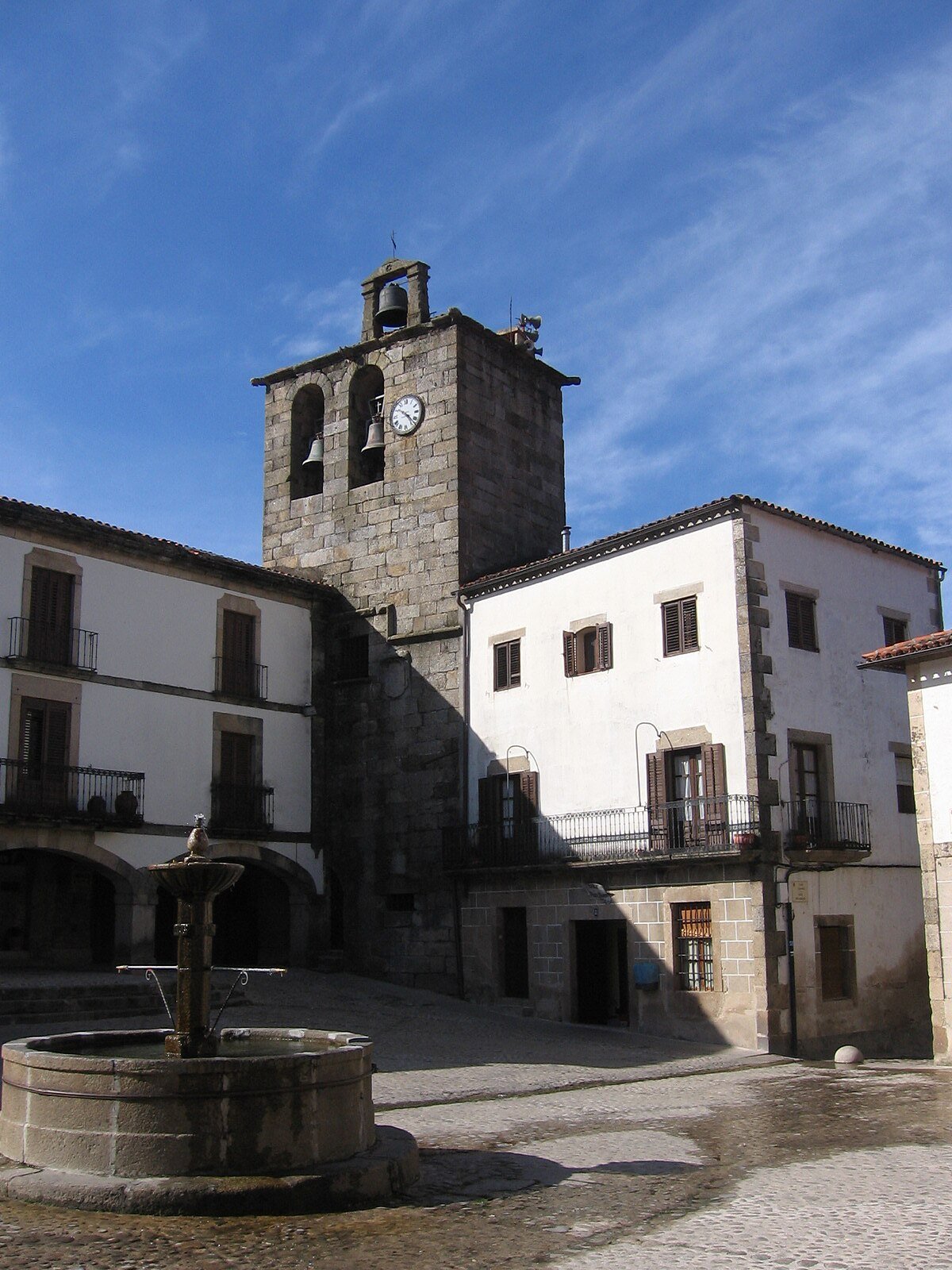
The Iglesia de la Asunción de Nuestra Señora marks the heart of the village. Its volume is visible from several streets and naturally becomes a point of reference when moving through the urban centre. Around it, there are stone houses and whitewashed façades, some with low arcades that offer shade during the summer.
The streets are short and slightly irregular. At times they narrow enough that you need to step close to the wall when a car passes. It is easy to picture how the village grew around the church and a handful of open spaces where neighbours still gather to talk.
During the middle of the day, especially in summer, many of these streets fall almost empty. Life shifts indoors, behind thick walls that keep out the heat. Outside, the stillness becomes part of the atmosphere rather than an absence of activity.
Paths leading into the dehesa
It takes only a few minutes on foot for the village to give way to open countryside. Paths begin between small kitchen gardens and soon enter a landscape of holm oaks and olive groves. The ground is earthy, with loose stones in places.
The dehesa, a traditional Spanish landscape of scattered oak trees used for grazing, appears almost immediately. At certain times of year, Iberian pigs can be seen moving among the oaks. Low stone walls also emerge here and there, marking out old plots of land.
Light changes the scene noticeably throughout the day. In the morning, the green of the olive trees has a silvery sheen. By late afternoon, the countryside darkens and the shadows of the oaks stretch across the ground.
Closed footwear is a good idea for these walks. After rain, some paths become muddy and uneven underfoot.
Wandering the streets
Perales del Puerto does not require a fixed route. The simplest approach is to walk without a map, linking one street to another until you circle back to where you started. In less than an hour, a large part of the village can be covered.
Along the way, small features come into view: old granite doorways, open corrals facing the street, or external staircases leading up to the upper floors of certain houses. These elements are typical of villages in this part of the Sierra de Gata, shaped by a way of life closely tied to the land.
Early morning brings a different rhythm. Garage doors open, someone sweeps the pavement, and a tractor passes through on its way to nearby fields. These everyday movements replace the stillness of midday, giving a brief sense of the routines that structure life here.
There is no need to search for highlights. The interest lies in how these ordinary details fit together.
Nearby villages in the Sierra de Gata
Perales del Puerto is often one stop within a broader journey through the Sierra de Gata. Within a few kilometres, other villages appear where both architecture and landscape shift slightly.
Some have tighter, more enclosed cobbled streets. Others open out towards small valleys filled with cultivated plots. Moving between them by car is straightforward, although the roads are winding and best taken at a relaxed pace.
Travelling this way helps build a clearer sense of the region: small settlements set close to one another, surrounded by dehesa, olive groves and low scrubland. Each place shares certain features, yet no two feel entirely the same.
When to come and what to expect
Spring and autumn are usually the most comfortable times to explore the surroundings on foot. The countryside shows more colour, and temperatures make it possible to walk at almost any hour of the day.
In summer, the heat becomes intense from midday onwards. It is easier to go out early in the morning or wait until late afternoon, when the streets begin to show some movement again.
It is worth keeping the scale of the place in mind. Perales del Puerto can be seen quickly. It works best as part of a wider route through the Sierra de Gata rather than as a base for several days on its own. The point here is not to fit in as much as possible, but to slow down and look around without hurry.