Full Article
about Santibáñez el Alto
Fortress village atop the sierra with a castle and panoramic views of the reservoir
Hide article Read full article
Early in the day, while there is still dampness in the stone, Santibáñez El Alto sounds like footsteps on cobbles and the occasional rooster somewhere out by the kitchen gardens. The castle rises above the rooftops like an uneven shadow. There is no need to go looking for it. From almost any street, it eventually comes into view.
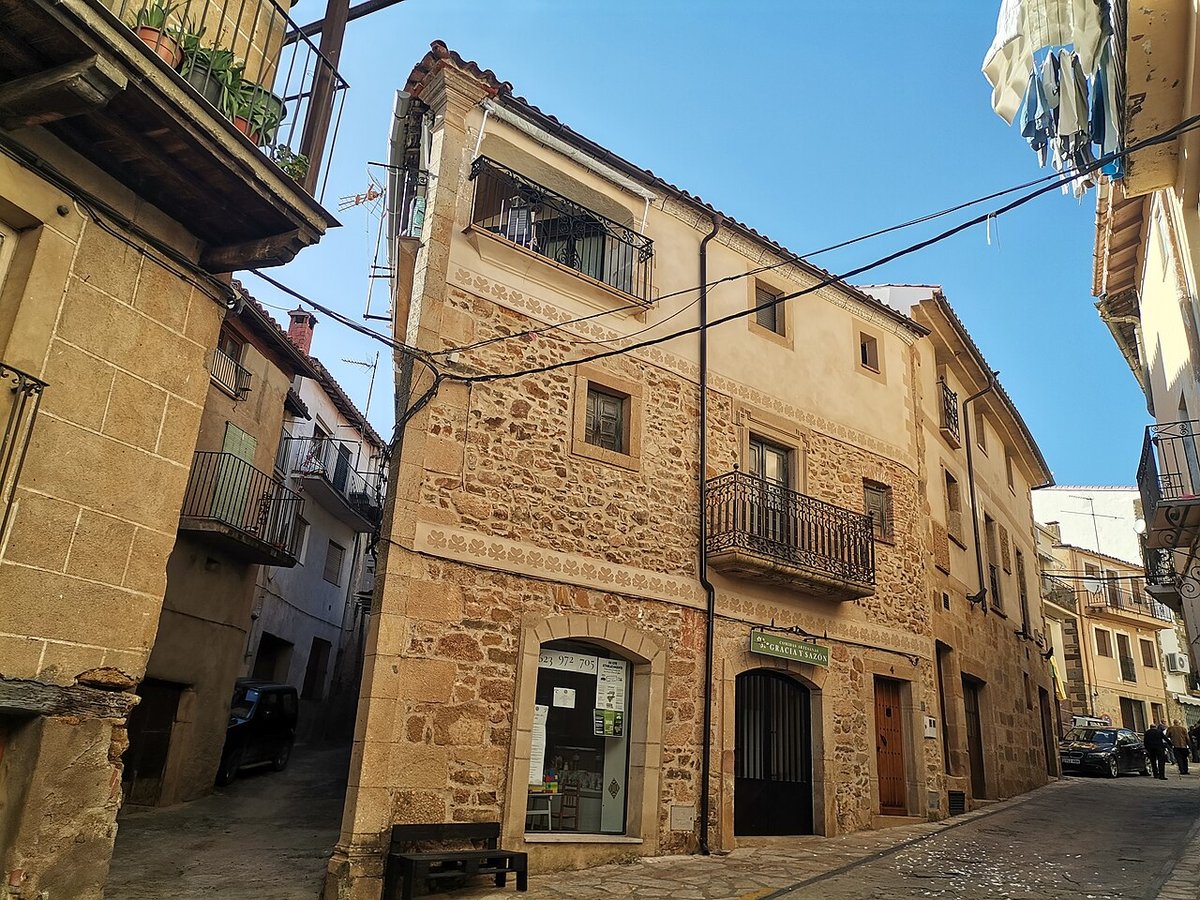
Tourism in Santibáñez El Alto unfolds slowly, partly because the village itself is shaped by slopes and tight corners. It sits in the Sierra de Gata, on a hill at around 650 metres above sea level, with a population of just over three hundred and eighty people. Granite, slate and timber form a compact whole that follows the incline of the land. Light slips through in narrow bands between the façades, revealing veins in the stone that have been there for centuries.
The narrow streets coil around the upper part of the village. On weekdays, by mid-morning or later in the afternoon, conversations drift out through open windows. It is not total silence. There is always a distant engine, dogs barking on the outskirts, or wind moving through the leaves of chestnut trees.
Wandering the village streets
The historic centre does not require a map. The simple approach is to walk uphill. With each stretch of street, the view over the valley shifts slightly.
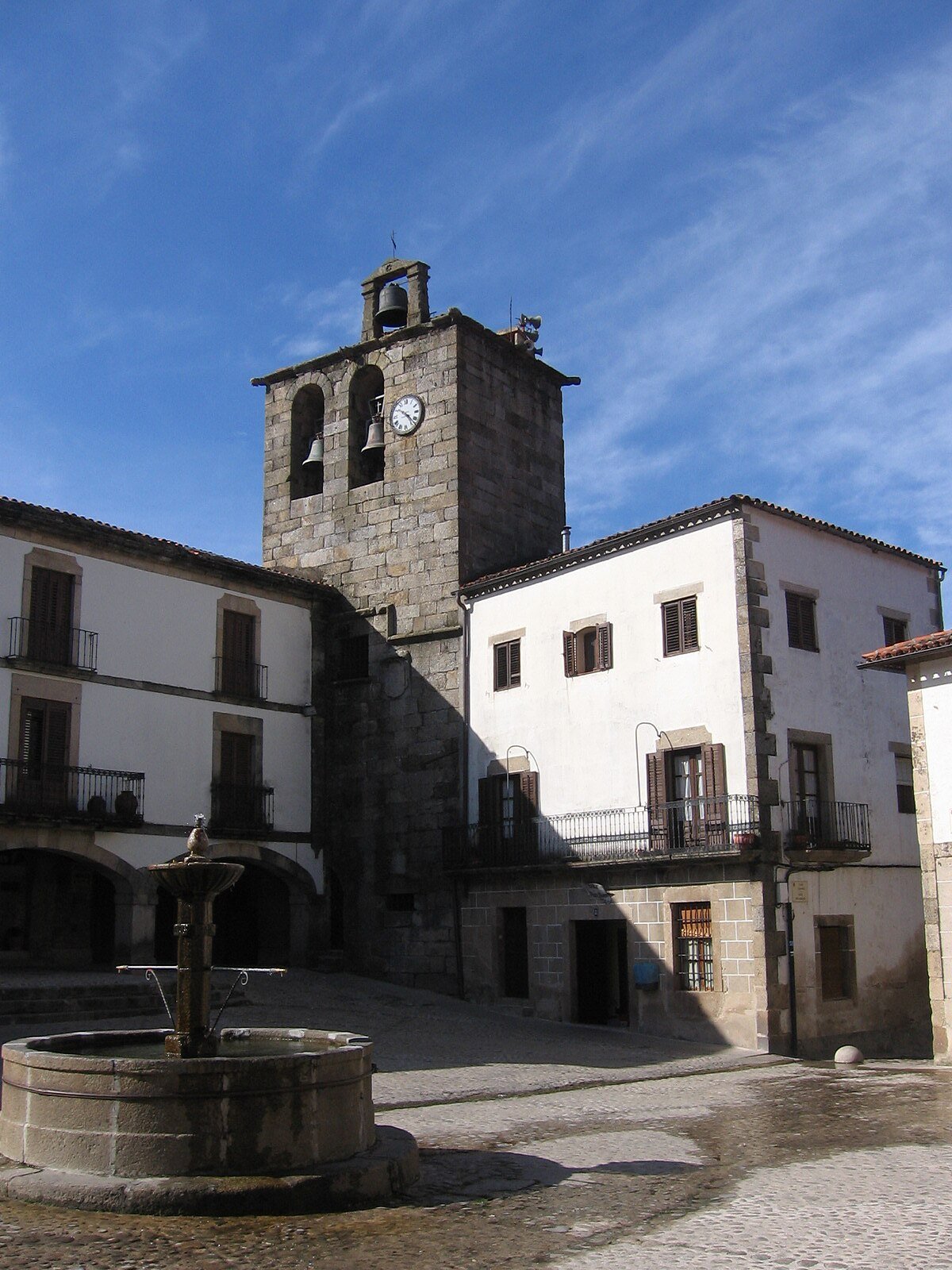
The parish church of San Benito marks one of the points where the village opens out a little. Its tower can be seen from below, framed by rooftops. Up close, the mix of dark stone and thick walls becomes clearer, typical of this part of the sierra. Around it, streets climb in uneven steps, with small balconies facing towards hills covered in chestnut and oak.
The Plaza Mayor acts more as a reference point than as a large open square. At certain times of day, neighbours sit outside or move in and out of their homes. From here, several streets branch off, some climbing towards the castle area, others descending to the edges of the village where rural paths begin.
The castle and the height of the hill
At the very top lie the remains of the castle of Santibáñez. The wind tends to be stronger here. From this point, it becomes clear why the village was built on this hill. The landscape opens out towards the Sierra de Gata and the Portuguese border.
The surviving walls reveal the structure of the fortress and its defensive use over centuries in this frontier region. It is not a large enclosure, but its position dominates the surroundings. Towards evening, the stone grows paler in the light and the valley fills with long shadows.
Paths through chestnut groves and dehesa
Beyond the last houses, paths begin to descend into fairly dense chestnut groves. In autumn, the ground is covered with dry leaves and the air turns cooler. The smell of damp earth becomes noticeable as soon as the built-up area is left behind.
Within a few kilometres, the landscape shifts. Areas of dehesa appear, a traditional type of open countryside with scattered holm oaks and cork oaks. It is common to see grazing livestock and the occasional stone enclosure. From Santibáñez, paths connect with other villages in the Sierra de Gata. It is worth checking the condition of these routes before setting out, especially after heavy rain, as the clay soil can become slippery.
A slow circuit of the village
The village itself can be walked in a short time, perhaps an hour and a half if taken at an unhurried pace and including the climb up to the castle area. The interest lies in the details: worn stone doorways, coats of arms on some older façades, wooden beams darkened with age.
From the higher streets, the surrounding hills are clearly visible. The light at the start or end of the day tends to define the contours of the valley more sharply, bringing out the shapes of the terrain.
Things to bear in mind
Santibáñez El Alto is full of slopes. The cobbled streets are uneven in many places, so comfortable footwear is a good idea. In summer, the sun falls directly onto the stone during the middle of the day and heat builds quickly.
This is not a large village or one packed with major monuments. A visit often works best when combined with a walk along the surrounding paths or a route through other nearby villages in the Sierra de Gata. The appeal here comes from moving slowly and paying attention to what is around you. The presence of the sierra is felt at every turn.