Full Article
about Torrecilla de los Ángeles
Agricultural town in the Sierra de Gata known for its wines and oils.
Hide article Read full article
Torrecilla de los Ángeles sits in the Sierra de Gata, in the north of Extremadura, among winding roads that link villages such as Robledillo and Ladrillar. Arriving here often means taking the long way round. The approach can feel uncertain, with narrow lanes that seem to fade into farmyards before finally leading up towards the higher part of the village. Entry from above reveals houses clinging to the hillside, stacked as best they can against the slope.
The first impression is clear. This is a Sierra de Gata village without cosmetic adjustments for visitors. Torrecilla de los Ángeles feels lived in rather than prepared.
A Village That Moves to Its Own Rhythm
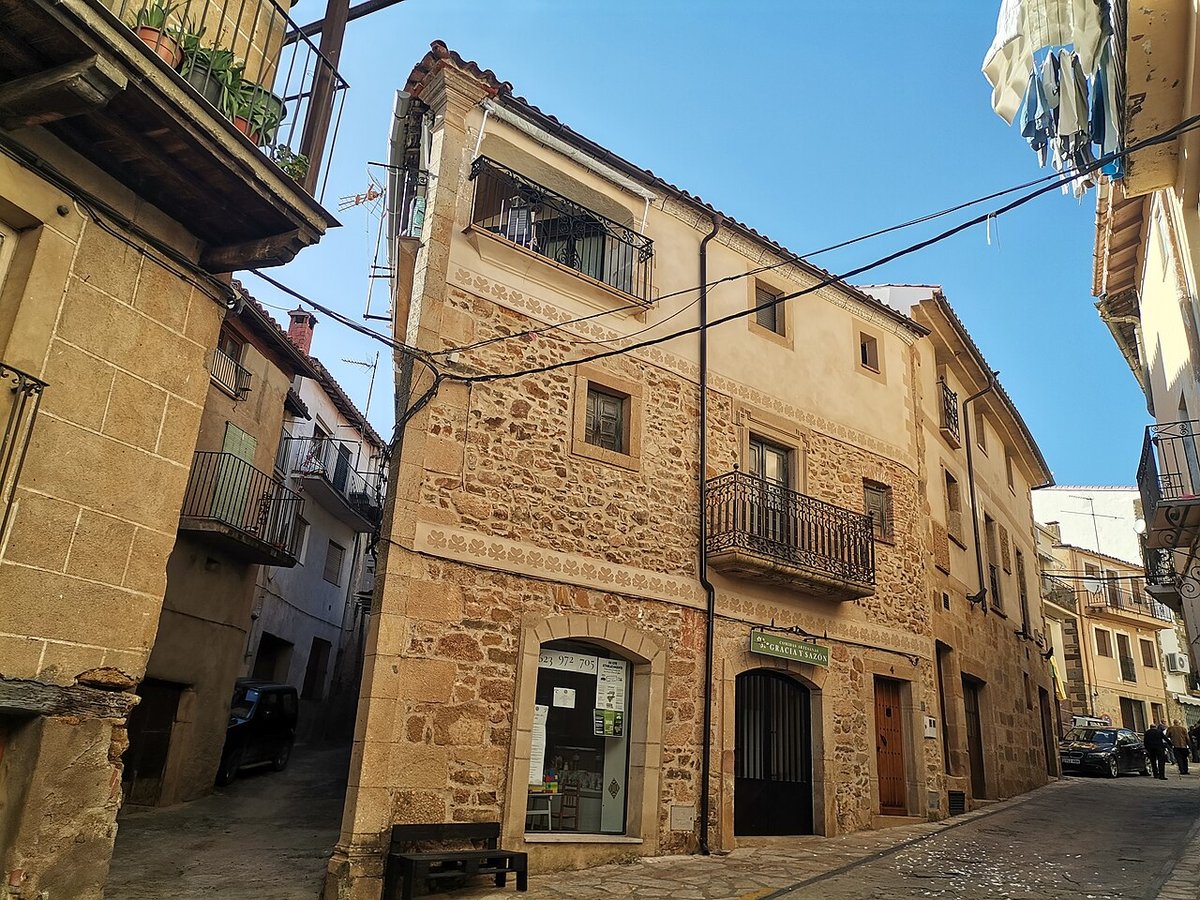
Torrecilla de los Ángeles has not gone through a phase of polishing everything for photographs. The houses remain built in dark slate, with wooden beams supporting overhanging upper floors. Roofs tilt at angles that seem steeper than expected, shaped by terrain more than by symmetry.
The streets require a generous definition of the word. Many are steep slopes paved in stone centuries ago. Walking here is physical. Two short stretches uphill are enough to make you pause, turn around and take in the sierra before continuing. The landscape becomes part of the rhythm of moving through the village.
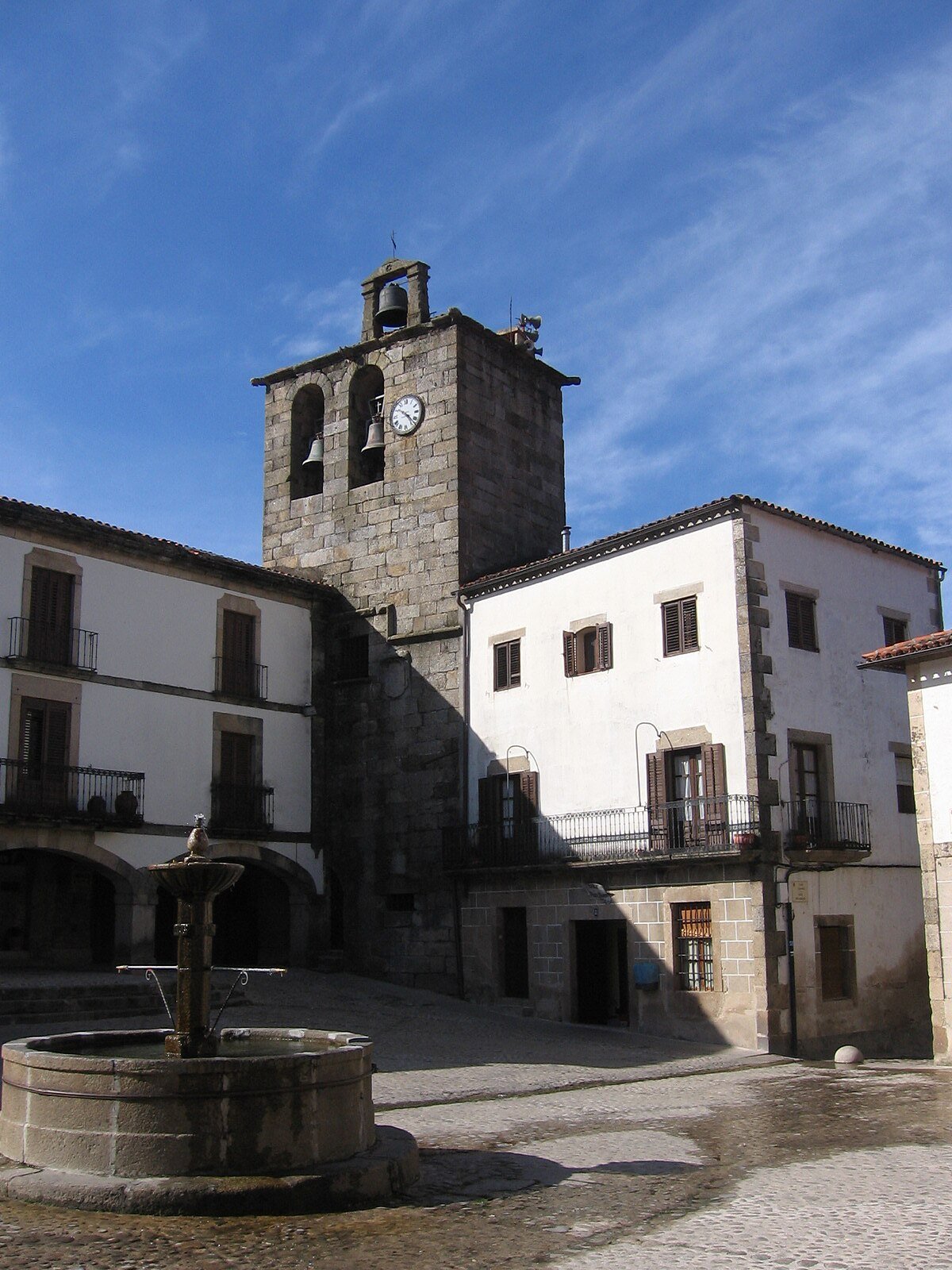
The Iglesia de la Asunción appears almost by surprise as you go up or down. It does not dominate the skyline. Instead, it sits within the fabric of the village. The building dates from the 16th century and has a particularly curious side doorway. Close to the tower, a reused Roman inscribed stone is set into the wall. Details like this hint at how materials have passed from hand to hand over the centuries. In places such as Torrecilla, stones have had more than one life.
When the Whole Village Takes Part
One of the most talked-about events in Torrecilla de los Ángeles is the representation of the Passion of Christ during Semana Santa, or Holy Week. This is not a small-scale performance with a handful of actors and a stage. A large part of the village gets involved.
Neighbours take on roles as Roman soldiers. Members of local theatre groups become apostles. The event is organised by residents themselves and performed through the streets, using the slopes and small squares as natural scenery. The setting shapes the performance, and the performance reshapes the setting for a few days.
It does not feel like a show designed primarily for outsiders. The impression is of a tradition the village performs for itself. Anyone who happens to be there at the time becomes a witness rather than a target audience.
Fire on the Saturday After Easter
Another striking tradition is the Fiesta del Capazo, held on the Saturday after Semana Santa. The celebration centres on an oak tree to which burning “capazos” are attached. A capazo is a large basket traditionally used in rural work. Here, they are set alight and fixed to the tree.
At first, the combination sounds unusual: fire, a tree, and much of the village gathered around. In Torrecilla de los Ángeles, it makes complete sense. The Fiesta del Capazo blends religious tradition, older local customs and the simple desire to come together outdoors. It is one of those events where participation matters more than spectacle.
There is also the romería of the Virgen de la Bienvenida. A romería is a rural pilgrimage, usually involving a walk or ride to a shrine in the countryside. In this case, people head to the hermitage located on a nearby hill. Families go up together. Many have known each other all their lives. The atmosphere follows the calm tempo typical of mountain romerías, where the day unfolds without hurry.
Food Rooted in the Land
The cooking in this area is closely linked to the matanza, the traditional pig slaughter that historically supplied families with preserved meat for the year. Dishes reflect a domestic, practical cuisine shaped by agricultural life.
One of the most frequently mentioned local specialities is ovejuela con chorrituelo. The name can sound almost humorous at first glance. In reality, it is a substantial dish, created to sustain long working days in the countryside. Presentation is not the priority here. There are no elaborate arrangements or miniature portions. The emphasis lies on flavour and warmth, food that fills you up and prepares you for steep paths and cold mornings.
Up to “Los Santitos”
Above the village stands the hermitage of San Marcos and San Marcelino, known locally as “los Santitos”. It occupies a hill overlooking Torrecilla de los Ángeles and opens out towards broad views of the Sierra de Gata.
The walk up is not long, though the incline makes itself felt. Once at the top, the dominant sound is often the wind rather than traffic. The quiet has a particular clarity in places like this, where the landscape stretches out without interruption.
From the hill, nearby villages appear between oak trees, olive groves and slate-covered slopes. The geography explains much about life here: small settlements, significant distances between them, and a strong relationship with the surrounding mountains.
Taking It Slowly
Torrecilla de los Ángeles does not lend itself to rushing from monument to monument. The experience lies in walking without a strict plan, climbing and descending the steep streets, and noticing the texture of slate and wood in the houses.
During its festivals, the atmosphere changes completely. When people gather outside for the Passion of Christ, the Fiesta del Capazo or the romería of the Virgen de la Bienvenida, the village shifts from quiet routine to shared celebration. The same slopes and squares take on a different energy.
A visit to “los Santitos” rewards patience. The path encourages a slower pace, and the view from the top helps make sense of this part of the Sierra de Gata. Small villages sit scattered among hills. Mountains frame everyday life. Things function according to a local rhythm that does not necessarily match the pace of a map.
Torrecilla de los Ángeles remains faithful to its own timing. That, more than any single monument or event, defines its character.