Full Article
about Villanueva de la Sierra
Town that hosted the world’s first Tree Festival (1805)
Hide article Read full article
A Small Village in the Sierra
Tourism in Villanueva de la Sierra is low‑key and fairly brief. You arrive, wander around, and before long you have a clear sense of the place.
From Cáceres, the usual route is along the EX‑204 towards the Sierra de Gata, passing through Gata. The drive takes a little over an hour. On arrival, the simplest option is to park near the main square or in one of the nearby streets. Spaces are limited and at weekends they fill up quickly, so if you want to look around without rushing, morning is the best time to come.
Villanueva de la Sierra is surrounded by scrubland, oak trees and chestnut groves. This is not a destination of grand monuments or streets lined with shops. What you find here is a small working village and the landscape that frames it.
A Short Walk Through the Centre
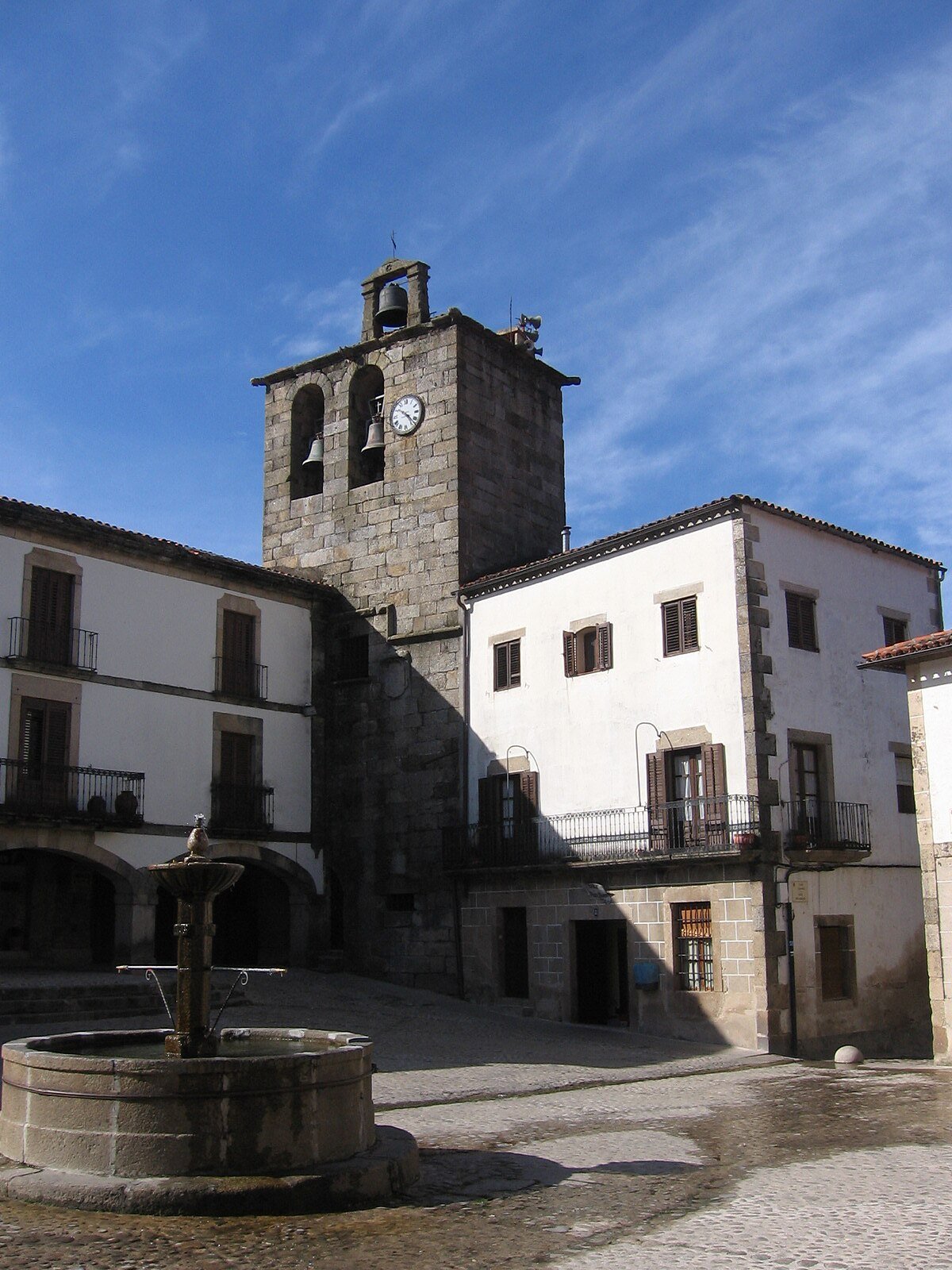
The main building is the parish church of la Asunción. Solid and built in masonry, it has a tower that defines the village skyline. The structure appears to date from the early modern period, probably between the 16th and 17th centuries, although later alterations are noticeable.
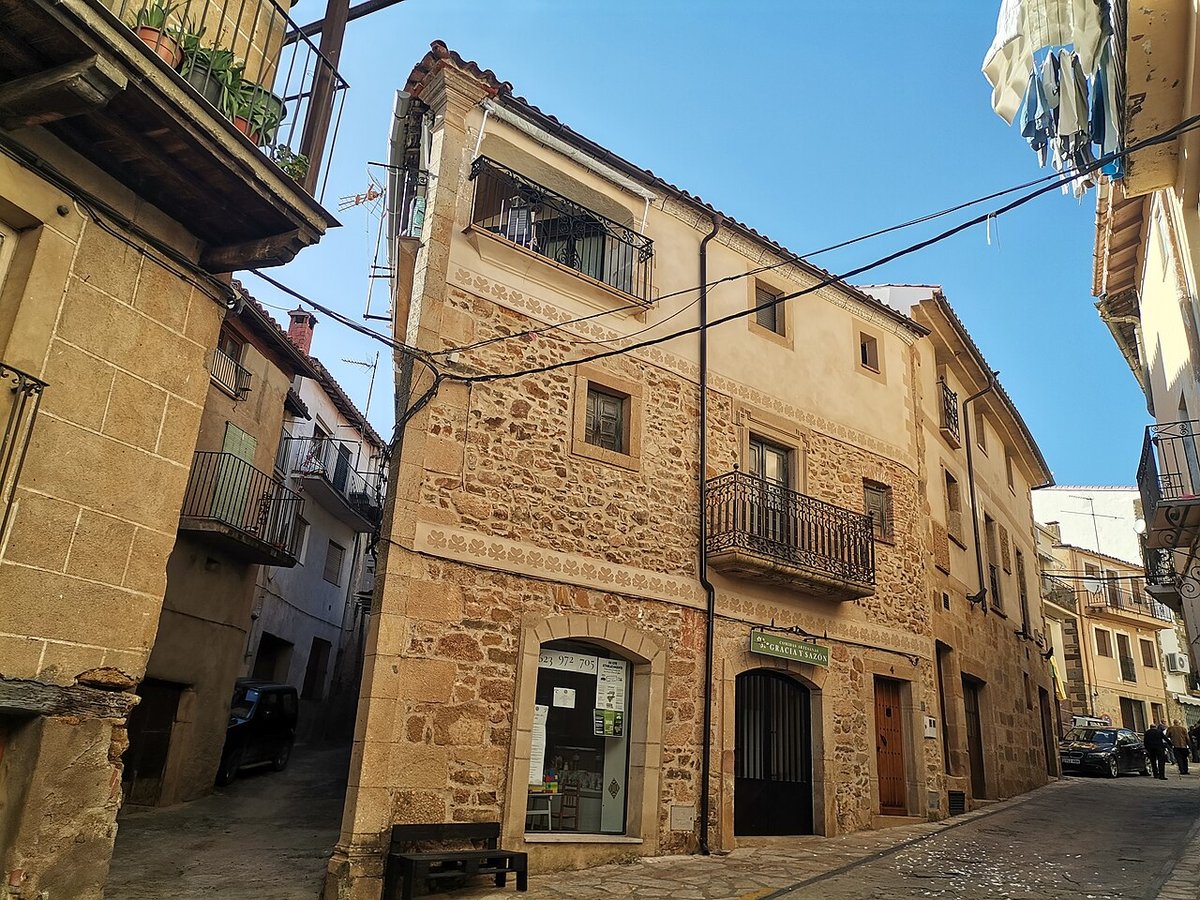
The old quarter is compact and can be covered in a single stroll. Whitewashed houses, wrought‑iron balconies and curved clay roof tiles give the streets a consistent look. Some homes still retain interior courtyards and corrals, a feature long associated with agricultural life in this part of Extremadura.
There are no large monumental ensembles or streets designed with visitors in mind. Villanueva de la Sierra continues to function first and foremost as a place where people live and work. Daily life shapes the rhythm of the centre more than tourism does.
Landscape and Paths Beyond the Village
If you make the journey here, the surroundings deserve more time than the streets.
Around Villanueva de la Sierra, the landscape alternates between dehesa and areas of oak and chestnut woodland. The dehesa is a traditional form of managed pastureland typical of western Spain, where scattered trees stand over open ground used for grazing. In autumn, the scenery changes noticeably as leaves turn colour, particularly in the shadier parts of the sierra.
Several paths and simple routes begin in the village. Do not expect extensive signposting or built infrastructure. These are tracks and trails used by local residents, people out for a walk, or those heading into the countryside for everyday tasks. After heavy rain, some sections can become muddy or overgrown.
In open areas it is common to see birds of prey circling overhead, especially vultures. During autumn, in the nearby hills, the berrea can sometimes be heard at dawn or dusk. This is the rutting call of red deer, a deep, echoing sound that carries across the slopes during mating season.
The overall impression is of a landscape that has not been overly adapted for visitors. The countryside remains practical and working in character. That is part of its appeal, but it also means coming prepared for uneven ground and limited waymarking.
Fiestas and Seasonal Traditions
Celebrations in Villanueva de la Sierra follow the calendar typical of many villages in the area.
In August, the feast of la Asunción takes place. It includes religious events linked to the parish church and activities organised by the village itself. At that time of year, people with family ties to the area, as well as those spending the summer in the sierra, often return.
Autumn brings attention to the chestnut. The fruit is closely tied to the surrounding hills, where chestnut trees form part of the local landscape and economy. Traditionally, gatherings or small events have been organised around the chestnut harvest. If this is of interest, it is worth checking in advance whether anything is planned in a given year.
Semana Santa, or Holy Week, is observed in a simple way. There are small processions with participation mainly from local residents. The scale reflects the size of the village, with an emphasis on community rather than spectacle.
Before You Go
Villanueva de la Sierra is not a monumental town. It does not take long to see.
What makes the visit worthwhile is pausing for a while, walking beyond the centre and taking in the landscape at a slower pace. The setting among scrub, oaks and chestnut trees defines the experience as much as the church or the streets.
If you plan to follow the paths out of the village, sturdy footwear is advisable. Waymarking should not be relied upon, and conditions can change after rain. Here, the countryside remains just that, countryside.