Full Article
about Higuera la Real
Major producer of Iberian pork; home to the Celtic site of Capote and a rich religious heritage.
Hide article Read full article
Tourism in Higuera La Real begins with your nose. It sounds odd, but that is how it happens. After the bends of the Puerto de San Pedro, you park, step out of the car and notice a mixture in the air: dehesa, holm oak and that unmistakable scent of ham curing in drying sheds. Nothing has been staged for visitors. It is simply what is there.
And the thought that follows is straightforward: if it smells like this, something good must come from this land.
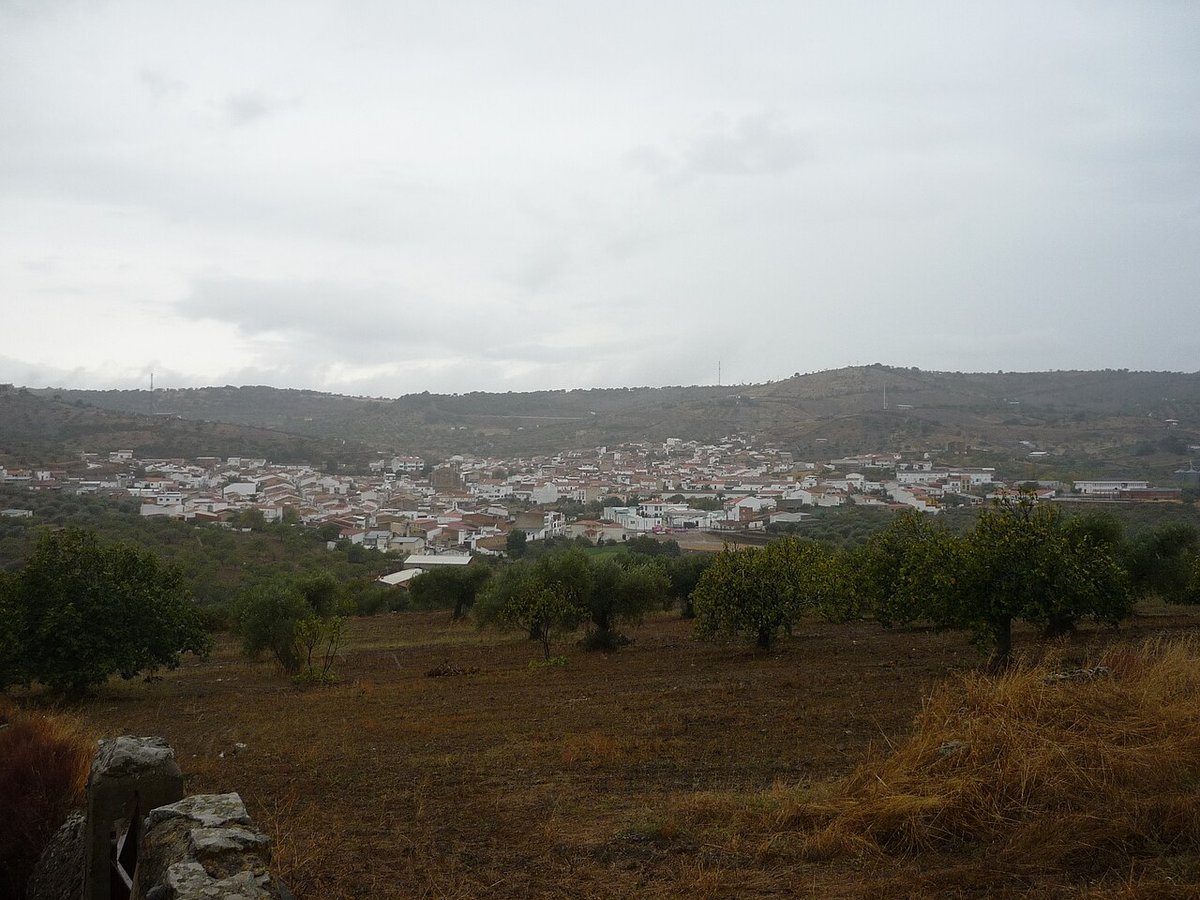
Higuera La Real sits in the south of Extremadura, surrounded by dehesa, the traditional landscape of scattered holm oaks and pasture that defines much of this region. Life here moves at an unhurried pace, and that rhythm shapes the experience of the place.
Where the Celtici Hosted 200-Person Barbecues
The first place locals tend to mention is the oppidum of Capote. The name might sound like something from a historical drama, but it is in fact a significant archaeological site just a few minutes from the village.
A dirt track leads out of town. You leave the car beside a vast holm oak, the kind that seems almost deliberately positioned, and walk towards a stone wall that has stood there since around the 2nd century BC.
This was a fortified settlement of the Celtici, a pre-Roman people who lived in this part of the Iberian Peninsula. Within the enclosure there is one structure that always draws attention: a square room with a continuous stone bench along the walls and a stone table at its centre. Picture a living room carved from rock, minus sofas and sockets.
Archaeologists found remains here that are interpreted as evidence of a large ritual banquet. The figure often mentioned is around two hundred people. It suggests a gathering on a serious scale. The explanation usually given is that the meal had a ceremonial purpose, perhaps to seal agreements or alliances.
It feels surprisingly familiar. Centuries pass, but many arrangements are still settled around a table.
The site is quiet, open to the sky, with the surrounding landscape stretching out beyond the walls. There are no elaborate reconstructions to guide the imagination. The stones do the work on their own.
The Neighbourhood That Feels Like Another Place
After prehistory, the Villa de Santa Lucía offers a change of tone. It is not exactly a separate village, more a residential colony attached to Higuera La Real, yet stepping into it brings a subtle shift in atmosphere.
The streets are laid out in orderly grids, lined with low houses and tidy gardens tended with the kind of care that suggests regular summer watering. It recalls those residential developments built decades ago for long stays, though here the mood is calmer and more everyday.
There is a square with benches and a fountain that runs continuously. Sit there for a while and ordinary life unfolds. A man pushes a shopping trolley home. A woman waters plants while chatting on the phone to a relative. A car passes slowly.
Nothing dramatic happens. That is precisely the point. It feels like someone has placed a small piece of neighbourhood life in the middle of the dehesa. For travellers unfamiliar with rural Spain, this glimpse of routine can be more revealing than any monument.
The Villa de Santa Lucía does not compete for attention. It simply exists alongside the older core of Higuera La Real, showing a different layer of how the town has grown.
Ham That Does Not Need Advertising
Ham in Higuera La Real has a particular status. In many places it is a headline attraction. Here it is the pantry.
Order a plate in one of the village bars and it arrives with the same naturalness that elsewhere accompanies a slice of tortilla. There is little need for explanation. The dehesa lies all around, and the Iberian pig has been part of the local economy for generations.
In autumn, during the montanera, the period when Iberian pigs feed on acorns, it is common to see the animals moving through the dehesa beneath the holm oaks. They root around for fallen acorns, following a cycle that has shaped both landscape and livelihood in Extremadura for centuries. It is not a performance for visitors. It is simply the countryside working as it always has here.
Specific recommendations are rarely necessary. In small towns, asking where to eat well tends to produce a straightforward answer and directions a couple of streets away. Word of mouth does the rest.
The connection between land, animal and product is direct. You smell it when you arrive. You taste it when you sit down.
How to Avoid Being Bored, or To Be Bored Well
Higuera La Real is not a destination built around a checklist of attractions. It is a place for walking and seeing what happens.
Tracks lead out towards the dehesa in every direction. Some are wide farm roads. Others are narrow paths that seem to exist because people have used them for years. One such path runs out behind the cemetery and opens onto a threshing floor where a farmer might be wrestling with a tractor.
Conversations arise easily in settings like this. Talk turns to late rains, the price of acorns, the perennial family debate over who makes the best gazpacho extremeño. Twenty minutes can pass without notice.
There are no large-scale plans to follow, no arrows every few metres pointing the way. Instead there is a quiet that stretches time. A walk through the streets, a solid meal, and at some point the idea of an afternoon siesta begins to sound entirely reasonable.
For international visitors used to more structured tourism, this can feel unfamiliar at first. Yet the appeal lies in that simplicity. The rhythm of the day is shaped by light, weather and conversation rather than timetables.
When it is time to leave, the impression is of having spent a straightforward Sunday. Nothing spectacular may have happened. Later, though, it is remembered with more affection than expected.
Higuera La Real does not try to impress. It smells of dehesa and curing ham. It preserves the stones of the oppidum of Capote. It carries on with daily life in places like the Villa de Santa Lucía. That combination is what defines tourism here: less about spectacle, more about paying attention.