Full Article
about Cabeza la Vaca
The highest village in the province, deep in the sierra; known for its chestnut forests and distinctive mountain architecture.
Hide article Read full article
Early light in a quiet village
At seven in the morning, the streets of Cabeza la Vaca are still. A distant cockerel breaks the silence, along with the dry sound of footsteps on cobbles. Cool air drifts down from the hills, carrying the faint smell of extinguished firewood and damp earth. For a few minutes, the village seems to hover just before the day properly begins.
Cabeza la Vaca sits in the Tentudía area, in the south of Badajoz province, where the dehesa begins to rise towards the first slopes of the sierra. The dehesa is a traditional landscape of open woodland, usually with holm oaks and cork oaks spaced across grazing land. Just over a thousand people live here, and the village has kept a simple shape: slightly irregular streets, whitewashed houses, reddish roofs, and the occasional façade where bare stone shows through.
Around the square
The centre gathers around a small square with a stone fountain and benches that fill with conversation by mid-morning. The parish church, dedicated to San Sebastián, stands close by. It is not especially grand, yet it sets the rhythm of daily life. The bells still mark the hours, and here those chimes are heard and noticed.
Nearby streets mix older houses with newer ones. Some doorways are lined with pots, and chairs appear in the shade as the afternoon heat settles in. Movement is unhurried. A car passes slowly, neighbours come and go from small shops, and conversations linger at street corners rather than rushing anywhere.
There is a sense that daily life is still tied to familiar routines. People step out for bread or errands, then stop to talk. Nothing feels staged or arranged for visitors, and the pace rarely changes.
Where the dehesa begins
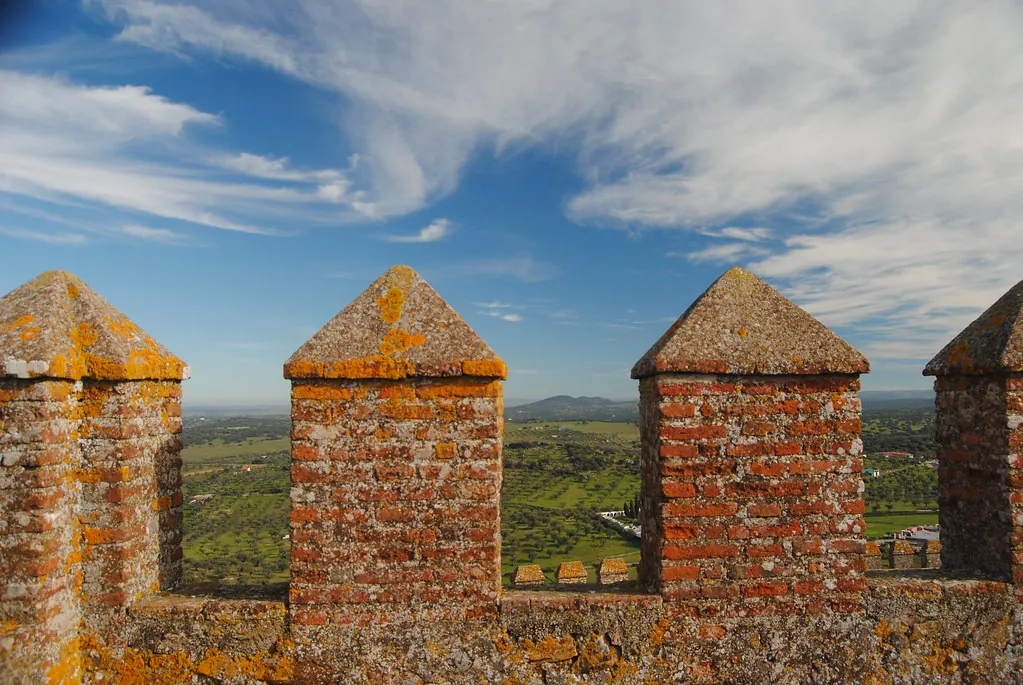
A short walk uphill is enough for the village to open onto the surrounding landscape. Holm oaks and cork oaks stretch across most of the view, broken by patches of pasture where livestock graze. When the sun is low, long shadows fall across the grass and the land takes on a soft golden tone.
From some of the nearby high points, the shape of the Sierra de Tentudía becomes clear. The best-known peak in the area, Tentudía, often stands out on clear days. This is not a jagged or dramatic range. Instead, it is a sequence of rounded hills that shift in colour with the seasons.
In spring, the countryside turns a bright green and low wildflowers appear among the grass. By autumn, the ground is covered in dry leaves, and the air carries the smell of damp soil and freshly cut cork from nearby estates. The changes are gradual but constant, and the same view can feel quite different depending on the time of year.
Paths through open land
Several rural tracks leave the edges of Cabeza la Vaca and cross the dehesa. Some follow old livestock routes, while others link farms and small streams in the area. The distances are not especially long, though walking in summer calls for care. Midday heat can be strong, so water and sun protection are important.
The landscape is at its most active early in the day or towards evening. Birds of prey can often be seen circling above the oaks, and there is the occasional sharp sound of an animal moving through the undergrowth. In autumn, when the ground holds more moisture, people from nearby areas head out to look for mushrooms in spots they know well.
These paths are not formal trails with clear signposting everywhere. They feel more like working routes shaped by long use, still tied to the rhythms of the land rather than tourism.
Livestock and everyday life
The dehesa around Cabeza la Vaca is not just scenery. It is still used for extensive livestock farming. Cattle and Iberian pigs are as much a part of the landscape as the trees themselves. This system combines grazing land, woodland and the harvesting of cork, maintaining a balance that has developed over generations.
That connection to the countryside carries into daily life in the village. Small shops and workshops continue to produce traditional goods, and it is common to see people coming and going with bags of bread or supplies linked to work in the fields. The boundary between village and countryside feels thin, almost blurred.
Life here does not revolve around visitors or major landmarks. What stands out instead is continuity. Work, conversation and routine follow patterns that have not shifted dramatically.
When to go
The light is often at its best in spring and autumn, when temperatures are milder and the landscape changes colour almost week by week. From late March to June, the countryside feels at its most alive. In October, cooler air returns and the ground begins to gather fallen leaves.
Summer brings intense heat at midday. Visiting during those months works best early in the morning or later in the afternoon, when the sun drops and the village regains a little movement in its streets.
Cabeza la Vaca does not centre itself around tourism or large monuments. What it offers is something quieter: early morning stillness, the dehesa within easy reach, and a slower pace that continues to shape daily life. Time here seems to follow the light over the oak trees rather than the clock.