Full Article
about Fuente de Cantos
Birthplace of painter Zurbarán; key town on the Vía de la Plata with rich cultural heritage and chanfaina cuisine.
Ocultar artículo Leer artículo completo
The only traffic jam in Fuente de Cantos happens at 08:45 when the school gate opens and half the town’s dogs tag along with the children. Otherwise the streets stay wide enough for two mules and a tractor, which is how the place was planned in 1452. At 582 m above the surrounding wheat sea, the air is cooler than down on the Badajoz plain; night-time temperatures can dip ten degrees below the provincial capital, 85 km away.
Why painters stopped here first
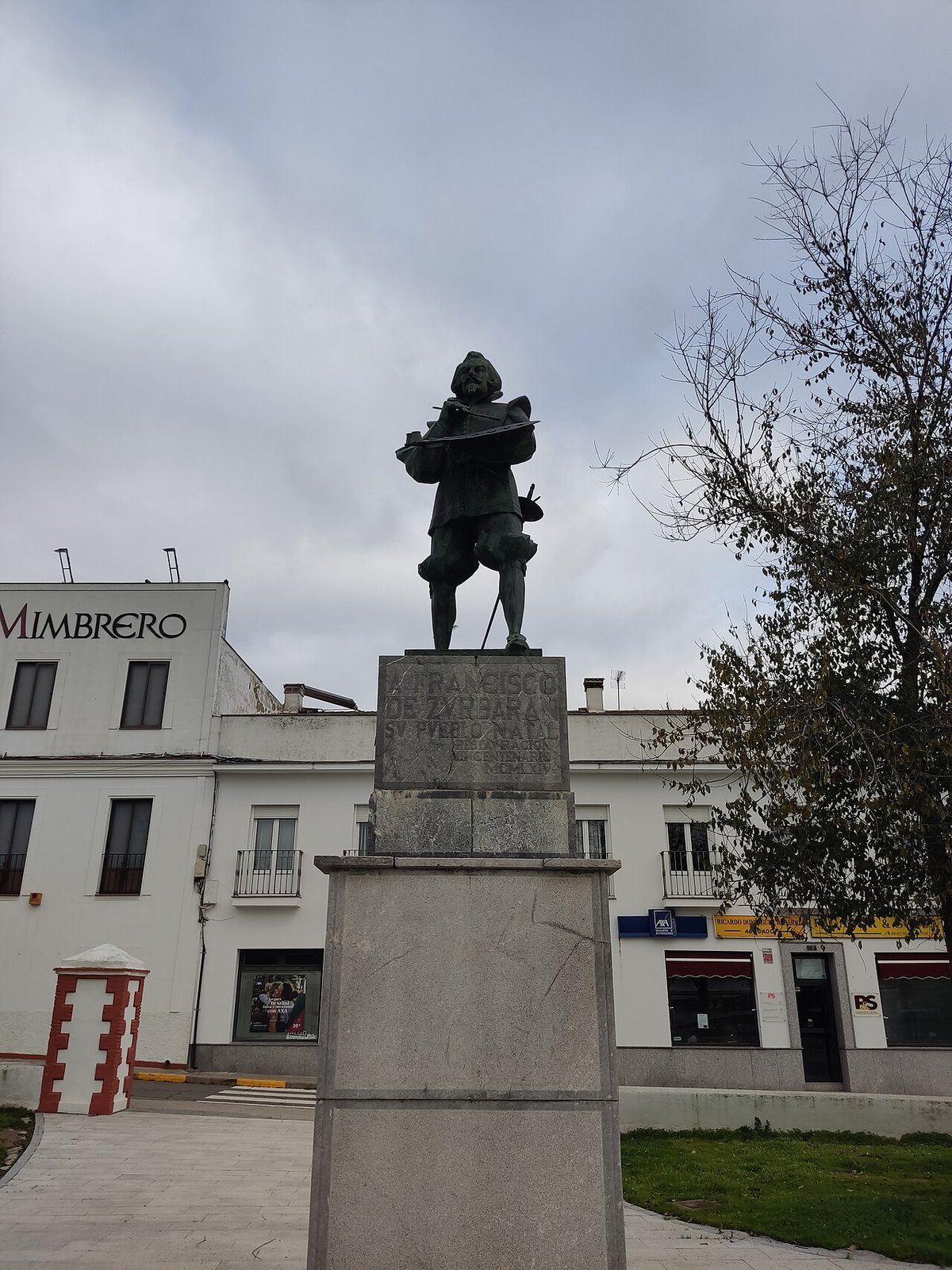
Francisco de Zurbarán was born in the tall house opposite the Franciscan convent in 1598. The convent cells now hold a one-room interpretation centre that traces his move from these sun-bleached walls to the court in Madrid. Entry is free, though the guardian will ask you to sign a ledger that still contains the pencil scrawl of a pre-Brexit Michael Palin. Thirty minutes is enough to see the digital copies of the monk portraits whose blacks he mixed from local olive soot. If you miss it you will still notice him: reproductions of his Agnus Dei hang in the chemist, the baker’s and the corridor of the public library where the Wi-Fi code is written on a Zurbarán postcard.
A day that starts with churros and ends with silence
Morning begins in the café at the southern exit where a loop of motorway audio tape marks the queue for churros. €3 buys six ridged sticks and a cup of chocolate thick enough to hold a spoon upright. Walkers on the Via de la Plata Camino drift in as early as seven; they have covered 20 km of olive groves since Monesterio and are already talking about blisters in three languages.
By ten the square belongs to older men in berets who read the Hoy newspaper aloud to each other. The palm gives only a coin of shade; the stone benches stay cold until April. Housewives swap plastic bags of seeds at the weekly market—no crafts, no fridge magnets, just produce. Try the goat cheese wrapped in chestnut leaves; it tastes of the thyme the animals grazed on and costs €4 for a wheel that will perfume your rucksack for days.
Lunch is the three-course menú del día at Bar Central: lentil soup, pork with pimentón, and arroz con leche that arrives with a skin you can lift off like felt. Bread, drink and coffee included for €11. Ask for the white wine from nearby Alange; it is poured from an unlabelled bottle kept cool in the fridge between the tonic water and the salad drawers.
Afternoons fade into siesta. Metal shutters clatter down at 14:00 and nothing re-opens until 17:30; even the petrol station kiosk locks its door. Plan accordingly—there is no ATM after 14:00 on Saturdays and the nearest alternative is 18 km away in Zafra.
Walking out of town before the heat returns
If you stay at the municipal albergue El Zaguán de la Plata you can rinse trail dust in the small pool (open May–September) and peg your socks to a line that overlooks wheat fields. Beds cost €12–15, sheets included, and the washing machine swallows €2 coins. The hospitalero will lend you a key to the side gate so you can leave at dawn without waking the dormitory.
Two footpaths start from the church. The shorter loop, 6 km, circles through dehesa woodland where black pigs nose for acorns and imperial eagles circle overhead. The longer one, 14 km, climbs gently towards the Sierra de Tentudía, reaching 900 m at an abandoned hermitage whose bell still hangs at a tipsy angle. Both routes are way-marked with yellow arrows; trainers are fine, but carry water—there are no fountains after the first kilometre.
Evenings that end earlier than you expect
By 20:30 the square smells of garlic and pimentón drifting from kitchen windows. Restaurants wind down fast; the last reliable hot meal is served at 21:00. After that you are left with packets of crisps and the house wine, which is drinkable and €1.50 a glass. British phone networks give up inside the 60 cm-thick walls of most houses; step into the street if you need to send photographs of the day’s ham.
The town’s soundtrack is conversation, not music. Young people migrate to Zafra or Seville for university, so Friday night means dominoes slapped onto wooden tables and, in summer, an outdoor cinema screen erected against the convent wall. Hollywood films are dubbed; expect Spanish Toy Story at full volume until midnight.
When to come, and when to stay away
April–May turns the surrounding fields emerald and brings clouds of butterflies along the verges. September light is soft enough for photography, and the patronal fiesta over the first weekend fills the streets with free paella and late-night sevillanas. July and August are furnace-hot—daytime 38 °C is routine—and many locals simply close their houses and head for the coast. Winter is crisp, often 5 °C at midday, but the albergue heating works and you will have the trails to yourself. Snow is rare; if it comes the access road from the N-630 is cleared within hours.
Getting here without the car (or with one)
Public transport is thin. The Badajoz–Seville coach line stops once in each direction; the 09:15 from Badajoz arrives 10:40, the 18:30 return reaches the city hospital just after eight. A single ticket is €7.65, paid in cash to the driver. From Madrid you change at Mérida, total journey five hours. Drivers leave the A-66 at Zafra, follow the EX-104 for 19 km of curves, and park free on Calle San Francisco. There is no disc zone, no meters, and no traffic warden—the mayor still issues the odd parking ticket himself when he walks to work.
What you will not find
Gift shops. Nightclubs. A train station. Guided tours in English. What you will find is the Spain that guidebooks keep promising has disappeared: neighbours arguing over ladder placement, waiters who remember how you like your coffee, and a church bell that counts the hours wrong on purpose because the sacristan likes the old mechanism the way it is. Stay a night, maybe two, then walk on or drive away before the quiet becomes uncanny.