Full Article
about Montemolín
Historic town with an Arab castle and birthplace of the Order of Santiago in the area; includes the outlying hamlets of Pallares and Santa María.
Hide article Read full article
A village that reveals itself slowly
Montemolín is the sort of place that does not try to impress straight away. It feels a bit like stepping into an older relative’s house in a rural village: everything seems calm, even a little quiet, yet the longer you look, the more details begin to appear. That is exactly where the appeal of tourism in Montemolín lies, in walking without hurry and letting the place explain itself.
The village has just over a thousand inhabitants and sits at around 600 metres above sea level, in the Tentudía area of Extremadura. It is not set up for visitors in any obvious way. Daily life carries on at its own pace: people greeting each other in the street, cars moving slowly up and down the slopes, small squares where someone is always sitting and chatting. Anyone arriving in search of spectacle might find it too subdued. Those who are curious about how real villages function will see it differently.
Traces of the past in everyday streets
A walk through the old centre begins to reveal clues about what has happened here over the centuries. Some houses still display coats of arms on their façades, while others have small windows with iron bars, the kind designed for Extremadura’s hot summers, letting in limited direct light while keeping interiors cool and shaded.
The Iglesia de Nuestra Señora de la Consolación stands at one of the central points of the village. It is solid and unpretentious, typical of larger rural churches in this part of the region, without much decoration on the outside. Inside, the atmosphere is calm in the way of places that are still used daily, not only when visitors arrive.
A short distance away, in the hills, lies the Monasterio de Tentudía. Many people travelling through the area head up there for both the views and the history that stretches back to the Middle Ages. From that higher vantage point, the character of the landscape becomes clear: gentle mountain ranges, open dehesa and villages separated by wide stretches of countryside. The dehesa, a traditional Iberian landscape of scattered oak trees and grazing land, is a defining feature of this part of Spain.
Back in Montemolín, the central plaza continues to serve as a meeting place. There is nothing grand about it, yet sitting there for a while is enough to see how the day unfolds: someone crossing with shopping bags, a group in conversation on a bench, the sound of a door opening nearby.
Just beyond the built-up area, the dehesa begins almost immediately. Holm oaks stand spaced apart, livestock moves slowly across the land, and dirt tracks stretch out in different directions. It is the kind of setting that encourages walking without checking the time.
Walking into the landscape
Several rural paths start from Montemolín and connect with the wider landscape of southern Badajoz province. There are no large-scale facilities or carefully prepared routes. Most of the paths are agricultural tracks or trails that local people have used for generations.
The most straightforward option for walkers is the route heading up towards the Sierra de Tentudía. Some sections are steep, so it makes sense to take it at an easy pace. As the elevation increases, the view opens out: dehesa, low hills and a strong sense of space that is characteristic of this part of Extremadura.
For those on a mountain bike, the terrain also works well. Secondary roads carry very little traffic, and there are plenty of kilometres of open countryside to explore.
Festivities rooted in local life
In a village of this size, traditional celebrations still play an important role in the calendar. In August, Montemolín celebrates festivities dedicated to Nuestra Señora de la Consolación, the local patron saint. During these days, the streets become more active, with events organised by residents and the familiar summer atmosphere found in many Spanish villages: people returning for a few days, families coming together again, and the plaza busier than usual.
Semana Santa, or Holy Week, is also marked with strong participation. Processions pass through the streets of the centre, maintaining a simple tone closely tied to the village’s own religious brotherhoods.
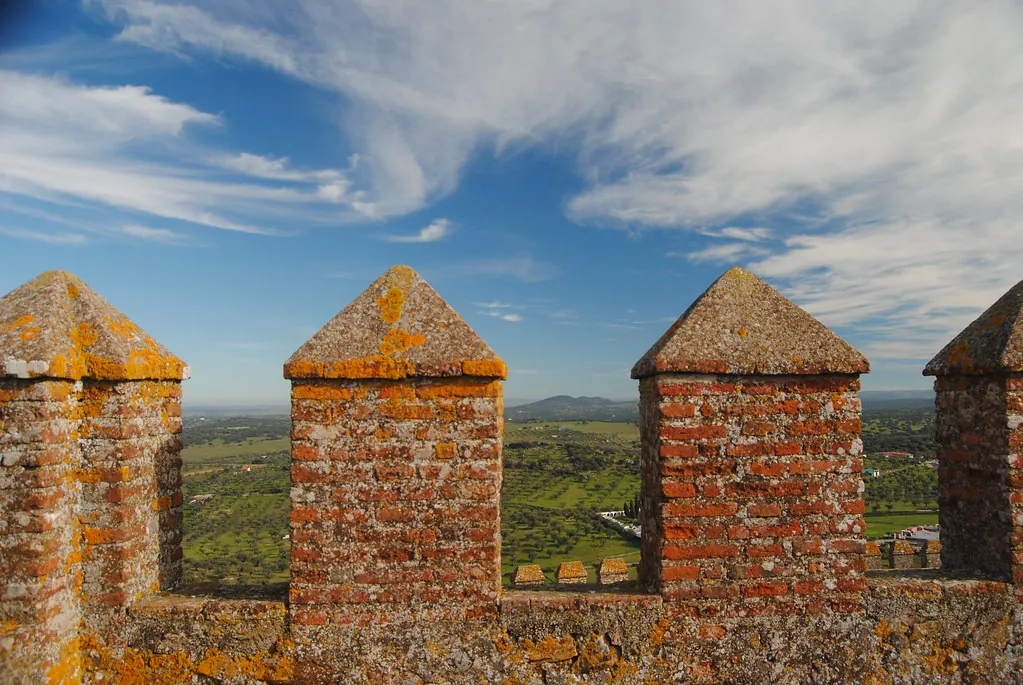
At other times of the year, smaller popular celebrations appear, often linked to local history and to the old castle that dominates a nearby hill. These are not large-scale events. Instead, they are moments when the community gathers, and anyone visiting at the time can see how life here really works.
Letting Montemolín find its rhythm
Montemolín is best understood without trying to see everything at once. A short walk through the sloping streets of the old centre, a pause in the plaza, a wander out towards the dehesa, and gradually the place begins to make sense.
It is a village that does not present itself all at once. The experience builds quietly, through small observations and unplanned moments. By the time it is time to leave, there is often a sense that it has grown on you more than expected at first glance.