Full Article
about Segura de León
Mountain village crowned by one of the best-preserved castles (now a hotel and open for tours); known for its traditional capeas.
Hide article Read full article
A Hilltop Village Shaped by Control and Landscape
At around 700 metres above sea level in the Sierra de Tentudía, Segura de León sits in a landscape that for centuries functioned as a frontier zone. This was once a strip of land where control over territory mattered on a daily basis. Today the town has roughly 1,700 inhabitants and a compact layout, with streets that climb steadily towards the hill crowned by its castle. That uphill design is no coincidence. It reflects a time when keeping watch over the surrounding countryside was essential.
From almost anywhere in the centre, the castle is visible above the rooftops. The fortress was built after the Christian conquest of the area in the 13th century and became linked to the Order of Santiago, the military and religious order that organised much of this part of southern Badajoz. From here, routes connecting what is now Extremadura with neighbouring Andalucía could be monitored.
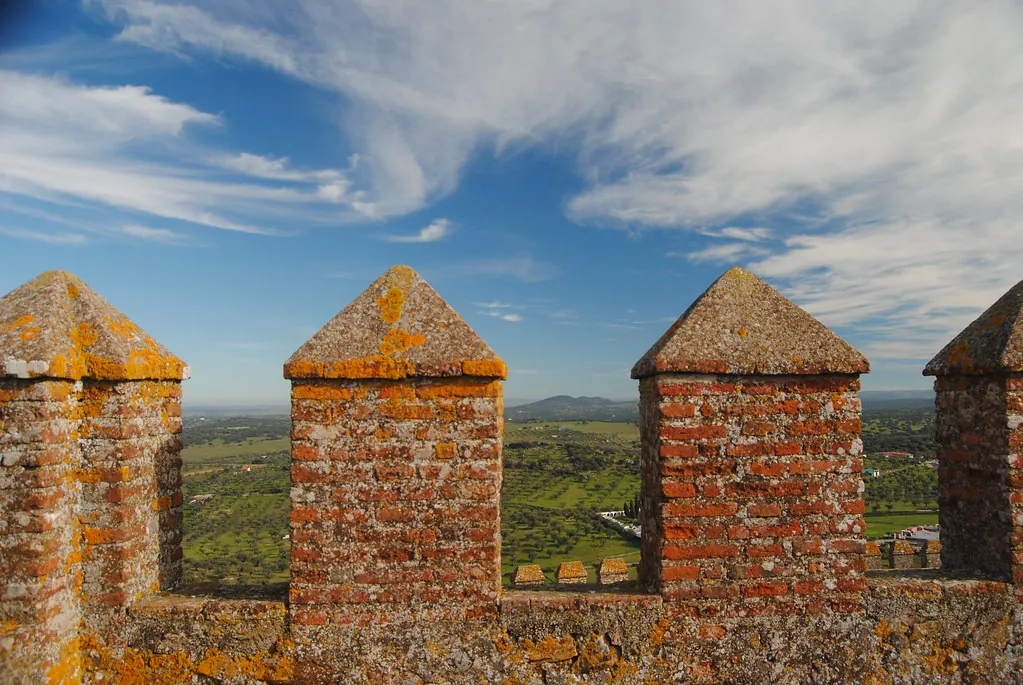
The structure visible today is the result of several construction phases. Even so, walking up to the enclosure makes the logic of the site clear. The dehesa opens out around it, a broad sweep of gently rolling land that allows views over considerable distances. There are no dramatic peaks or abrupt ridges. Instead, the terrain unfolds in soft hills that make movement and surveillance equally straightforward.
The Urban Core: Stone, Limewash and a Medieval Church
Segura de León’s historic centre has preserved its traditional scale. Narrow streets, some of them steep, lead towards the upper part of town where the castle and the parish church stand close together.
The church of Santa María Magdalena has medieval origins, although the present building includes later alterations. Gothic elements sit alongside additions from the Renaissance period, giving the structure a layered character rather than a single stylistic statement. Its tower, visible from different points across the municipality, remains a clear reference point when moving through the old streets.
The houses follow the mountain style typical of this area of Extremadura. Rubble stone walls, tiled roofs and whitewashed façades define the look of the town. Many properties still have stone doorways and internal courtyards that once served both domestic life and small-scale agricultural or livestock tasks. Wrought-iron balconies and large chimneys hint at cold winters and an economy closely tied to the land.
The overall impression is of a place that has grown gradually, adapting to the slope and to practical needs. The higher one climbs, the more the relationship between town and countryside becomes apparent, with views opening out towards the surrounding hills.
The Dehesa: Working Countryside on the Edge of Town
Just beyond the last houses begins the dehesa. This is the characteristic landscape of south-western Spain, a system of open woodland shaped over generations for extensive livestock farming. Around Segura de León it consists of widely spaced holm oaks and cork oaks, old olive groves and open pasture. Stone walls and wire fencing mark out different plots of land.
It is not a mountainous landscape in the dramatic sense, yet it is highly representative of the region. The ground undulates gently, and rural tracks link farms, small ponds and former cortijos, the traditional rural estates of the area.
These paths can be explored on foot or by bicycle, bearing in mind that many cross private property used for grazing. Early in the day there is often visible activity: birds moving through the trees, livestock being managed, work in the olive groves or, depending on the season, the olive harvest itself. The territory has been worked for generations, particularly for extensive livestock farming associated with the Iberian pig, a key element of the local economy.
From the higher ground near the castle, the pattern of this landscape is easy to read. The scattered trees, the patches of pasture and the soft lines of the hills explain why the area was both agriculturally viable and strategically useful.
Everyday Cooking in Southern Badajoz
Local cooking in Segura de León depends largely on what the dehesa produces. Iberian pork holds a central place, whether in cured sausages or in traditional stews prepared at home. Dishes such as migas, a preparation based on fried breadcrumbs traditionally made to make use of leftover bread, remain common in family kitchens. Various recipes linked to the matanza, the traditional winter pig slaughter, are still prepared in some households.
In spring, wild ingredients appear that are closely tied to domestic cooking. Espárragos trigueros, wild green asparagus gathered from the countryside, are a familiar seasonal product. In autumn, if the year has been wet enough, mushrooms are also collected in parts of the sierra.
Rather than a visitor-oriented dining scene, what exists here is village cooking, the kind that has long been prepared in this part of Badajoz. It reflects the rhythms of agricultural life and the availability of local produce, more than any attempt to reinvent tradition.
Festivals and the Rural Calendar
The main festivities are held in summer in honour of Santa María Magdalena. During these days the population swells as people who live elsewhere return to spend time with family. The atmosphere changes noticeably, with the town busier than at other points in the year.
Alongside these patronal celebrations, traditions linked to the rural cycle remain important. The matanza, usually carried out during the colder months, continues to be a collective moment of work in many households. In spring, cruces de mayo, decorative crosses associated with May Day traditions, appear in some streets. In autumn, the pace of life is influenced by the olive harvest in the surrounding groves.
These moments mark the year more clearly than any formal calendar. They connect present-day Segura de León with practices that have shaped the community for generations.
Walking the Slopes and Taking in the Views
Segura de León can be explored easily on foot, although the climb towards the castle involves noticeable slopes. Reaching the upper part of town brings broad views over the Sierra de Tentudía and the dehesa that surrounds the municipality.
For those wishing to head beyond the streets, the most sensible option is to follow rural tracks already used by local residents or established routes within the wider district. The terrain is generally forgiving, allowing for long walks without significant gradients, particularly in spring and autumn when the weather is usually more favourable.
In Segura de León, the relationship between settlement and landscape remains clear. The castle explains its strategic past, the church and houses speak of continuity, and the dehesa defines daily life. Together they form a portrait of a small Extremaduran town whose character is still closely tied to the land around it.