Full Article
about Alburquerque
Impressive medieval border town dominated by the Castillo de Luna; it preserves a Gothic Jewish quarter and a landscape of dehesas and cork oak.
Hide article Read full article
Alburquerque and its castle
Tourism in Alburquerque often starts with the same image: a castle on a granite crag, houses tumbling down the slope below it. The view is accurate. For centuries, the Castillo de Luna dictated the town’s form. Homes leaned against rock and defensive walls. The old quarter remains a clear diagram of a protected enclosure that grew around a frontier fortress.
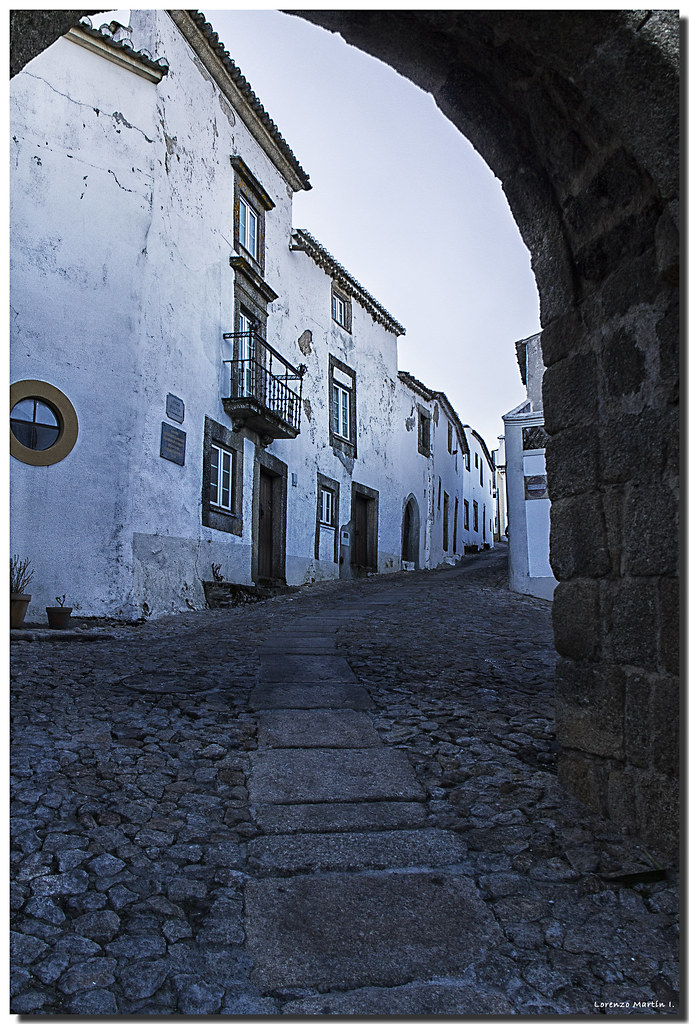
A walk through the historic centre makes this past tangible. Streets stay narrow, sections of wall embed themselves in house façades, and several gateways mark the original defensive perimeter. The built space relates to the terrain directly, as if the town simply adapted to the rock.
A place on the border
Geography explains Alburquerque’s history. The town sits in a natural corridor between the Sierra de San Pedro and Portugal. For long periods, this was watched, contested and fortified land.
Signs of early occupation exist in the area. A pre-Roman settlement is often cited on the cerro de Carrión, though details are broad. The name has Andalusi roots: Abu al‑Qurq, linked to the cork oaks covering these hills. After the Christian conquest in the 13th century, the settlement assumed a military role within the frontier’s defensive system.
The Castillo de Luna originates from that century. It was later expanded and converted into a noble residence tied to Álvaro de Luna, a key figure at the court of John II of Castile. The complex keeps its walls, towers and an inner courtyard that speaks of both defence and authority.
Reaching the keep involves narrow stairways within thick walls designed for protection, not comfort. The view from the top clarifies the wider setting. The dehesa unfolds, dotted with cork oaks and shaped by gentle rolls in the land. A line of hills to the west marks the direction of Portugal.
An extended defensive system
The fortifications extended beyond the main castle. A few kilometres from town stands the fortification of Azagala, set on another hill that surveilled the same border corridor. Remaining sections of wall and several towers illustrate its role as an advanced lookout.
The route to that hill crosses open dehesa, where livestock graze among dry-stone walls. The walk is not long, but the final ascent is noticeable. From the top, the perspective shifts. The town appears in the distance, anchored by its larger castle.
Inside the urban area, another structure connects to local history: the 18th-century bullring. Its form is somewhat unusual. Stone walls support seating that incorporates wooden elements, giving it a different character from larger arenas. It functions as a space woven into the town fabric, a traditional gathering point for social life.
Marks on stone at Risco de San Blas
On the outskirts, the site known as Risco de San Blas holds schematic rock paintings. They show simplified human figures and geometric signs applied directly to the stone. These are generally linked to communities from later prehistory, though precise dating can be complex.
Access follows a forest track and a short walk. The place is not a monumental landmark in the conventional sense. It is better understood as a rocky shelter where someone left marks thousands of years ago. The scale is modest, and the experience hinges on that minimal trace of human presence in a rural setting.
A festival rooted in the 15th century
Each summer, typically in August, Alburquerque holds a medieval festival based on a 15th-century event: the granting of the dukedom to Beltrán de la Cueva by King Henry IV.
For several days, the historic centre changes. A market appears, historical reenactments occur, and activities centre on the castle and its walls. Residents often take an active role in costumes and parades, which lends the event a communal character.
Food from the dehesa
Local cooking mirrors the surrounding landscape of dehesa, livestock and slow preparation over fire.
Caldereta de cordero, a lamb stew, is common at celebrations and family gatherings. Migas, made from stale bread, are another staple, adapted by season. Iberian pork forms a regular part of the local larder. Sheep’s milk cheeses from the wider area are available in local shops.
Traditional baking includes lard-based sweets like perrunillas, alongside recipes tied to festive dates and home ovens.
On the ground
The old quarter can be walked in a relatively short time, though it rewards a slower pace. Narrow streets, fragments of wall integrated into houses, and historic gateways all point to its defensive origins.
Set aside time to climb to the castle for the view. From that height, the connection between fortress, dehesa and frontier becomes clearer than any written explanation.